
No products in the cart.
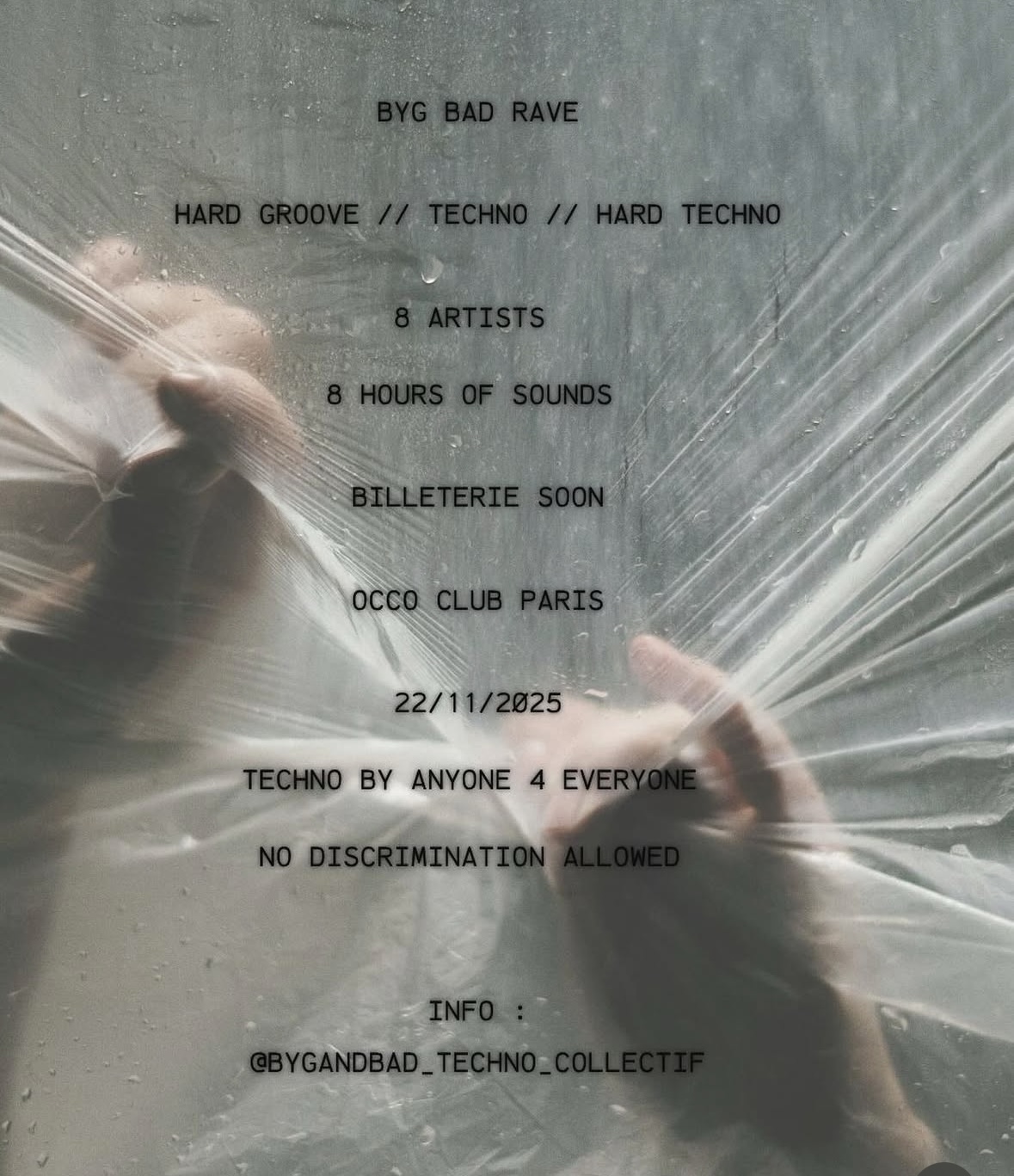
Born from a desire to break away and return to the essence of rave culture, BYG & BAD presents itself as a collective that embraces passion, diversity, and accessibility. Built on a ten-year friendship and a shared vision, the duo hopes to recreate nights where music, talent, and the crowd regain their rightful place. Just days before their first event, Mikey and Chaper share the origins, values, and ambitions of a project built like a family — and designed to last.
INTERVIEW
1. What triggered the creation of the collective?
The triggering moment was cutting myself off completely from what I was doing before in terms of music. I wanted to start from scratch, and with my best friend of more than 10 years, we felt it was time to create something that looks like us and brings people together!
What better than a collective to connect with other artists and share our philosophy: hit harder and go further.
I’ve been going to raves for almost 10 years, and I simply dreamed of bringing the scene to life and making people dance — it was the logical next step for us!
2. How would you define your collective?
Our collective is passion, family, and perseverance.
3. How do you share roles as DJs and producers?
I’ve been singing and rapping for a few years now, and I started producing not long ago.
Chaper is a music professional: she brings me a lot of knowledge and constructive criticism!
We complement each other well because she brings her expertise, and then I add my creativity.
I also lend my voice, which creates tracks mixing rap and techno.
In terms of production, I bring the dark, heavy kick/bass direction, while she and Hkan handle arrangements, production work, and mixing.
It’s a group effort where we all need each other, and it allows us to never run out of ideas or resources.
4. What place does diversity hold in your vision?
What I notice is that the capitalist model has completely taken over the culture: always the same DJs, the same clubs, the same vision and security rules, and totally ridiculous prices!
We don’t claim to change the scene, but we want to bring more diversity: more women DJs, Black DJs, and/or queer DJs, for example!
Same for the line-ups: we bring you artists from all over France, with varying levels of visibility.
Our goal is to put TALENT and THE CROWD back at the center of the scene!
5. What does it mean to preserve techno culture and its pioneers today?
Techno is exploding — and that’s great — but the culture isn’t evolving with it.
Many ravers today don’t know techno history, the names of the pioneers, or the unspoken rules of the scene.
I’m not saying everyone has to be a historian, but at least we should respect what came before us.
In DJ sets, that means playing tracks from 20–30 years ago and not just the same trendy remixes.
Stopping filming every 5 minutes, not booking influencer-DJs…
To make the culture last, we need to go back to the roots: parties in unexpected places, being surprised by the line-up, enjoying the moment together without needing to show it online.
Fortunately, even if techno is exploding, there will always be a small underground niche, and those who want to join us are welcome!
6. What criteria must a young talent meet to join your line-up?
A young talent must be able to play while having fun and respect our values of passion and determination — that’s basically it!
7. Why did you choose low-priced events?
As I said earlier, in almost 10 years of partying, I’ve never seen prices this high — drinks, tickets, transport…
Going out today is a whole budget, and we’re in Macron’s France…
We need to go out to clear our heads, so we don’t want to empty your wallets 🙂
We’d like to keep this ethic as long as possible so events remain accessible to as many people as possible!
8. How do you balance accessibility with artistic and technical quality?
To combine accessibility with artistic quality, everything relies on collective determination from artists and technicians who are now our friends!
They believed in our project and help us voluntarily. Everyone looks for solutions, contacts, equipment.
Today, big productions (laser shows, huge mapping) often take over, and while visually impressive, they sometimes hide a lack of organization. For example, Dream Nation this year:
There were many stands, merch and cosy areas, but we noticed there were far fewer subwoofers than in previous years…
It makes you think ravers aren’t being invited for a sound experience anymore, but more as a way to profit from regulars.
So having a big budget doesn’t necessarily make an event good.
I still love this festival — I’ve been going for 8 years — but it made me want to go back to the basics: partying in unknown places and focusing exclusively on the music.
To mix accessibility and quality, you need a good team, determination, and clear objectives.
You also need to know how to limit your choices and take care of both artists and technicians.
9. Where do you want BYG & BAD to be in one year? And in five years?
Our goal in one year is to perform at the warehouse on 17 rue de l’Industrie.
I’ve had incredible moments there — it’s a place that means a lot to us.
In 5 years, we’d like to have a label and export our concept abroad while staying financially accessible, and of course always highlighting the emerging scene above all.
10. Have you faced obstacles as young women in a very male-dominated environment?
For now, no — I must say I’m very well surrounded.
However, I’ve always seen this wave of hate and harassment toward women DJs.
Whether in comments or in clubs, it’s clear that some men assume we DJ to be looked at, not for our technical or curation skills.
Being a DJ means being the conductor of the atmosphere, the guide.
For some people, it’s still unthinkable that we might express ourselves artistically to free ourselves and gain confidence.
Fortunately, we’ve always stood our ground, and I’m happy to see more and more women doing it too!
11. How are you experiencing the organization of this first event?
It’s a mix of excitement and calm — it’s quite strange.
I have such confidence in the people around me that I know it will go well, but there’s always something unexpected.
Even if I replay all the scenarios in my head, I can’t wait.
I’ve learned a lot already, and I’m excited to learn even more during the event.
12. A word for those who will come to the first rave on November 22?
Come as you are, leave even more special.
13. What is the biggest challenge when launching a collective today?
The biggest challenge for a collective today is being heard…
It sounds silly in the era of social media and constant rage bait, but filling clubs requires contacts and followers, so it’s hard to convince people when you don’t have many events behind you.
That’s why we chose to go back to simple but unexpected concepts.
We decided not to reveal the line-up on the paper flyers we distributed everywhere.
It was a way to spark curiosity.
Making too much noise isn’t an option for us — our biggest challenge is to leave a mark in the moment.