

No products in the cart.
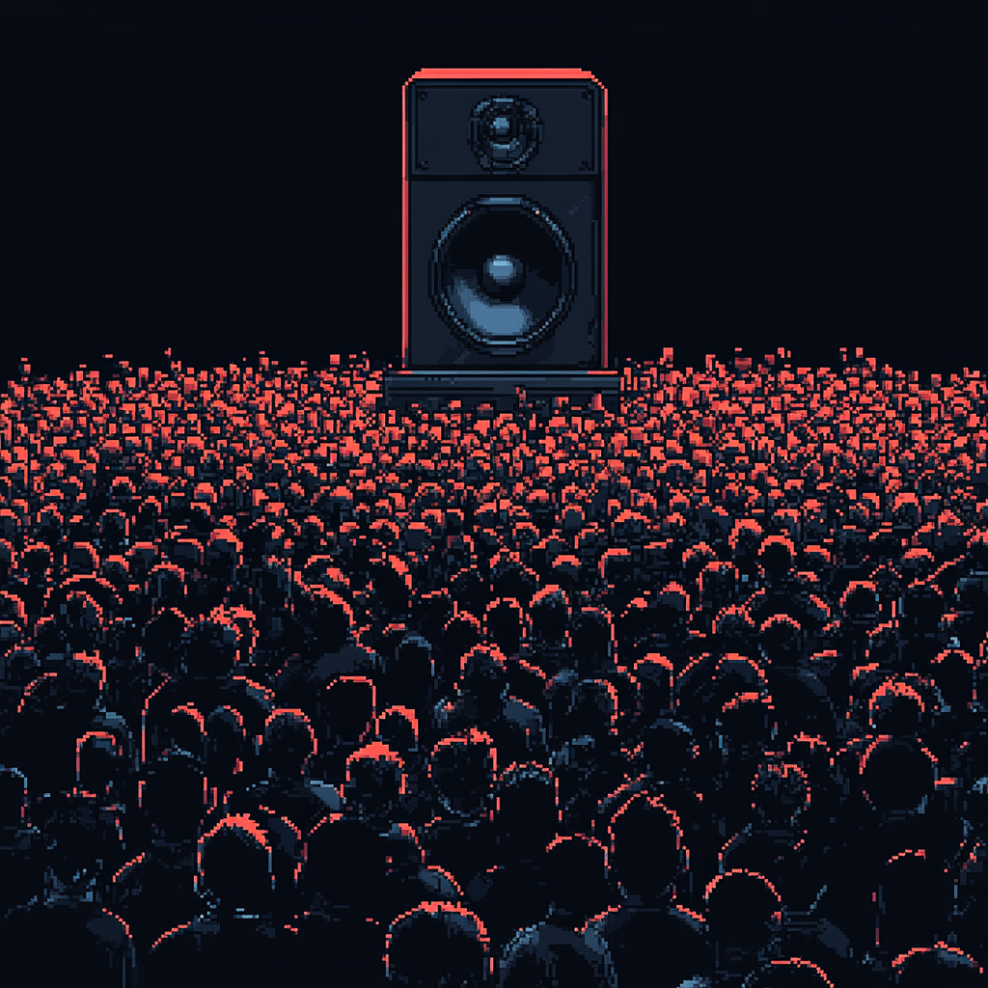
They emerged in the late 1980s and early 1990s in the UK, before spreading to France in the wake of rave, traveller and soundsystem scenes.
At their core, they were spaces of rupture. A rupture with commercial frameworks, with authorization logics, with the usual hierarchies of nightlife. From the beginning, they carried a political dimension: anti-authoritarian, anti-commercial, and deeply tied to the idea that another relationship to music, to the collective, and to the occupation of space was possible.
That is also why they are often misunderstood when looked at only from the outside. A free party is not just a free party in a field. It is not just a rougher version of the club. It is a specific environment, with its own codes, tensions, risks, solidarities and contradictions. And maybe that is where we need to start again: no, a free party is not for everyone.
Not because it should be reserved for some underground elite, and not because it should be turned into an untouchable sanctuary either. But because a space with so few barriers and so little formal structure demands something more than simply wanting to try out a vibe.
A freedom that requires real awareness of others
People often talk about freedom when they talk about free parties. Freedom to dance, to move around, to exist outside the usual frameworks, to step out of constant control. But that freedom never meant a total absence of rules. On the contrary, it rests on a fragile balance where your own freedom should never crush anyone else’s.
That may be where one of today’s biggest misunderstandings lies, especially in parliament. Many people fantasize about free parties as ruleless spaces, and therefore limitless ones. But just because there are fewer visible institutions does not mean there is no responsibility. Quite the opposite. In a free party, you cannot outsource everything to security, staff, a formal safety setup or an oversized mediation team. Part of the framework depends on the collective itself, on the attention paid to others, on the ability to read a situation, to self-regulate, not to act recklessly.
That is what makes these spaces strong. And it is also what makes them demanding — when it is done properly.
Harm reduction did not wait for institutions
Free parties were, long before many other party spaces, important grounds for harm reduction. Information about substances, peer-to-peer knowledge sharing, prevention, mutual aid, the circulation of practical knowledge, attention to bad trips, mixing, and vulnerable states. On the ground, an entire culture of vigilance developed there, often in a DIY way, but in a very concrete one.
Of course, that does not mean everything was always done well, or that everything is safe there. That would be false, and even dangerous to pretend. But there is a real history in free parties of collectively dealing with risk, and that history has also had a broader influence on the way partying is thought about in other contexts. These spaces so often pointed at as being out of control have also produced, from within, forms of responsibility that many more institutional scenes took a long time to take seriously.
TikTok changes the game
What has changed, though, is visibility. With TikTok, Instagram, and the mass circulation of videos, free parties have become objects of fascination for part of the general public. The sound, the walls of speakers, the convoys, the mud, the dust, the night, the collective energy, the out-of-system feeling.
And inevitably, that visibility brings in new people. Some arrive with sincerity, curiosity and respect, and take the time to understand where they are stepping. Others come the way people consume an experience, but above all to make images. And then there are those who arrive without measuring the risks, without knowing the codes, without understanding what it means to spend hours, sometimes days, in an environment where nothing is really designed for comfort, protection or structure in the usual sense.
That is where the phrase it’s not for everyone recovers its simplest meaning, which is honesty.
No, a free party has never been completely safe
Free parties have also — and it is important to insist on this — never been totally safe spaces. They were not before TikTok, and they are not any more today. There can be extreme exhaustion, problematic substance use, accidents, violent behavior, sexual and sexist violence, toxic group dynamics, situations of isolation, difficulties accessing emergency help, and grey areas in every sense of the term.
Pretending otherwise would be irresponsible. And sometimes, in trying to defend these spaces at all costs, some people end up making them more desirable than they really are, almost cooler than they are true. That is a huge mistake, because honesty protects better than storytelling.
Not everyone is made to navigate an environment this porous. Acknowledging that is not reactionary. It is simply refusing to sell a false fantasy. There are other forms of parties, other frameworks, other levels of support, other intensities. And that is perfectly fine.
What the law also says
This debate is also happening at a tense political moment. On April 9, 2026, the French National Assembly adopted at first reading, under an accelerated procedure, a bill aimed at increasing penalties around the organization of rave parties. The text notably creates an offense for taking part in the organization of a rave party, punishable by six months in prison and a €5,000 fine, and provides for the confiscation of equipment seized by law enforcement. The legislative file states that this was a text adopted at first reading by the Assembly after committee review and public debate.
We can obviously take a critical view of this highly repressive response, and many already have. But it also reminds us, quite brutally, that free parties do not float in some romantic outside-world. They exist in a constant state of tension with the State, with local authorities, with residents, with issues of public order, health, safety and the occupation of space. Pretending otherwise would be just as naive as reducing them to a simple policing problem.
Saying more clearly what a free party is, instead of selling it
That is also why today organizers, soundsystems, regular ravers and people invested in these scenes probably have a responsibility to be clearer about what a free party actually is — and not a rave party, by the way.
To say that it is not a ready-made cultural product, that it is not a safe space in the way many people understand the term today. To say that yes, there is solidarity there, but also roughness. To say that beautiful, political, collective, liberating things can happen there, but also difficult experiences, crossed boundaries, moments of disorientation. To say, finally, that going there requires more than just desire: it requires a certain form of preparation and lucidity.
We will help new audiences better by speaking to them honestly.
Preserving their radical edge
Preserving the radical authenticity of free parties means refusing to let them be turned into marketing objects or into a “digestible” version of themselves.
Free parties are precious precisely because they are not trying to appeal to everyone. They demand real involvement, attention to others, and an awareness of personal and collective limits. Free parties are powerful, necessary, sometimes very beautiful — but no, they are not for everyone.