

No products in the cart.

After our first investigation, Do You Really Need to Live in Paris to Exist in Electronic Music?, we started receiving more stories. Testimonies from people who work at night, sometimes in very unclear, very harsh conditions that are far too often normalised. DJs, photographers, videographers, technicians, staff members, programmers, organisers… many told us about late payments, working without contracts, pressure to accept the unacceptable, exhaustion, violence, and the fear of not being called back. This subject affects us directly too. Because as nightlife workers ourselves, sometimes precarious ones, we know that fatigue, that blur, that feeling that you often have to say yes just to keep existing in the circuit. Through this questionnaire, we wanted to document what many people are already living through in silence. And the words that keep coming back are brutal. “If you say no, someone else will.” “100€ is better than 0.” “Speaking up cost me several jobs.” Behind the party are the people who keep it going. And for many of them, the price to pay is far too heavy, whether physically, mentally, or in ways that clash with our values.
ANSWER TO OUR NEXT INVESTiGATION : CAN YOU DO A SOCIAL MEDIA BREAK AS A DJ?
The panel
For this investigation, we gathered 26 responses from people who work at night, in different places and in different roles. The panel includes DJs, photographers, videographers, technicians, staff members, PR workers, but also other profiles that keep nightlife running from within: programming, organisation, prevention, artistic direction, graphic design and communication. Many of them actually combine several roles at once, which also says something about the reality of the sector. The people interviewed live and work in places including Paris, Lille, Lyon, Nantes, Marseille, Montpellier, Rouen, Strasbourg, Bordeaux, Ivry-sur-Seine, Saint-Michel-sur-Orge, Liège and Barcelona. Ages range from 20 to 44, with an average of around 30 years old. Most of the people who answered our questionnaire are women or people perceived as such, although several responses were anonymous or did not make it possible to infer a gender. In terms of experience, the panel mixes relatively new profiles with others who are more established: most have been working at night for 1 to 3 years, but several respondents have also been living this rhythm for 5, 10 years or more. In other words, this investigation does not only bring together people who are just discovering the scene, but also workers who have already seen the same patterns repeat over time.
Getting paid late, less than agreed, or not at all
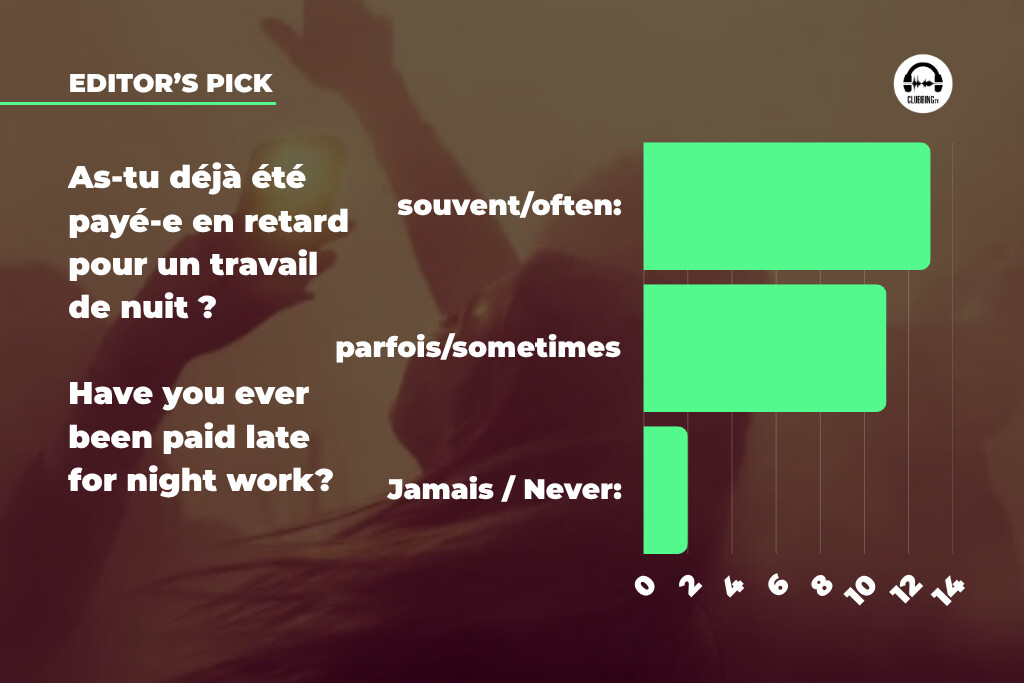
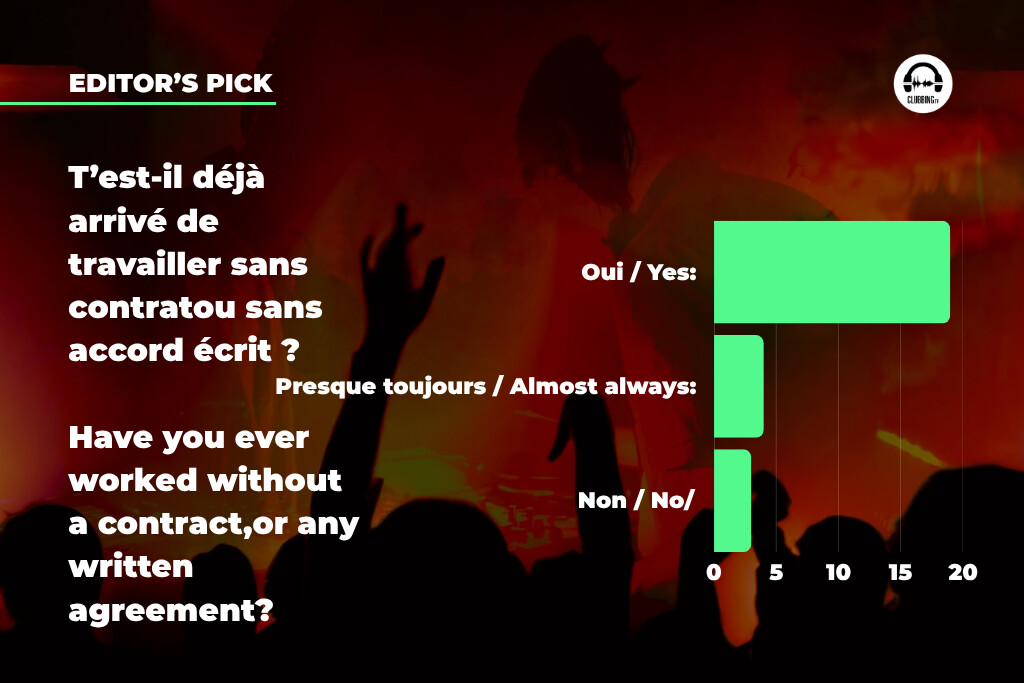
This is the first finding that emerges from our questionnaire, and probably the hardest in its sheer banality: in night work, getting paid properly, on time, and according to what was agreed is far from guaranteed. Out of the 26 people interviewed, 24 say they have already been paid late, including 13 often. 20 say they have already been paid less than expected, or not paid at all. And 23 say they have already worked without a contract, without a quote, or without any written agreement, including 4 for whom this is almost always the case. In other words, insecurity does not only begin when a problem arises. It is often already there from the start, built into the vagueness of the conditions, the lack of structure, verbal agreements, and the difficulty of enforcing what had been promised.
Several testimonies describe the same pattern: a fee revised downward after the event, a payment blocked because “there weren’t enough people through the door,” an invoice supposedly misunderstood, or an event suddenly presented as financially unviable once the work is done. In some cases, the pay almost disappears entirely. In others, it arrives weeks or even months later. “Two months late, ‘forgotten invoice,’” says one respondent. Another puts it even more bluntly: “paid in beers.” What really appears here is a constant transfer of economic risk onto the people doing the work. When a night goes badly, it is often the DJs, photographers, technicians, programmers or staff members who absorb the losses. As if their pay became variable after the fact, dependent on ticket sales, a client’s mood, or an organiser’s goodwill.
One respondent says a collective paid her half of what had been agreed after a date that was nonetheless sold out. Another explains that she worked for months on a project, advanced expenses, and was then replaced overnight, receiving only 100 euros for all of her work. Added to this payment insecurity is the insecurity of the expenses people have to put forward simply in order to work. 18 respondents out of 26 say they have already had to cover costs themselves, transport, hotel, equipment, without being reimbursed afterwards.
Once again, the problem is not exceptional. It seems built into the ordinary functioning of the sector. You agree to pay upfront, hope you’ll get it back, then follow up, wait, or give up. Behind the fantasy of a scene driven by passion, these testimonies tell something much simpler and much harsher: work that often rests on fragile agreements, random payments, and a widespread tolerance for practices that, elsewhere, would immediately be considered abusive. “If you’re not happy, there are 15 people who’ll take your place,” as one respondent put it. In this context, getting paid starts to feel almost like a negotiation.
Saying no, at the risk of disappearing
If so many workers accept conditions they consider unfair, it is not only because the sector is poorly regulated. It is also because refusing can be costly. In our questionnaire, 22 out of 26 people say they have already been afraid to turn down a date or a job for fear of not being called back. The fear of falling out of the circuit, missing an opportunity, being replaced, or simply being forgotten runs through a large part of the responses. That fear creates a very clear power imbalance. Several people say they accepted a fee that was too low, a vague setup, or mediocre conditions simply because they knew someone else would say yes if they did not. “If you say no, someone else will.” The phrase comes back again and again, and we know it ourselves too. Another respondent puts it differently, but with the same social violence: “100€ is better than 0.” When work is scarce, when slots are limited, when network matters as much as talent, saying no becomes a luxury.
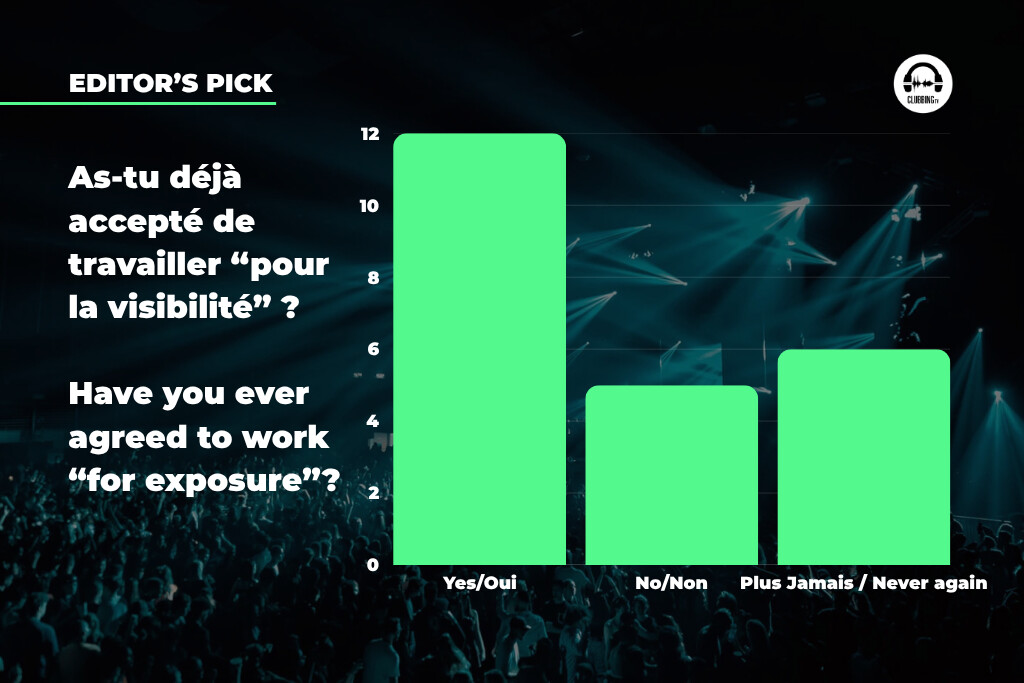
This pressure becomes even stronger when a date is seen as worth taking, whether it is a hyped club, a well-known festival, or a night that can bring credibility, images, contacts, or future opportunities. In those cases, injustice is often wrapped in the language of “chance.” Several testimonies also mention working “for exposure.” Out of the 23 usable responses to that question, 12 people say they have already accepted it, and 6 go as far as saying “never again.” That “never again” says a lot. It speaks of promises rarely kept and of a life lesson that tells us visibility does not pay the rent, the transport, or the fatigue. Visibility does not necessarily lead to a career or real progress. In many cases, it is an exciting moment, but a fleeting one that cannot always be turned into something long-term.
Beginners seem especially exposed to this reality. Some say low fees are justified by their lack of experience, while they are still expected to deliver flawless professionalism. Others say they accepted because they had to make space for themselves, build a portfolio, enter the scene, stay visible, have content to post.
Once again, night work appears as a world where the most precarious are asked to prove more, for less. What these responses ultimately describe is an economy of replaceability. An economy where passion, the desire to be part of the scene, fear of emptiness, and constant competition become tools of pressure. Turning down a bad deal, asking for a better framework, setting a boundary, all of this can be experienced as a risk, and that risk is what allows so many abuses to continue.
Fatigue, health, exhaustion: the work that wears us down
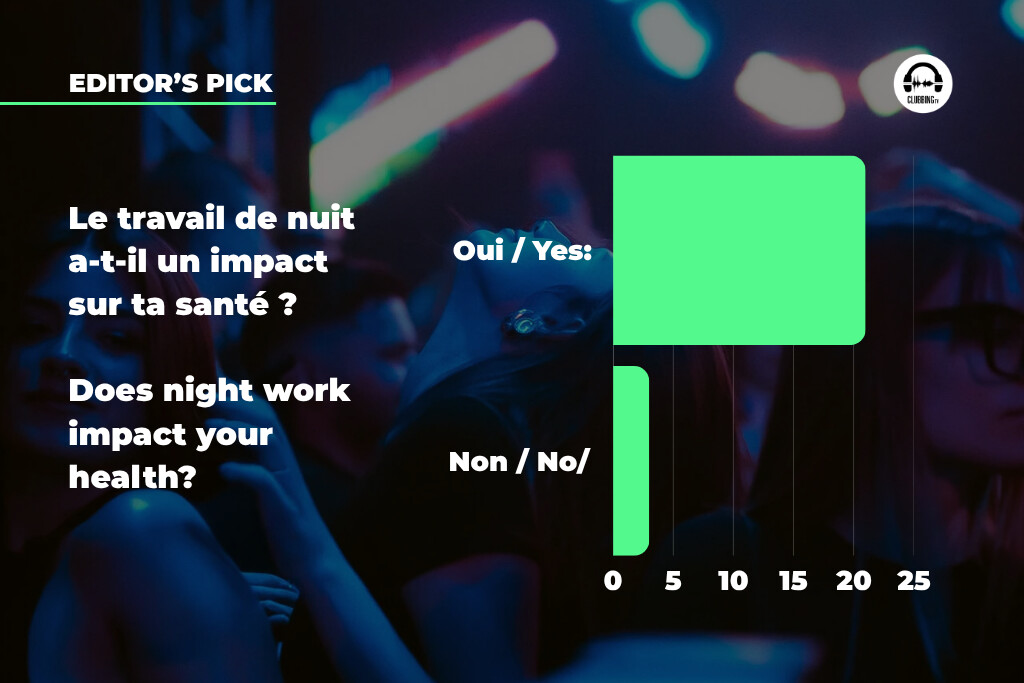
To economic precarity must be added the cost of what night work does to bodies and minds. Among the 24 responses to this question, 21 people believe that night work affects their health. And out of 25 responses, 21 say they have already carried on despite exhaustion or emotional distress. Once again, the numbers are massive. They describe a sector where enduring, taking the hit, and carrying on no matter what seems to be part of the unspoken contract. In the responses, this wear and tear takes very concrete forms: endless nights, whole weekends chained together with no real recovery, going back to day jobs, fragmented sleep, accumulated fatigue, pressure not to cancel. One person says they have already worked with a hand sprain, or with a 39°C fever. Another talks about back-to-back nights on weekends while still having to work in person during the week.
The question of rest time points in the same direction. Out of 22 responses, 10 people say their schedules and rest time are rarely respected. Granted, 10 others answer often, which shows very different situations depending on the places and roles. But the mere fact that such a large part of the panel talks about rest and schedules being rarely respected is enough to show that irregularity is far from marginal. In a world where the boundaries between work, presence, availability and improvisation are often blurry, rest still seems to come after everything else. And sometimes exhaustion does not come alone. 14 respondents out of 26 say they have already worked in conditions they consider dangerous or abusive.
The testimonies mention lack of water, lack of security, unprotected equipment, safety standards not being respected, very little rest time at festivals, or night journeys home that are not taken care of. “I was left alone with no way to get back,” says one person. Another describes having to negotiate taxis in the middle of the night in cities they do not know. This set of responses reminds us of one simple thing: in night work, fatigue is not just discomfort, it is also a factor of vulnerability. When you work late, sleep little, keep going, advance expenses, and are not always protected or properly supervised, the body ends up absorbing what the organisation refuses to take care of. And that kind of wear, because it is diffuse, gradual, and often internalised, is probably one of the most normalised forms of violence in the sector.
When speaking up can cost you your place
In many testimonies, the problem is not only what happens, but what it costs to say it. When a problem arises, most of the people interviewed answer neither clearly yes nor clearly no when asked whether they feel able to talk about it. Out of 25 usable responses, 18 answer “it depends.” That is revealing. It shows that there is no clear framework, no real safety, no certainty of being listened to, supported, or even simply believed. Some did speak up. According to the figures, 18 people say they have already reported an abusive situation.
But the reasons given by those who did not are just as telling: fear, isolation, lack of recourse, and above all normalisation. This is probably one of the most important points in the whole investigation. Many respondents do not just describe abuse, but a milieu where these abuses are known, repeated, digested, sometimes almost expected. Speaking up can also expose you. 11 people out of 26 say they have already experienced attempts at intimidation. The accounts mention messages telling them to stay quiet, threats of being pushed out of the circuit, fear of being blacklisted, or remarks meant to remind everyone of their place. “It was better if I didn’t talk too much.” Another person puts it more bluntly: “Speaking up cost me several jobs.”
Once again, the issue is not abstract because it touches directly on professional survival. In a milieu where contacts, affinities, reputation and word of mouth matter so much, reporting a problem can quickly be perceived as a risk. This fragility of speech also appears in the way respondents perceive the sector as a whole. When asked whether the abuses of night work are isolated, frequent or systemic, only 2 out of 26 answer that they are isolated. 16 consider them frequent, 8 systemic.
In other words, most are not talking about isolated bad memories, but about a broader functioning, almost a culture. A culture where asking for a contract, on-time payment, a safe ride home, a fair salary, or simply respect can still be enough to make trouble. That may be where the heart of the problem lies. Abuse does not last only because it exists, but because it is embedded in a power structure where speaking remains fragile, costly, and sometimes punished. As long as the risk of speaking up is greater than the risk of abusing, nothing will really change.
Aggression, contempt and impunity
At this point, this is no longer just about precarity, fatigue or administrative vagueness. Some testimonies describe much more serious things: assaults, humiliation, abuse of power, and the chilling feeling that on the other side, no one will really move. One person says they were followed and then assaulted by a client, who grabbed their buttocks violently. Security did not remove him. Another describes repeated assault in a venue, in front of a security staff member who did absolutely nothing. Further on, one testimony sums up the horror in just a few words: “Attempted rape. The organisers sided with their friend.”
These accounts show that in some nightlife spaces, violence is possible and badly dealt with. The problem is not only that an assault can happen, but that it can happen within a work setting, be seen, be reported, and still be left without any serious response. This failure comes back often in the testimonies: passive security, absent or overwhelmed organisers, no protocol, silence, minimisation, or even reversal of blame. When protective mechanisms barely exist or function inconsistently, the party becomes a space where some people work in a state of permanent vigilance, sometimes at the expense of their own safety. But violence does not always take the form of physical assault. It can also be verbal or symbolic. One respondent says that a member of an organisation told her she should simply “study engineering if [she] wanted to be paid,” and that by choosing this profession, she had chosen precarity “for the love of culture.” Another says her manager told her in front of clients that she was useless.
Others mention infantilisation, sexism, comments about their gender, their body, their age, or their legitimacy. In those moments, night work is also shaped by very crude power relations, where some people can be publicly belittled without it seeming to shock anyone.
The inequalities of treatment described in the investigation point in the same direction. One DJ recalls a date where she was asked to cover part of her transport, where her fee was capped at 120 euros, and where she had to make do with minimal conditions in the name of passion and lack of resources. On site, she discovers that a more famous artist has her train ticket covered, a private dressing room, gifts, tailored hospitality and a fee of over 1000 euros. More than just an anecdote, this kind of story shows how starification also organises hierarchies of dignity: some people are entitled to attention, comfort and consideration, while others are expected to be grateful just to be there.
What these testimonies sketch out is an ecosystem where violence and contempt are not always spectacular, but are often found in security that does not protect, organisers who cover for their friends, normalised humiliations, accepted disparities in treatment, inappropriate advances, and bookings conditioned on something other than the work itself. The party likes to tell itself as a space of freedom. For some of the people who keep it running, it also looks, at times, like a place where impunity still circulates far too easily.
Abuses seen as frequent, sometimes systemic
Taken separately, each testimony could be filed away as a bad experience. But put together, they tell something much bigger. When respondents are asked who is most responsible, the most frequent answer is neither a specific name nor a single link in the chain: it is “everyone.” Out of 24 responses, 14 point to a collective responsibility. Behind that come organisers, then clubs, and more marginally platforms. Here too, the message is clear.
These abuses are not perceived as the product of a few malicious individuals, but of an entire ecosystem: employers, venues, collectives, networking logics, starification, hierarchies, and tolerance towards practices that are nonetheless well known. The answers to the question “what should change first?” go exactly in the same direction. What comes up first is pay: being paid in line with the work provided, putting an end to obscene gaps between headliners and the people behind the scenes, clarifying the rules, and stopping the whole system from resting on the acceptance of precarity. Then comes recognition: recognising the invisible jobs, treating service providers differently, and stopping the habit of treating as secondary those without whom the events would simply not exist. But respondents are not only asking for more money. They also talk about discrimination, VSS, infantilisation, gatekeeping, the overwhelming place of social media, the weight of followers, the starification of DJs, mindsets seen as archaic, and behaviours so normalised that they should finally be named for what they are. In other words, what is being challenged here is not just a series of bad practices, but a whole culture of the scene. That is probably why the solutions mentioned go beyond individual goodwill. What these testimonies are asking for, at heart, is a deeper transformation: pay better, protect better, frame things better, listen better, train better, distribute value and respect better. Make sure the party no longer rests on the tacit idea that some people have to silently endure so that others can shine.
Our investigation does not claim to say everything about night work. But it shows at least one thing: for many of the people who live it, the abuses are neither new, nor rare, nor accidental. Keeping the night alive takes work, care, energy, skills, time, and bodies. As long as that reality remains invisible, as long as precarity is presented as the normal price of passion, and as long as speaking up remains risky, the same mechanisms will keep reproducing themselves. And it will always be the same people who pay the price.
ANSWER TO OUR NEXT INVESTiGATION : CAN YOU DO A SOCIAL MEDIA BREAK AS A DJ?