

No products in the cart.
Live Nation moves to acquire Paris La Défense Arena: what’s really at stake
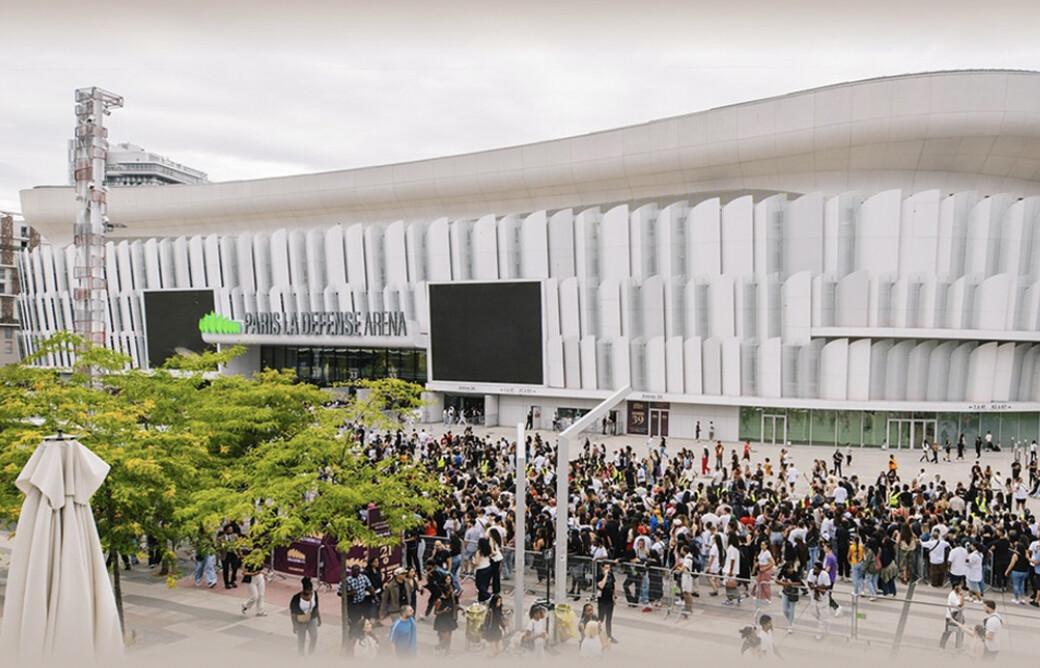
Live Nation has announced an agreement to acquire Paris La Défense Arena, Europe’s largest indoor venue, from the Ovalto group (owned by Jacky Lorenzetti). The deal, revealed in early January, is still subject to approval by the French Competition Authority, a step that could take several months.
On paper, it looks like a strategic real estate move. In reality, it raises deeper questions about market concentration, access to venues, ticketing power, and the future balance of live music in Paris.
A strategic venue in the European touring circuit
Opened in 2017, Paris La Défense Arena sits in a category of its own. With a capacity that can exceed 40,000 depending on configuration, it operates as a “stadium indoors”, designed for global touring acts, large-scale productions, and multi-night runs.
For Live Nation, controlling such a venue means securing a crucial bottleneck in the European live ecosystem. Paris is already a mandatory stop for world tours; owning one of its biggest stages strengthens Live Nation’s ability to attract, schedule, and structure major productions on its own terms.
Vertical integration: the real issue behind the deal
Live Nation is not just a promoter. It is also:
a global concert operator
a venue owner
the parent company of Ticketmaster
This level of vertical integration is precisely what regulators are increasingly scrutinising worldwide. In France, the Competition Authority has already flagged risks linked to concentration in the live music sector, particularly when a single player controls multiple stages of the value chain.
The concern is not theoretical. When the same group promotes artists, owns major venues, and dominates ticketing, it can indirectly influence:
which tours access premium venues
rental conditions and scheduling
ticketing solutions imposed on productions
Live Nation has stated that Paris La Défense Arena would remain open to all promoters, but this promise will likely be central to the regulator’s assessment.
What does this mean for audiences?
In practical terms, the acquisition could bring:
more large-scale international shows to Paris
higher production standards and technical upgrades
smoother logistics for major tours
But it also raises familiar concerns:
further centralisation of ticketing
premium pricing strategies
fewer alternative routes outside dominant circuits
The debate around Ticketmaster — particularly in the US, where Live Nation faces antitrust action — inevitably echoes here, even if the legal context differs.
And for electronic music?
Paris La Défense Arena is not a club, nor a traditional electronic music venue. However, Live Nation has a track record of scaling electronic formats into arena-sized experiences: EDM headliners, hybrid pop-electronic shows, immersive productions.
This could open doors for large electronic events — but it may also reinforce a model where only the most commercially viable electronic acts can access such stages, leaving independent promoters and underground scenes further sidelined.
A decision that goes beyond one venue
Beyond Paris La Défense Arena, this deal reflects a broader transformation of the live music industry: fewer actors, bigger assets, tighter control.
If approved, the acquisition could strengthen Paris’s position on the global touring map. The real question is whether it will also preserve diversity, competition, and access — or further tilt the ecosystem towards a handful of dominant players.
Tagged with :