
No products in the cart.
Meta’s Censorship Is Silencing Queer Nightlife
In recent months, two of Europe’s most prominent queer nightlife collectives :Replicant Events in Paris and Gegen in Berlin have faced the same brutal reality: Meta’s platforms can erase years of cultural work in seconds, without warning, and without explanation.
For Replicant, the shock came when both their Instagram accounts : @ForensicsParis, dedicated to their fetish techno party, and @ReplicantEvents, the page of their production company, were suddenly suspended. “There was no new content, nothing violating the rules, except for one post on our feed expressing solidarity with Palestine,” explains Lenny, producer and president of Replicant. “We’ve been speaking out for months in stories, and we received hateful messages and coordinated mass reports. But the suspension came precisely after that first feed post. Within minutes, both accounts were gone.”
The attack, however, went further. After the deletion of @ForensicsParis, Meta also erased two other event accounts (@TechNoireParis and @MarcheDrag), Lenny’s artist profile (@GhostElektra), and even the personal accounts of Lenny and his partner. “This only reinforces the fact that it’s a personal and targeted attack,” he says.
Although the accounts were restored after an appeal, dozens of posts remained deleted and both pages were shadow banned, stripped of key features like livestreaming and sponsorship. The next day, @ReplicantEvents was deleted again. “We now understand this is not just negligence. It’s discrimination,” says Lenny. “Meta tolerates misogynist, racist, and homophobic abuse, but deletes LGBTQIA+ content under the pretext of violating its own rules.”
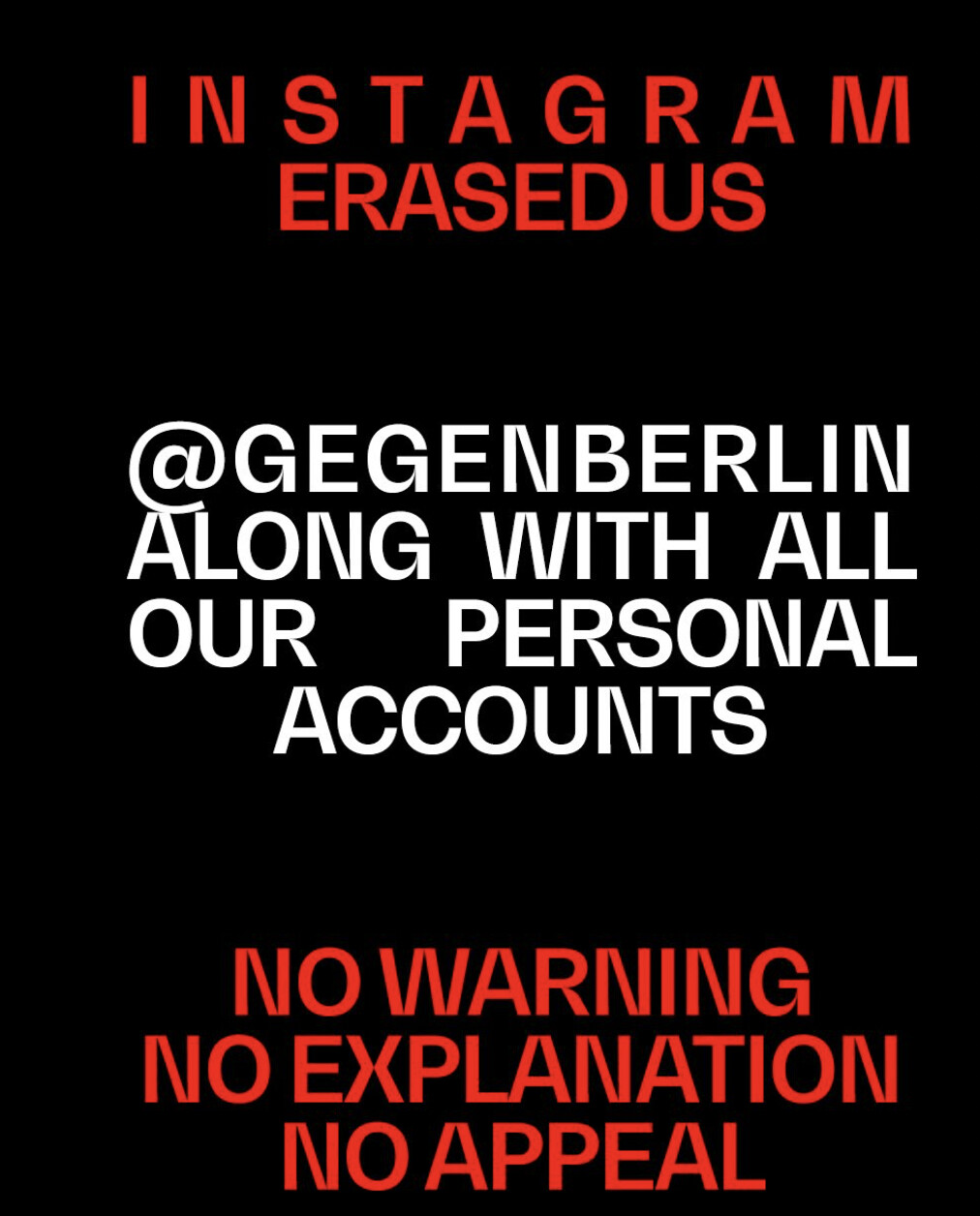
In Berlin, Gegen’s erasure was even more sudden. “We received an email titled ‘Take action or lose access to gegenberlin’ demanding passports, selfies, and sensitive personal data,” recalls Fabio, founder of Gegen. “Marius submitted his ID, it was rejected instantly, and he was logged out. Within minutes not only was @gegenberlin permanently disabled, but both of our personal accounts were wiped too, including Fabio’s Facebook profile, without ever being given a chance to log in.” Eight years of work, 92,000 followers, and their entire digital archive disappeared in seconds.
Both collectives describe the same Kafkaesque exchanges with Meta: contradictory responses from Business Support, references only to the generic Community Standards page, and refusals to give any specific reason “for security concerns.” No flagged content, no prior violations, no human review. “They just keep passing you from one department to another until you give up,” says Lenny. Fabio echoes the same frustration: “We asked for a human review, but were told repeatedly the accounts were ‘correctly removed.’ At no point did they provide a single example of what supposedly broke the rules.”
The consequences are devastating. Replicant and Gegen lost their main communication channels overnight, leaving their communities confused and in some cases convinced the collectives had shut down. Ticket sales, event promotion, and years of cultural archives vanished. “Financially, it puts us at risk,” Fabio explains. “Organizationally, it forces us to rebuild under pressure. Reputationally, it damages us to be suddenly invisible especially when Meta’s official accusation carries the weight of a criminal offense.”
What unites both testimonies is the sense of a double standard. Fetish aesthetics, latex, and shirtless photos are tolerated when worn by celebrities or published in fashion magazines, but deemed “too suggestive” when posted by queer collectives. “Queer and fetish content is systematically penalized,” says Fabio. “Meanwhile mainstream brands use the same aesthetics without consequence.” For Replicant, the discrimination is blatant: “We reclaim words and aesthetics to empower ourselves, but when we do, Meta censors us. Yet violent speech from the far right is left online.”
Legal action is no longer just being considered: it is already underway. “I hired a lawyer this morning,” Lenny says. His counsel stresses that in the coming months, media coverage and public support will be essential, convinced that this case is only a symptom of Meta’s broader authoritarian drift. Gegen is also represented by a lawyer, arguing that Meta’s accusations and procedures violate European law.
At the same time, they are trying to mobilize the community. “Visibility and solidarity are crucial,” Fabio insists. “Talking about these cases publicly pressures platforms to change. We need media to expose how biased moderation undermines cultural work.” Lenny adds: “It’s not only about us. The first step is to denounce Meta’s hypocrisy. The second step is to disinvest, to move away from platforms that target us.”
Yet the monopoly remains. No alternative platform offers the same reach as Instagram, which keeps queer cultural workers dependent on Meta. Collectives are diversifying toward Telegram, Bluesky, and their own websites, but the long-term challenge is bigger. “Queer communities need to build independent channels where our survival isn’t left to the mercy of biased and weaponized algorithms,” Fabio concludes.
Their message is clear: when Meta erases queer nightlife, it is not a technical accident, it is a political act. And these are not isolated cases. In Hong Kong, Mihn Club also saw its profile erased after sharing queer content. The censorship crosses borders, pointing to a troubling pattern: queer cultural spaces are systematically targeted instead of being protected and celebrated.