

No products in the cart.
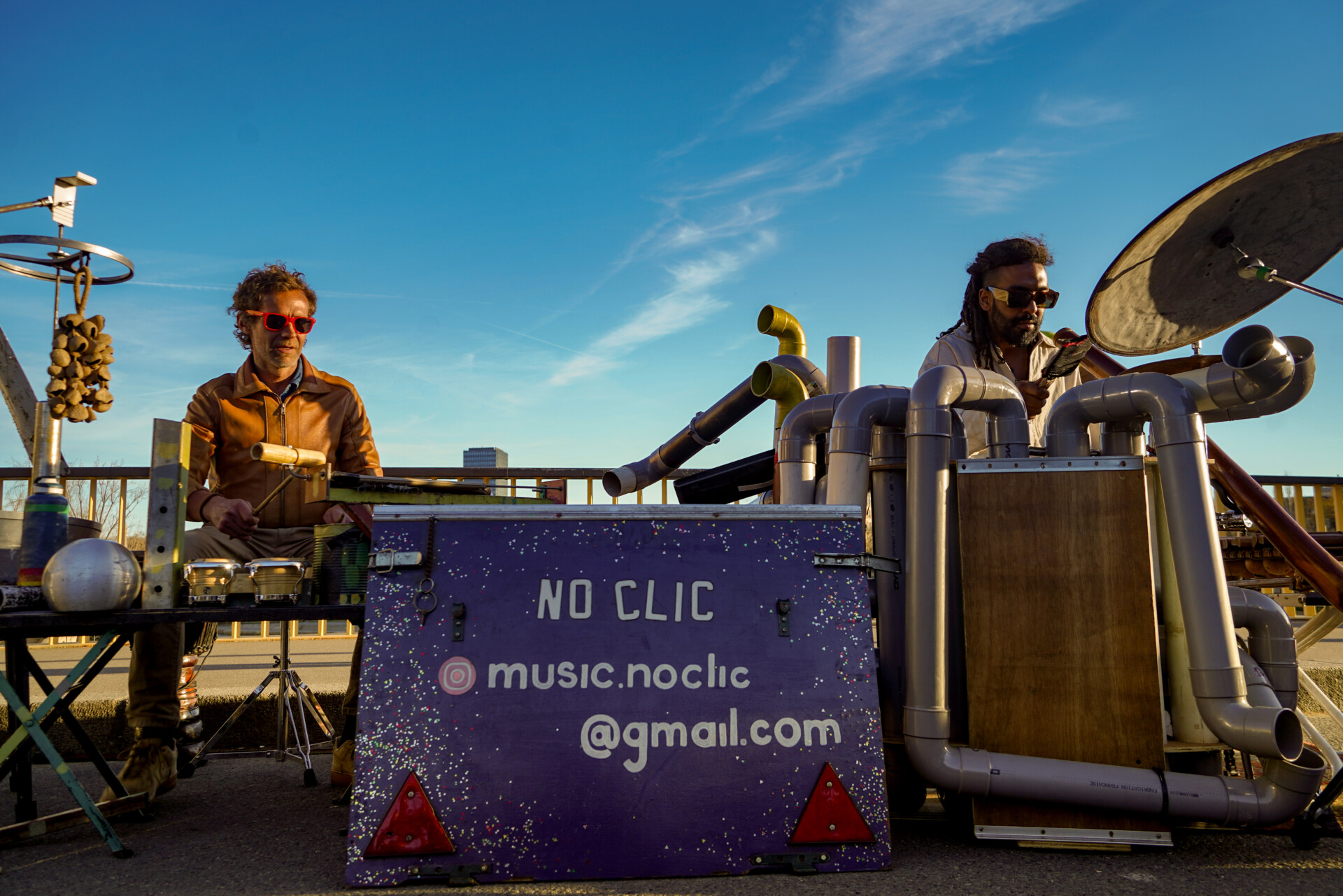
I was walking through Paris with two friends when I was suddenly drawn in by a kind of bassline, thick, deep, round, and intensely rhythmic. The kind of sound that instantly brightens your day. But it was impossible to tell where it was coming from. We naively assumed it was just the carousel’s playlist, when in fact it was hiding a much bigger surprise: electronic music, yes, but with no machines at all.
No cables, no computer, no synths: that is the bold premise behind No Clic, the project created by Yann and Léo, whom I stumbled upon in the middle of an instrumental trance that immediately won me over. It had the fever of rock, the improvisational spirit of jazz, and the pulse of techno, all unfolding on a noisy Paris afternoon. I had to learn more, and now, so do you.
Their concept is simple: “We make electro without electricity. Our project is 100% acoustic.”
Behind that idea lies a meeting of several shared sensibilities. “We came together around a number of common passions: old objects, recycling, but above all music,” they explain. The two artists also “co-founded an associative project around cultivating the land without fossil energy, but also cultivating the mind.” Out of that intersection came not only a musical intuition, but a political one as well: “Very naturally, we mixed all these ingredients together and realised that we could formulate a critique of consumer society by hitting pieces of wood and damaged cooking pots.”
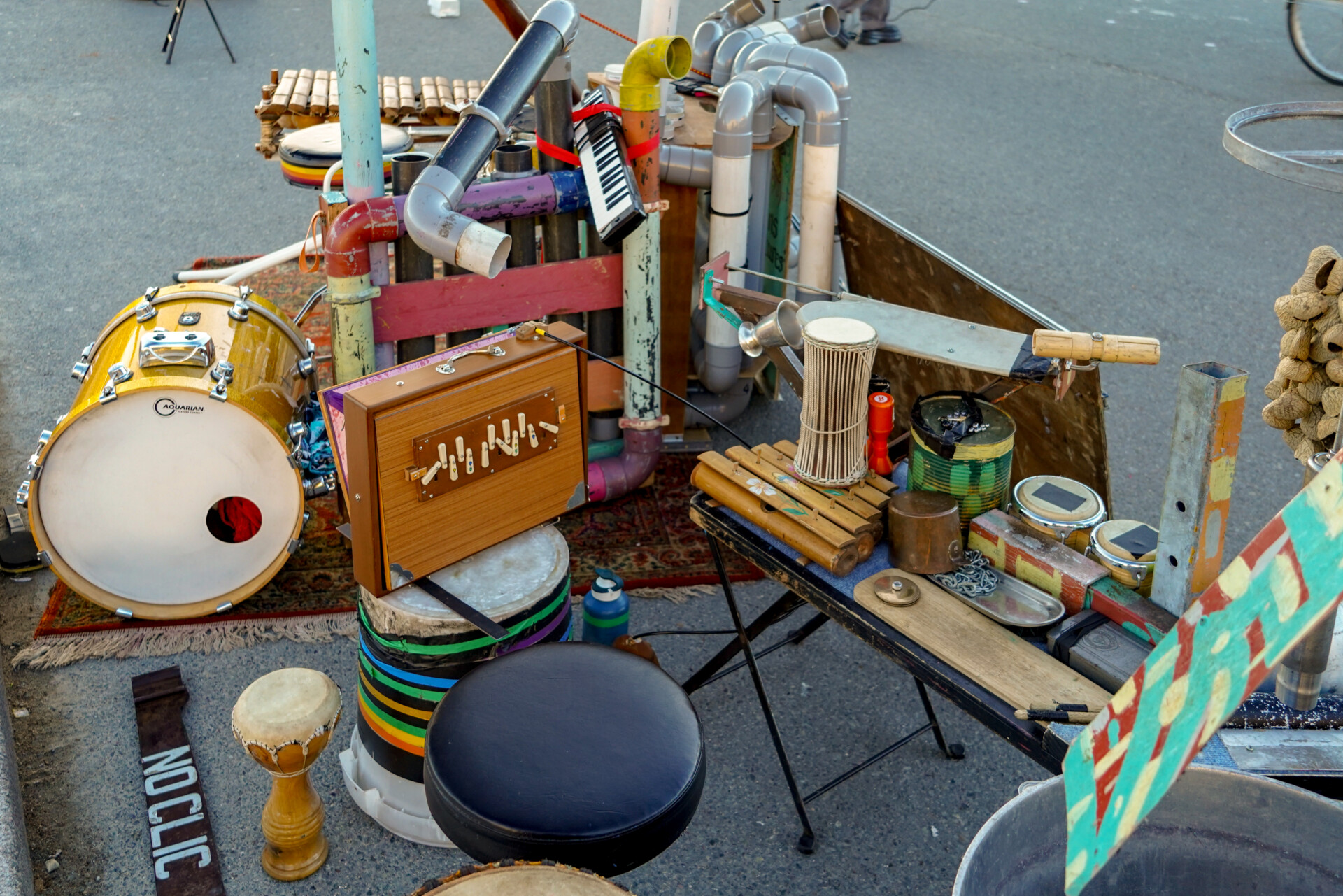
No Clic is built from salvaged objects, transformed into raw sonic material. “Everything is music, everything is an instrument.” But behind that statement lies a real aesthetic discipline. “What we are looking for is coherence between all the selected sounds,” they say. Their setup is constantly evolving, with only two essential conditions: “the object has to have a real sonic interest, and above all, it has to fit in the trailer.”
Reproducing or producing?
The project also raises a deeper question: what still defines the essence of electronic music today? Yann and Léo remain cautious when it comes to labels: “We do not come from electronic music, so we do not know its codes. That creates something singular in spite of ourselves. By nature, our music cannot really be described as electronic, even if we still call it that.”
Electronic music is, after all, the sound of the machine — and that sound has shaped an aesthetic that No Clic now echoes in its own way. Strictly speaking, you cannot call it electronic music if it is not electronic. And yet I am still convinced that I heard techno and psytrance that day.
The duo does not reproduce techno in the literal sense, but it does recover some of its defining logics: the loop, the pulse, repetition, collective energy. “Techno is a musical current based on electricity, in a world where energy has become a major issue. With this project, we are questioning the place of energy in contemporary music,” they explain. In that sense, they shift the question away from the machine and toward listening, gesture, and material.
Street music
“The street is a fantastic space for artistic expression. It desacralises the artist and gives them a more direct relationship with the audience.” It is such an interesting response at a time when the dominant, almost hegemonic place of the artist on stage is constantly being questioned. Here, it felt like a true moment of exchange, everyone sharing the same pavement. For the duo, it is also a way of making themselves heard in a very real sense and creating “a social network in real life,” offering “a unique and free moment.”
That direct relationship to reality also shapes the way they perform. “We do have a foundation, but within it we are in constant improvisation,” they explain. “The place, the time, and the audience have a huge influence on the direction we take to develop our show.” In the street, the environment itself becomes part of the performance: “Flexibility is absolutely fundamental, and the unexpected is the fuel of our creativity. A fire truck siren can very well integrate itself spontaneously into our music. Public space is constantly in motion.”
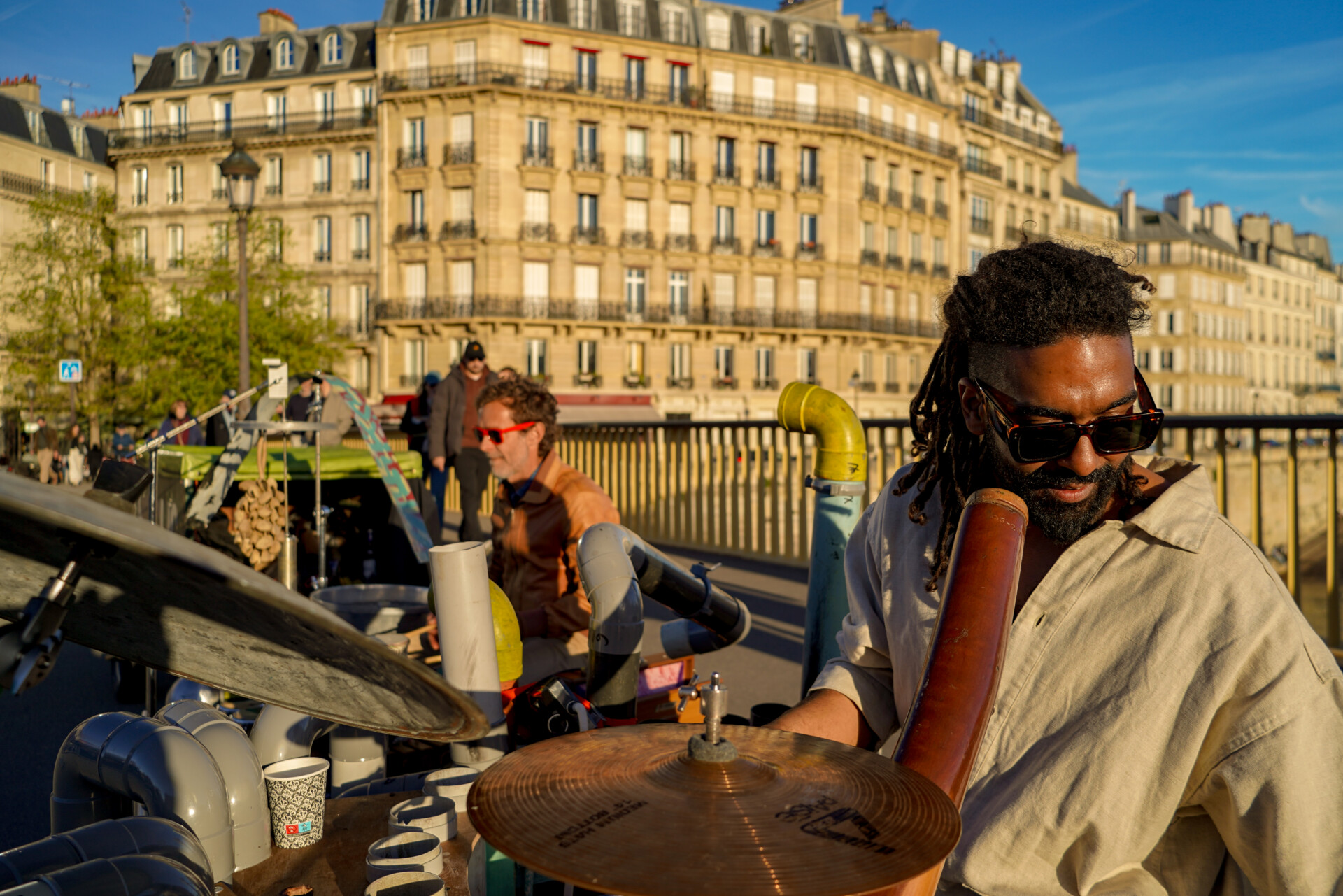
As a duo, their work is built on a clear complementarity. “Our quest lies in the aesthetics of rhythmic interweaving,”they say. “Each of us has a defined role, and we are looking for balance. Léo tends to provide the foundation, while Yann handles the colour.” Their music moves forward between structure and texture, rhythmic grounding and carefully crafted sonic nuance.
But the heart of the project lies in this impossible dialogue with the machine: getting as close as possible to what it does, without ever reaching robotic perfection. As they put it: “Physical fatigue, imperfect timing, in the end, our artistic quest is to rehumanise the supposedly perfect loop of the machine.” In other words, removing electricity does not mean stripping electronic music of its substance; it means giving it back a body, accidents, and presence.
The spirit of the project is also reflected in the reactions it provokes. Among their memories, they recall “that time when a local resident came over to complain that the sound system was too loud, but ended up staying and enjoying the concert with us!” And while their music opens up a reflection on objects, energy, and even the very definition of techno, what matters most is still joy: “If someone leaves with a smile, we’ve won.” And that was certainly the case for me.
credit photos : Eric bretonneau