No products in the cart.
Can you really take a break from social media when you’re a DJ?
“I just want to play.” In the responses to our survey, this phrase comes up again and again in different forms. Behind it lies a clear reality: for many DJs, making music is no longer enough. They also have to post, share, show themselves, and stay present in people’s feeds. Social media has become a necessary passage point, to the extent that even the idea of taking a break can trigger a very concrete anxiety: the fear of disappearing. That fear runs through a large part of the testimonies we collected. On the one hand, platforms are exhausting, fuel comparison, sometimes damage creativity, and blur people’s relationship with music. On the other, they are still seen as essential to keeping a place in the landscape.
A break therefore appears both as a risk and as a luxury that not everyone can afford.
That is one of the main takeaways from our survey conducted among around thirty artists based in France and across Europe, aged 19 to 44.
The panel
89.29% of the DJs surveyed are active on Instagram, far ahead of Facebook (32.14%) and TikTok (28.57%). Above all, 80.65% believe that social media is now essential in order to exist as a DJ. No one in the panel said it was not. In other words, the question is no longer whether platforms matter, but how possible it still is to distance yourself from them.
Social media: a presence that has become almost mandatory
The numbers speak for themselves. 80.65% of respondents consider social media indispensable nowadays in order to exist as a DJ, while only 19.35% qualify that answer with a “it depends.”
This central role is not simply a matter of promotional reflex. When asked what social media is mainly used for, 80% answered: “all of the above.” In other words, media visibility (36%), maintaining one’s network (32%), responding to implicit pressure (28%), or finding gigs (16%) are not seen as separate uses, but as different sides of the same imperative: staying within the scene’s field of vision.
Posting to exist, posting under pressure
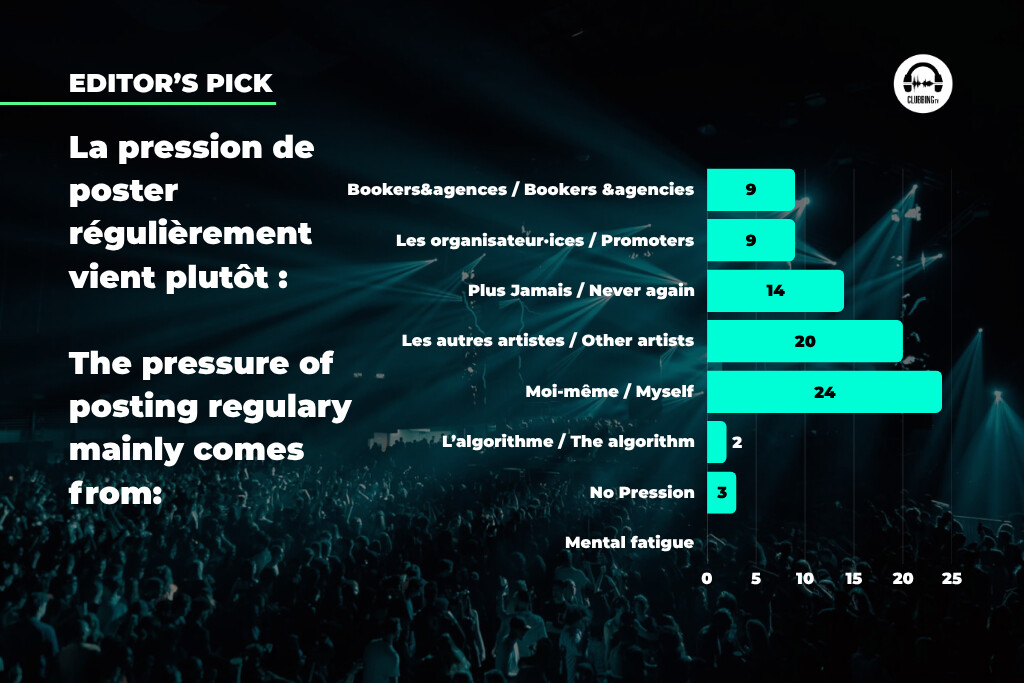
83.87% of the DJs surveyed say they have already felt pressure to post regularly. And when asked where that pressure comes from, the algorithm is named first (77.42%), followed by themselves (64.52%), other artists (45.16%), then bookers or agencies and event organizers (both at 29.03%). Only 6.45% say they feel no particular pressure.
That pressure is not only external; it is also deeply internalized. Platforms impose a rhythm, the scene reinforces it, and artists themselves eventually absorb it as something obvious. The obligation to publish becomes less of an explicit instruction than an unavoidable norm.
One testimony puts it very clearly: “My manager told me: ‘you need more updates,’ even though I already had great gigs and a radio residency. I later understood that what he meant was posting more and filming myself while playing in order to interest promoters.” Even when the musical activity is there, it no longer seems sufficient. It also has to be made continuously visible.
When visibility starts to matter more than the music
This is probably one of the hardest findings in the survey. 66.67% of respondents say they have already had the feeling that their online activity mattered more than their music, and 9.52% answered “sometimes.” At the same time, 96.67% believe that some artists are now booked mainly for their visibility. The suspicion is therefore almost unanimous.
This sheds light on many of the other results. If 74.19% say that their biggest fear, in the event of a break, would be becoming invisible, it is also because a huge majority feel that visibility directly affects opportunities. Social media has become a selection criterion.
“I feel bad seeing these influencers get more bookings than me even though I’ve been in the scene longer. I have great technique that I work on every day but I don’t have many followers. It discourages me because I just want to play!”
Another respondent puts it even more bluntly: “When I see ‘influencers’ getting loads of gigs without even knowing how to line up two tracks, it’s pretty lame. It prioritizes social media stats over musical technique.” What is at stake here goes beyond simple jealousy or frustration, and that is very important to point out. What we are talking about is a shift in the criteria of recognition. That is what we tried to highlight in our article about influencers becoming DJs.
Mental fatigue, comparison, loss of meaning
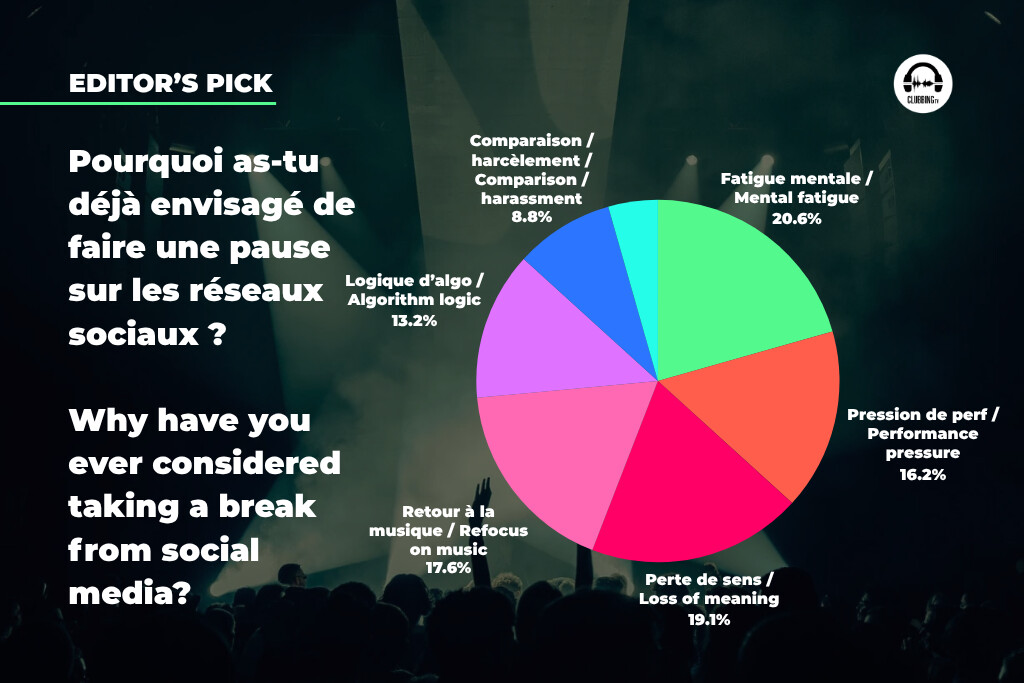
If many DJs think about taking a break, it is not out of simple digital weariness. Among those who have already considered it, 66.67% mention mental fatigue, 61.90% a loss of meaning, 57.14% the need to refocus on music, and 52.38% performance pressure. Rejection of algorithm-driven logic is mentioned by 42.86%, while 28.57% refer to harassment or constant comparison.
Current feelings point in the same direction. Today, social media mainly brings visibility for 61.29% of respondents. But almost as many mainly associate it with stress (51.61%) or obligation (48.39%). 38.71% even mention jealousy or envy. By contrast, only 19.35% say they mainly find energy there.
In other words, platforms remain effective, but their psychological cost appears high. Yes, visibility is there, but it comes with a persistent wear and tear that the testimonies make very concrete. People speak of permanent comparison, loss of confidence, time consumed, and creativity weakened.
Some testimonies describe this psychological cost very directly. “Social media creates a lot of anxiety for me, and sometimes even panic. I compare myself constantly and it takes up a huge amount of energy. I can spend 4 hours editing an Instagram post, and if it doesn’t work, I feel ridiculous and abandoned by my community.” That sentence alone contains the full package: wasted time, exhaustion, comparison, fear of abandonment, and dependence on immediate feedback.
“Instagram encourages comparison with others in a way that is really unhealthy and diminishes my creativity and my confidence in myself and my project.” Or again: “Music matters less, and music lasts less. To exist, you have to be a good communicator, and accept fitting into boxes. You have to forget your originality and your authenticity, and that’s the hardest part.” What these people are describing is not only digital fatigue, but also the feeling that platforms are transforming their relationship to themselves, to creation, and to what being an artist even means.
Playing a role, framing your image
Self-staging runs through a large part of the testimonies. 32.26% of the DJs surveyed say they feel like they are playing a role on social media, and 38.71% answer sometimes. Altogether, nearly 7 out of 10 therefore acknowledge, at least occasionally, some form of adjustment of their online image. In a scene where 83.87% say they feel pressure to post regularly, this new role reflects the need to remain visible and polished.
What does taking a break say?
The idea of unplugging comes up often. 64.52% of the DJs surveyed say they have already considered taking a break from social media, and 19.35% think about it sometimes. Only 16.13% say they have never considered it. Yet when asked how such a break would be experienced, 53.85% see it as a return to what really matters, while 50% also view it as a risk to their career. 34.62% even describe it as an inaccessible luxury, and 26.92% as a political act.
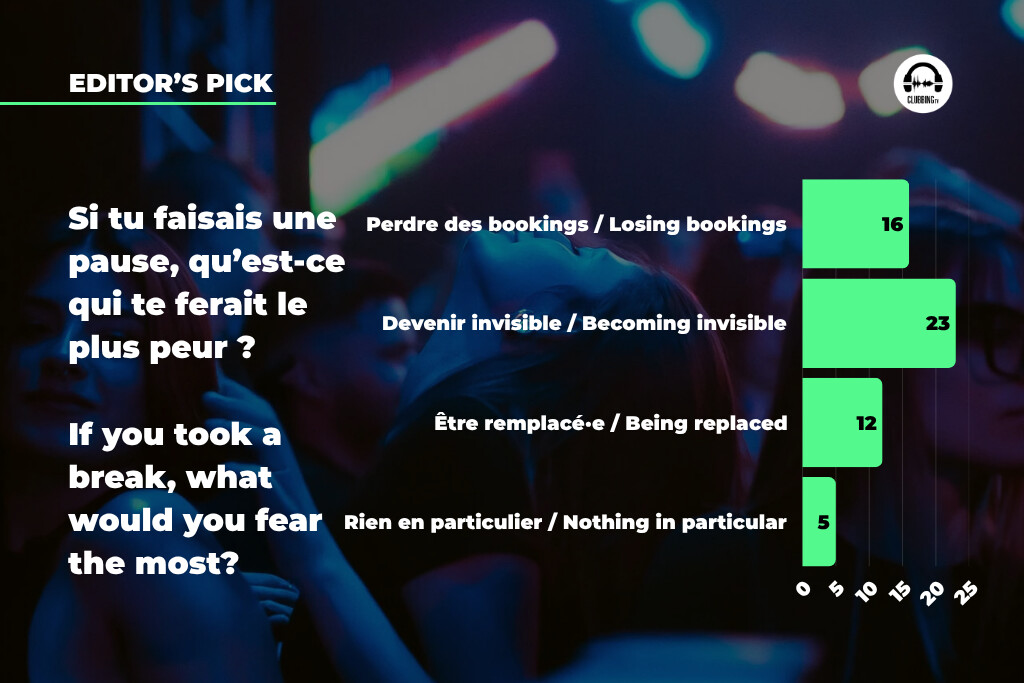
The ambivalence is very strong. Cutting off would be beneficial, but never neutral. The main fear is not even only economic: 74.19% are first and foremost afraid of becoming invisible, ahead of the fear of losing bookings (51.61%) or being replaced (38.71%).
Even before the loss of gigs, it is symbolic erasure that worries people. As if disappearing from the feed or the “For You” page already meant disappearing from the scene itself.
Silence: an unequal privilege
The question of silence sums up almost the entire paradox. To the question “Do you feel free to remain silent?”, respondents are split exactly in half: 50% yes, 50% no. Silence is therefore neither impossible nor truly guaranteed. It remains a freedom that is very unequally distributed.
This also explains why so few respondents say, without qualification, that it is possible to build a career without being very active on social media: only 9.68% answer yes, while 45.16% answer no and 45.16% say it depends on the style of music or on one’s network. At the same time, 54.84% say they have already seen artists succeed while being little present or not present online at all. Counterexamples therefore do exist, but they appear more as exceptions, often artists who emerged before social media, than as a realistic model today.
For some, staying silent is not only an aesthetic or strategic choice. It can also be linked to violence, power dynamics, or local scenes where speaking out comes at a high price. One testimony expresses it this way: “Remaining silent in the face of a local scene that protects problematic people and excludes those who dare speak up.” Here, social media also becomes a place where speaking out, self-censorship, and the cost of visibility and activism are all at stake.
Local scenes, collectives, word of mouth: the alternatives that still hold
And yet the survey does not completely close the horizon. When asked which alternatives work best, the responses focus on more embodied forms of circulation: local scenes and collectives are each cited by 70.83% of respondents, word of mouth by 66.67%, local networks by 45.83%, agencies by 33.33%, and radio by 25%.
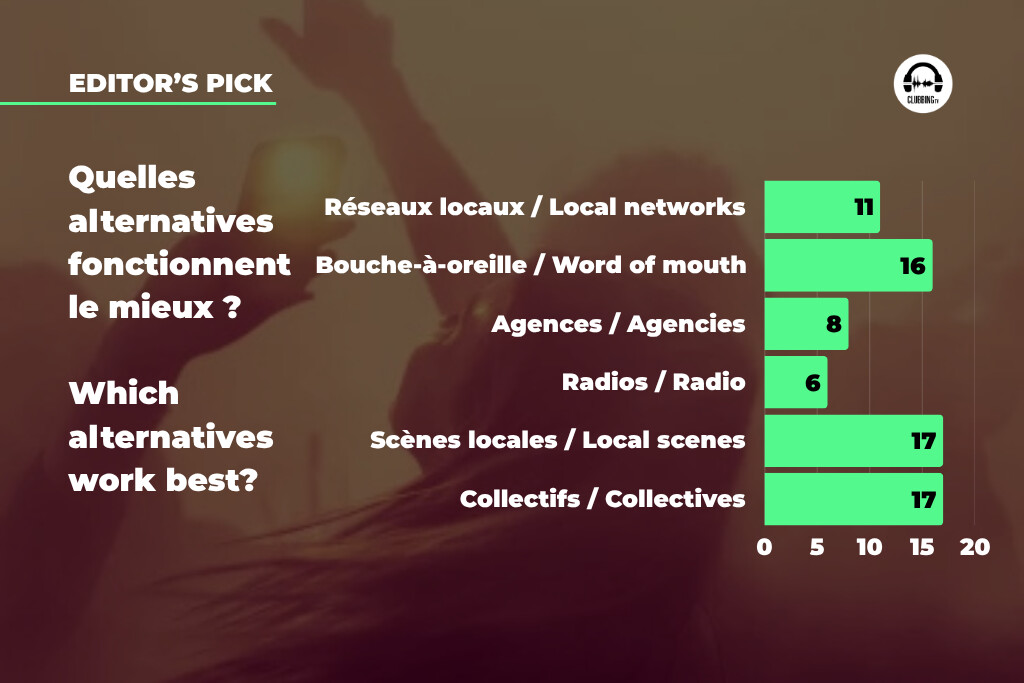
This point matters. It suggests that a break from social media is probably more feasible when you do not depend on a single channel in order to exist. When there is already a scene, a close network, a collective, a real community, visibility no longer depends exclusively on the platform. You can then step away a little without disappearing completely.
What DJs are really asking for is not to depend on it anymore
The final question may be the most telling of all. If DJs really had the choice, only 3.33% would simply prefer to post less, and 3.33% to disappear sometimes. By contrast, 30% would like to post differently, and above all, 63.33% would prefer not to depend on it at all.
And that may be the best way to conclude. The problem is not only posting frequency, nor even the existence of social media in itself. What weighs on people is dependence, and the fact that visibility has become so structurally important that it sometimes seems to condition legitimacy, opportunities, and even the feeling of artistically existing within the scene. What all of us want is to recover a margin of freedom.
That may be why one sentence, buried among the testimonies, resonates more strongly than all the others: “The algorithm lies, but the quality of your work does not.”