

No products in the cart.
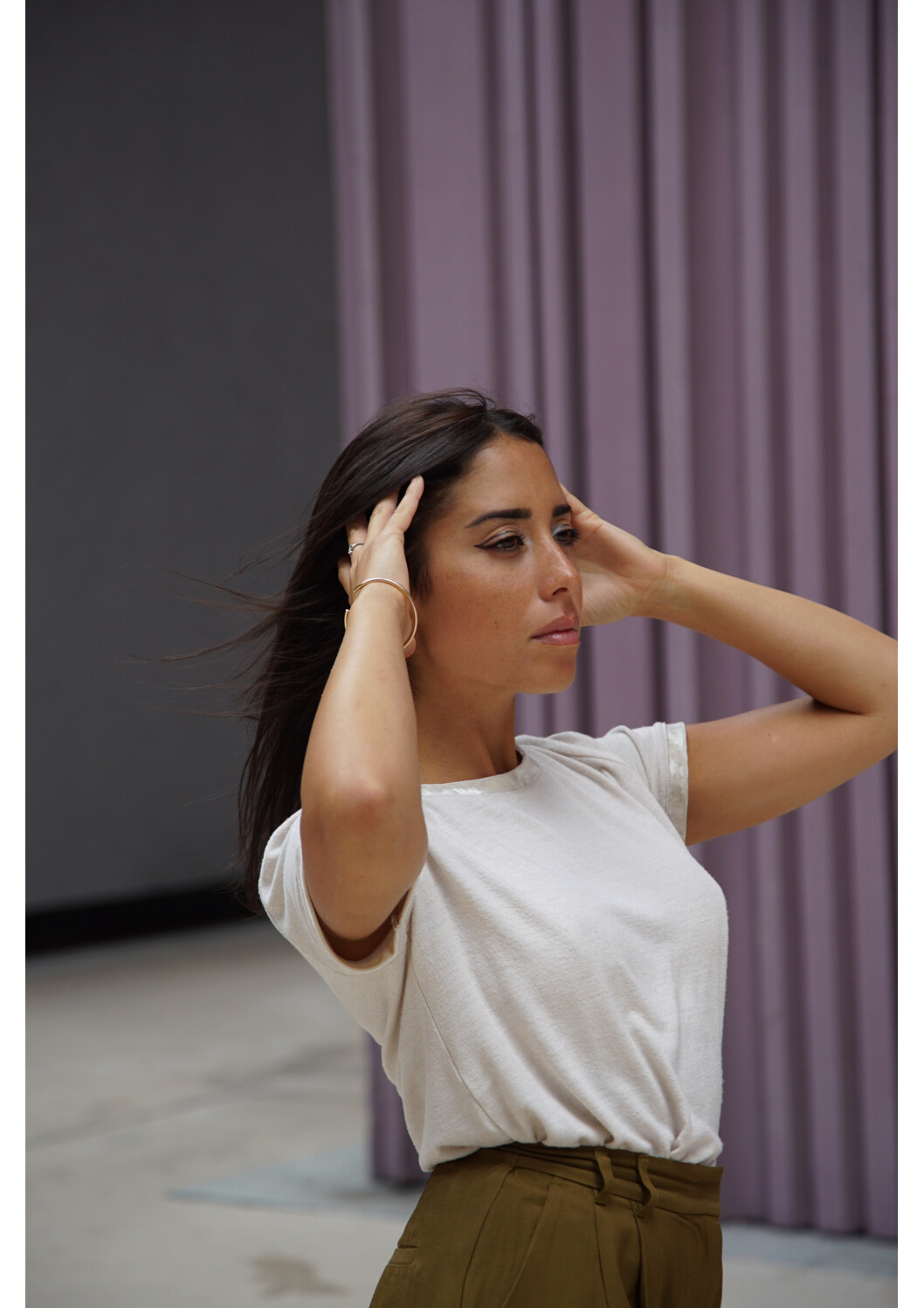
The invisibilization of women’s suffering in DJing — Interview with Poppie de Paris
After two “miscarriages” — a term that feels false in every possible way — Poppie de Paris opens up about the unspeakable pain of grief, hidden behind taboo and appearances. Being a DJ sometimes means becoming a sad clown in the middle of a dazzling frenzy, for women going through involuntary pregnancy loss in an industry where image, energy and availability still too often matter more than bodily realities. Menstruating people suffer, bleed, grieve… and are still sometimes expected to put on a show. A raw testimony about loss, loneliness, and the pressure to keep standing no matter what:
Would you be willing to revisit what you went through, using the words that feel right to you today?
Yes, if it can serve a constructive purpose and convey a broader social message. There is a real omertà, a real taboo around this subject — and even more so in professions tied to image and performance, like mine. I find that unacceptable in 2026.
What would you want people to understand first, even before we talk about music or work?
I would want them to understand that we are human beings, with bodies, emotions, and vulnerabilities. Behind a public image, there can be very difficult moments in life that no one suspects, because society pushes us to show only the “beautiful” side of things, while what happens behind the scenes is often far less glamorous. Having to perform, deliver, wear a smile and a mask while I was going through two losses in such a short time — two invisible griefs — was indescribable. My heart was shattered into a thousand pieces, and very few people knew it. I was literally extinguished, just a shadow of myself. People talk a lot about physical pain, but much less about emotional loneliness.
Is there a word, or a way of naming this experience, that feels more accurate to you than another? (Because in truth, there is nothing “false” about a “miscarriage.”)
I find that term so violent and minimizing. I never imagined I would go through something like this in my life. Because I have endometriosis, I had imagined I might struggle to get pregnant, but I had not really considered the possibility of losing a baby. We talk about it so little, even among women. There is nothing “false” about it indeed — it is painfully real. It is a long grief, sometimes an impossible one, a rupture with a projection of life. It is not just a “plan that didn’t work out,” to use the clumsy language so many people use. It is a loss you feel in your flesh and in your heart, sometimes under extremely difficult circumstances.
What changes when you go through an involuntary pregnancy loss while working in such a public, nocturnal, other-facing profession?
It is an incredibly anxiety-inducing contrast. You are expected to be radiant, polished, present, and to give off an energy you simply do not have. Beyond that, even during my second pregnancy, I was facing the demands of the profession. My blood pressure was low, I was nauseous all the time, I was dealing with extreme fatigue that kept me in bed, and I still had not recovered from the grief of the first miscarriage, which had happened in a fairly traumatic way. I was terrified I would not be able to make it to my gigs. I had to cancel some, even though my career had been my absolute priority. So when the second pregnancy ended at three months, after I had put my career aside and given up important gigs, I felt an immense sense of frustration and injustice. There was this implicit pressure to keep going, as though nothing had happened, even though all I wanted was to scream to the world what I was going through.
How do you live through an intimate loss in a world that expects energy, charisma, pleasure — even a form of euphoria — from you?
It is very violent, because you almost have to play a role. You have to make people dance, create pleasure, while you yourself are grieving. I remember DJing the day after my first “miscarriage,” losing a huge amount of blood, going to the bathroom to cry and double over in pain, while telling myself that if I did not push through, I would lose my job and everything I had built so far — on top of failing to build the family life I longed for. I was extremely hard on myself. I gritted my teeth and went back to work like a zombie. Since then, I have come to think that women’s strength is infinite.
Did you feel pressure to “carry on anyway,” to remain professional, to honor your dates, to show nothing?
Unfortunately yes, because in this industry, stopping can be seen as a weakness. But in my case, the booking agencies, venues, and partners I work with were exceptional. I still get emotional when I think about their words and the fact that no one let me down during or after all of this.
Did you feel like you had to separate your real body from your public image as an artist in order to keep entertaining?
My body was exhausted, between the hormones, the fatigue, and the emotional shock. I no longer recognized myself in this body that had carried life, but had not brought it into the world. I hated this new body — I used to say I felt “disfigured for nothing.” I tried to keep posting on social media because it is part of the job, but since I was working less, or not at all, it felt meaningless. Most of all, I could not bear to see that little belly, now empty. And in my private life, I did not have the support I should have had during such a moment of extreme vulnerability. I saw very clearly who was there when I was “on top,” and who was not there when I was at rock bottom. In recent months, I have truly understood the meaning of loyalty and reliability. Life sorted things out, and I am extremely grateful for that. So yes, in a way, I dissociated and switched to autopilot, knowing I could only really count on myself. I controlled my image — and I still do, in order to last as an artist — while carrying this wound deep inside me for life, as a woman.
How was your body affected, and did that change your relationship to touring, traveling, lack of sleep, and performing?
I had to stop completely during the first three months of my pregnancy because I was physically unable to perform. My agencies knew I had already gone through one miscarriage, so everything felt very delicate. I was afraid of being jostled, of standing and stomping around for hours. The bass, the extremely loud music for the baby — it is a very physical job too. I felt a real sense of incompatibility. People also noticed that I had gained weight. My body changed so quickly. I already felt like a mother, and I had this visceral need to protect my baby. I kept telling myself that if I pushed too hard, I would put the baby at risk and lose it again… And yet it still happened, despite all those precautions.
Before this experience, did you already feel that nightlife was not really designed for bodies that carry — or can carry — a child?
I developed the desire to become pregnant fairly late, and I thought I had met the right person to take that step with, so no, before that I had not really thought about it. These babies were wanted, and anything but accidents. It was only when I became pregnant that I realized the world of DJing — and entertainment more broadly — is not designed for this. It is a world that values image, availability, and energy, but much less the realities of the female body. And yet being pregnant is not an illness. I hope that in the near future, people will accept seeing a pregnant DJ performing while seated, for example, without her having to justify herself.
In this profession, do people talk enough about the real physical constraints: fatigue, jet lag, stress, hormones, painful periods, recovery?
Absolutely not. This profession is heavily romanticized. In my case, being a DJ with endometriosis means dragging yourself to a gig while on your period, with pain radiating down into your legs, experiencing an intense fatigue that leaves you bedridden — and still having to show nothing, because it is not considered sexy. Men can have health issues too, of course, but for us it happens every month, not to mention hormonal fluctuations that affect us physically and psychologically.
Why do you think this subject remains so invisible in electronic music, and more broadly in the music industry?
Because it kills the mood, it disrupts the image, and it forces people to talk about deeper things: vulnerability, women’s bodies, and even the human dynamics surrounding them. Music is one thing, profitability is another, but there are people and lives behind all of this. Men are still very uncomfortable with issues related to women, and they are generally the ones pulling the strings in the industry, so everything stays at surface level. Talking about babies, miscarriages, or painful periods in a mostly male profession seems to be treated as a non-issue, even though it is a very real one for the minority of women who work in this sphere. We are still so underrepresented on the electronic scene. It is time for that to change, and for mentalities to evolve.
Did you feel alone in this experience, or on the contrary supported by other artists?
Supported — thank you, Instagram. I was absolutely right to share my story online, despite the fact that the future father of this child — that partner at the time, who did not exactly shine in terms of loyalty, without going into too much detail — was against it. After I received a private message, certain things revealed themselves on their own. Pregnancy is such a precious moment that no man has the right to ruin it through immaturity and lack of values. In any case, I received hundreds of supportive messages from male and female artists across different music scenes, from booking agencies, labels, close friends and more distant acquaintances. I was hit by this overwhelming wave of love at the exact moment when I was living through grief, betrayal, and the most violent identity crisis of my life. It was extraordinary.
Had you heard similar stories around you?
Yes. Amelie Lens miscarried at the same time I did, and she spoke about it on Instagram. It was a strange feeling — I felt close to her because she is also a DJ and must have gone through the same emotions I did. I told myself that if her sharing helped me, then I also had to tell my story, on my own smaller scale, to tell women: we are in this together. Unfortunately, from my point of view, even women who have never experienced miscarriage cannot fully understand this grief. You live with this loss every day. I still find myself crying when I see a pregnant woman or a baby.
Were you afraid of being perceived differently by speaking about it?
No. I will not expand on this too much, but I have never been afraid to speak. It is part of my personality — take it or leave it. Women are finally being allowed to speak after centuries of silence. And if I am perceived differently because of it, then all the better. That means that, in some way, I will have helped shift something on a subject that left a permanent mark on me.
Do you think there is still a double standard between male artists and people who carry a child when it comes to the body, availability, or parenthood?
On that point, I do not want to generalize, but clearly, as artists — and in many other fields as well — men and women do not live the same life during pregnancy or after pregnancy. Parenthood is absolutely an issue of inequality between men and women. I think the best advice I could give, whether you are a DJ or not, is to choose a life partner who is deeply present and able to be there emotionally, but also concretely, in real life. Someone reliable, stable, and someone who loves you for the right reasons — not just for what you represent outwardly.
Are women DJs — or artists perceived as such — still expected to remain “available,” “unburdened,” “disembodied”?
Yes, and that applies to all women working in image-based professions. We are always expected to appear radiant, desirable, and available if we want people to “stay,” “follow,” “like,” “love.” But sometimes you have to let people see behind the scenes. Reality and authenticity will always win. Lying is not my thing, and I believe people have followed me for ten years for that exact reason: I do not fake it.
At any point, was music and club culture a refuge for you — or on the contrary something terrible?
Music has saved me lately, and it saves me every day. I am passionate about what I do, and it was by getting back on stage that I started breathing again. I feel better than ever today thanks to music.
Why did you choose to speak about it? And why now?
Because I no longer wanted to carry this alone, or pretend everything was fine. It happened eight months ago. I needed time to understand what I had been through, to make sense of something so brutal, and above all to regain a form of stability. And today, I am speaking about it because I know I am not the only one living through this. If it can help other women feel less isolated, then it matters. And also because there are truths that can no longer be silenced indefinitely.
What would you like to see change so that people going through involuntary pregnancy loss are not forced into invisibility or constant over-adaptation?
I want us to stop asking women to be strong in silence.
A miscarriage is not just an “incident”; it is a real physical and emotional upheaval. I would like there to be more space for vulnerability, for the reality that slowing down, stopping, being supported should be normal — without guilt, without pressure to perform. And I would also like people to talk more about the role of those around us, because the way you are supported — or not — changes absolutely everything.
Is there something no one asked you, that you wish someone had?
Yes. No one really asked me how I was doing, beyond the surface. People often ask, “Are you feeling better?” but rarely, “What has this changed for you?” And the truth is, it transformed me. This kind of experience brings you much closer to yourself. I feel 100% aligned now with who I am, with my desires, and with my personal and professional goals. Looking back, I also have a more spiritual vision of what I went through. I tell myself that some things do not happen by chance. Today I have all my answers, and I have a profession I am passionate about. I cannot wait to keep living from that passion while helping evolve the place of women in the microcosm of DJing.