

No products in the cart.

A study initiated by the Syndicat des Musiques Actuelles, the LiveDMA, and the European organization Reset Network maps the economic concentration in the European live music sector. The study is divided into two maps: one focusing on music venues and the other on festivals. It is based on the work of independent researcher Matthieu Barreira, who specializes in the economic aspects of the music sector.
200 Festivals Are Owned by Four Groups
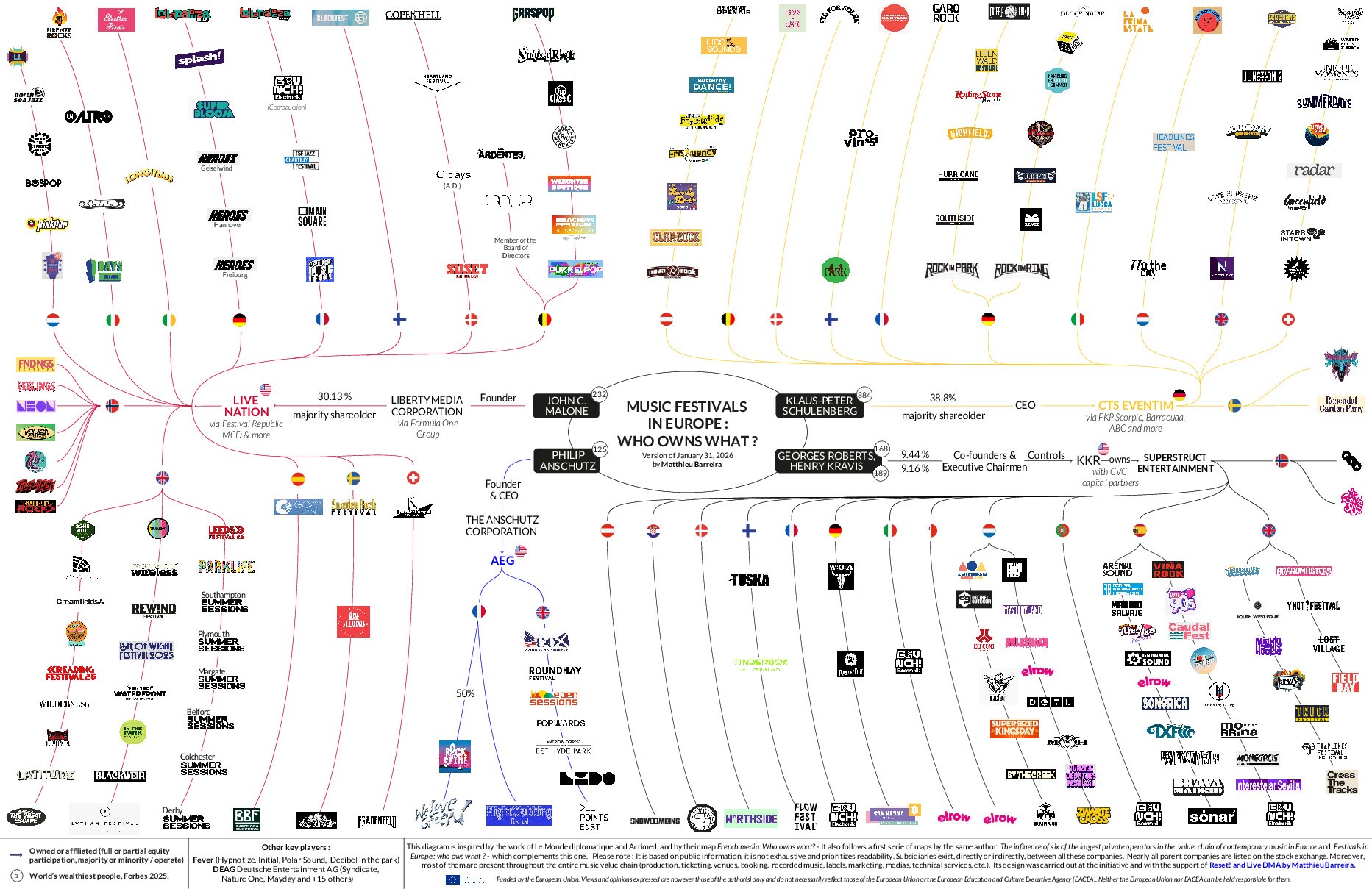
They reveal that 200 festivals in Europe and the United Kingdom are owned by four major private groups: Anschutz Entertainment Group, Live Nation Entertainment, CTS Eventim, and Superstruct Entertainment. Superstruct, in particular, owns festivals such as Awakenings Festival, Monegros Desert Festival, and Upclose Festival. While concentration in the music industry is not a new phenomenon, it has been accelerating in recent years due to the multiplication of mergers and acquisitions led by large corporations and private investment funds.
An Entire Ecosystem Disrupted
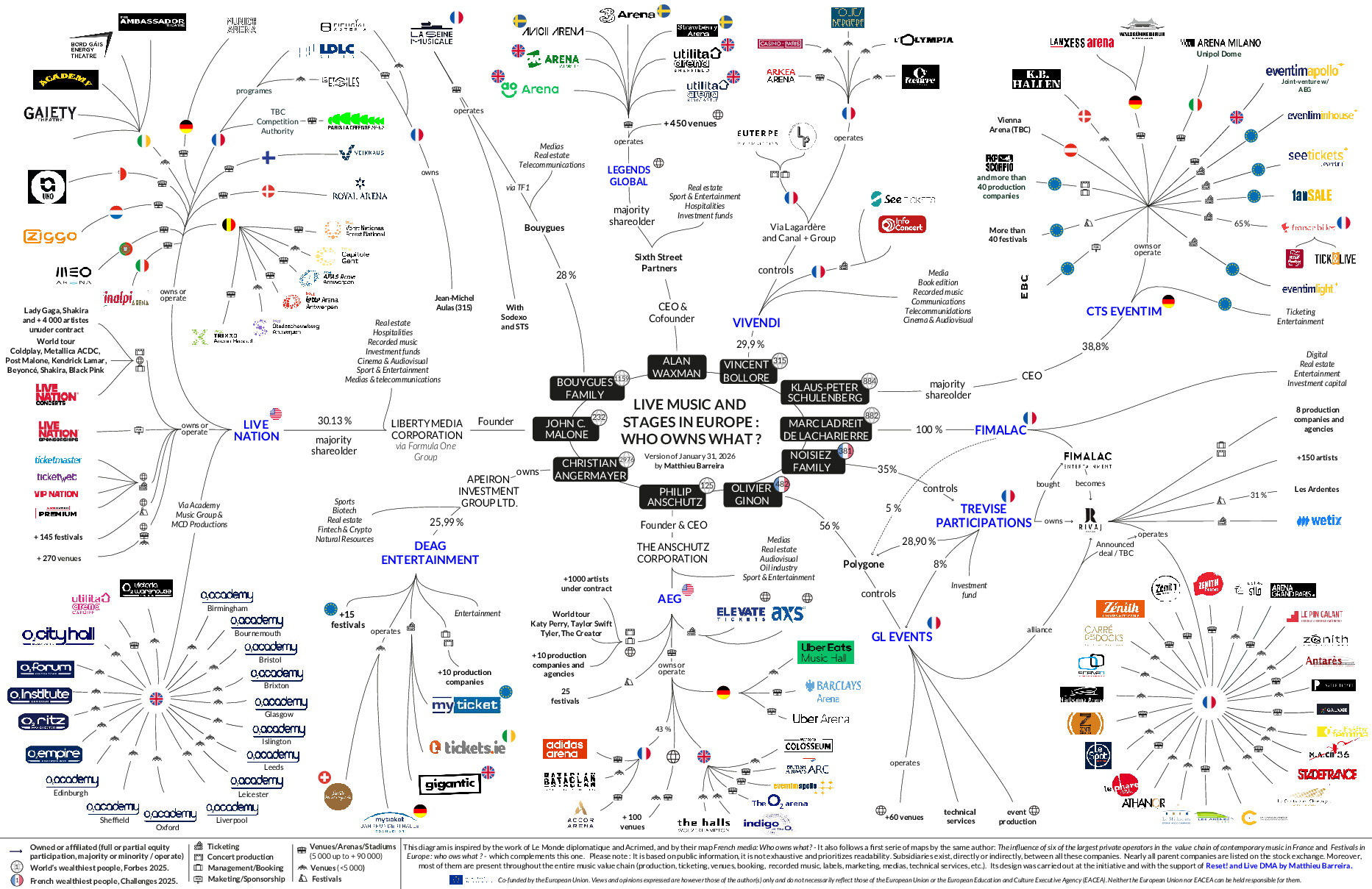
This threatens the diversity of European music scenes. Indeed, this concentration is mainly focused on stadiums and arenas, which weakens the ecosystem of small and medium-sized venues, most of which are non-profit or independent. Moreover, these same four groups also own some of the most widely used ticketing platforms, shaping pricing practices. Live Nation Entertainment, for example, owns the See Tickets platform. These groups therefore control a large share of live music revenues and are experiencing strong growth.
An Impact on Diversity
This could influence the policies of concert venues and festivals: even if a group does not hold shares in an organization, that does not necessarily mean it has no influence. This is particularly evident through their activities in programming, ticketing, sponsorship, and their roles on boards of directors. The organizations emphasize the importance of European-level regulation to ensure the sustainability of small-scale structures and, in turn, cultural diversity.
Double Standards
The combination of political decisions, economic pressures, and market dynamics is driving the growth of oligopolies in the music industry. In this context, small structures are running out of steam. Indeed, they are the ones bringing emerging talent to the forefront of the scene. This necessarily comes at the cost of financial risk-taking and very low profit margins on ticket sales. All of this is taking place against a backdrop of cultural budget cuts and inflation. In the Paris region alone, two key cultural community spaces for the electronic music scene—the Sample in Bagnolet and the Cité Fertile in Pantin—are expected to close before the end of 2026.