

No products in the cart.
We’re not going to talk today about influencers becoming DJs, nor about media outlets getting paid for their editorial coverage. Those subjects have already been covered, and the backlash that followed is enough to last a few months.
Today we’re talking about rave influencers. And about the way they sometimes profoundly reshape your perception of nightlife.
From Nightlife Recaps to Lifestyle Product
You’ve seen them appear on your feeds. At first, nothing alarming. Recaps of nights out, enthusiastic videos, seemingly genuine shares. Then come the invitations in exchange for a few stories. Then promo codes, often symbolic, sometimes frankly useless. And gradually, partying becomes a job. Or rather, a product.
The issue isn’t documenting the night. Electronic culture has always been told, photographed, archived. The problem begins when commercial logic overtakes cultural logic.
Promotion Is Not Journalism
These profiles are not journalists. That’s not an insult, it’s a distinction. Journalism implies ethics, research, context, sometimes critical distance. Influence works differently. The subject isn’t examined, it’s promoted. The night isn’t analyzed, it’s sold. And that changes everything.
When the Dancefloor Becomes Content
The dancefloor becomes a content backdrop. Bodies become extras, sometimes for the wrong reasons. Moments become opportunities. Backstage and VIP areas become offices.
A drop is no longer just a moment of musical tension. It becomes potential content. A face in trance is no longer simply someone living an experience. It becomes exploitable imagery. Someone peaking becomes a viral clip. Everything is, consciously or not, treated as material to capture. The dancefloor stops being a space of immersion and becomes a reservoir of visuals.
Backstage, VIP and the Return of Hierarchy
Backstage and VIP zones turn into mobile workspaces. Where underground culture once valued anonymity and the dissolution of ego within the crowd, influencer logic reintroduces visual hierarchy. Being on stage is not just logistical privilege, it’s strategic positioning. Height offers an angle. The angle offers content. The content offers visibility.
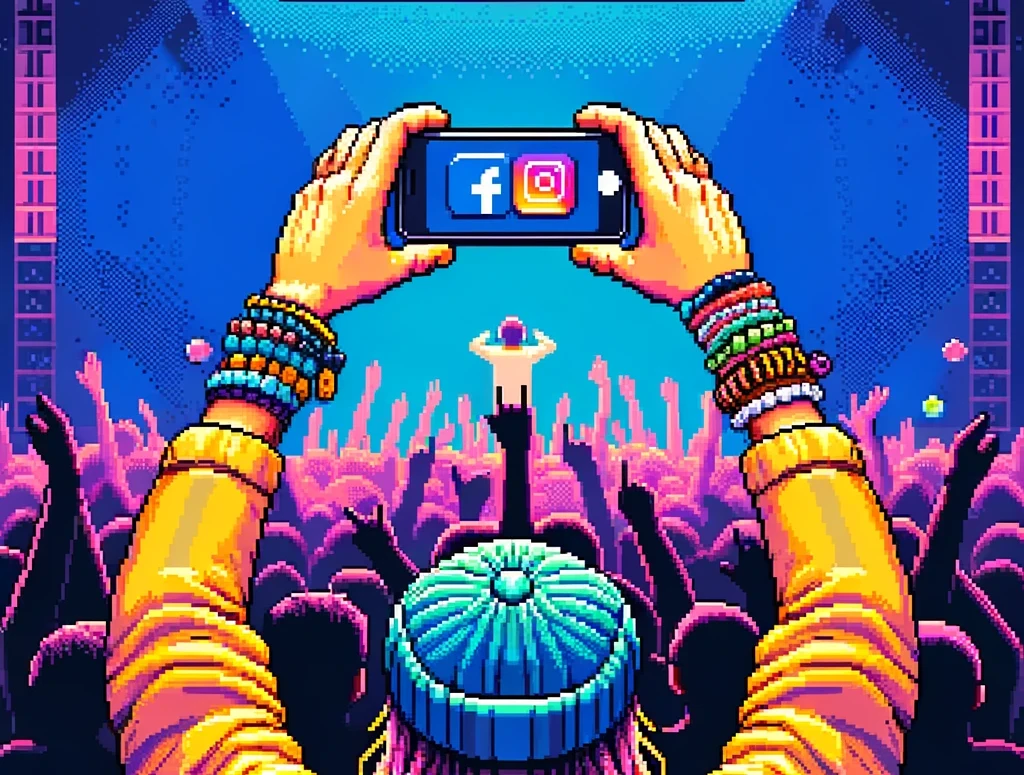
You’ll rarely see them deep in the crowd, squeezed between strangers, experiencing the music head-on. More often, they’re on the side, at the back, or most commonly on stage, phone raised. That’s not random. Immersion makes stable filming difficult. Immersion means surrendering control of the image. And influence depends on control.
At that precise moment, you already know the “report” will be biased. Not out of malice, but because of positioning. Filming from the stage means narrating the night from a place of power. From privilege. From a vertical perspective. And that transforms how the party is perceived.
A 90-Second Video Cannot Tell the Truth of a Night
A 90-second video will never tell the story of a night. It can capture a fragment, raw energy, an aesthetic. But it won’t show the transitions, the slow builds, the awkward moments, the line at the bar or the toilets, the DJ mistakes, the sound issues, the outside conversations, the fatigue, the tension, the contrasts. It won’t show context. It won’t show what isn’t spectacular.
It’s advertising.
A great night is not defined by its loudest moment, which, by the way, is different for everyone on the dancefloor. By showing only the peak, expectations shift. Imaginations are conditioned, especially for newer audiences. The value of an event starts being measured by the violence of the drop, the size of the lasers, the number of likes on a post.
Nuance disappears. And when nuance disappears, culture flattens.
From Artistic Experience to Algorithm-Friendly Highlights
We stop talking about programming, artistic coherence, sound quality, the narrative progression of a set. We talk about viral moments. The issue isn’t documentation. It’s narrative compression forced into algorithm-friendly formats.
When Passion, Promotion and Silence Blur Together
There are also influencers who begin by lip-syncing to tracks they genuinely love. Then to tracks they’re paid to promote on Reels or TikTok. The line between passion and paid placement becomes blurred, and rarely disclosed.
And then there are the ones who genuinely anger people. Those who promote artists accused of sexual or gender-based violence. There’s no effort to inform, contextualize, or question. The priority is access, maintaining invitations, not upsetting promoters.
Selling the Dream, Ignoring the Cost
There are those who rack up flights all season long, hopping from festival to festival, sometimes across continents, sometimes across the world, for a few hours of presence and a few stories. Excessive travel simply to document a weekend and feed the FOMO machine. They sell dream experiences and exceptional moments, without ever addressing the environmental impact of that mobility or the consumer logic it encourages.
Others normalize excess consumption. Alcohol becomes a prop. Substances are insinuated. Exhaustion becomes a badge of honor. Fashion follows the same logic: new outfits for every event, endless accumulation of rave-coded aesthetics turned into seasonal trends.
This isn’t just about individual morality. It’s about a model. When visibility depends on spectacle, you have to produce more intensity, more movement, more, more, more.
Once again, this isn’t a personal attack. It’s an analysis of a structure.
The Influencer as a Structural Salesperson
An influencer is, structurally, a digital salesperson. Their income depends on converting attention into purchases. Their independence is limited by partnerships. Their silence can be strategic. Their enthusiasm is monetized.
That doesn’t mean there aren’t sincere, knowledgeable, engaged creators. There are. But they’re rarely the ones with the biggest budgets. And often, they don’t even define themselves as influencers. They write, research, contextualize. They take the risk of being unpopular.
Is the Influencer Model Compatible with Rave Culture?
The question isn’t whether rave influencers genuinely love the culture. Many of them do. The question is whether their economic model is compatible with a culture historically rooted in community and resistance to commercial logic.
Rave culture doesn’t disappear because of influencers. It transforms. But without critical distance, we risk confusing documentation with advertising, passion with placement, community with market.
And in a culture born on the margins, that confusion can be costly.
This hot take is especially for newer audiences: don’t let social media define what rave is for you. Experience it yourself. Arrive without expectations. Rave doesn’t owe you anything. But if you allow yourself to surrender to it, to love it and respect it, it will give back. It has done so for generations of ravers before you, and it will continue to do so as long as we live it rather than consume it.