

No products in the cart.

When a duo dares to bring techno and electronic pop into a sport that still sanctifies the “great repertoire,” it never goes unnoticed. Brissaud and Lopareva have chosen their signature: a living, generational culture, sometimes provocative.
Back in 2024, they were already shaking up grandma and grandpa watching France Télévisions at 4 p.m., who definitely weren’t expecting to hear Benny Benassi’s Satisfaction. Last year, at the European Championships, they impressed us once again with a techno program: modern, powerful, almost “destroy.” And the reaction followed: “We won our European medal with this music, which caused a sensation with the audience.”
But why does it grab us so much?
Because it’s original enough, surprising enough, to stick in your mind. In a sport that’s still highly coded, where the “right” music is often the kind that’s already recognized and legitimized (big emotion, big drama, big tradition), choosing electronic music is more than an artistic decision. It’s a way of positioning yourself in the cultural field. They claim it openly: “We love to innovate, we’re betting on our originality and our strong personality.” It’s also a way of saying: our culture, our references, our era belong here too.
Even if this year, for the Olympics, the imposed theme was the 1990s, and their program built around Eiffel 65 and Daft Punk fits the brief perfectly while still staying completely on the margins (well played), what stands out most is their choreographic inventiveness, perfectly aligned with their musical choices: “We chose Eiffel and Around the World because we felt the vibe was fun, offbeat, and above all provocative.”
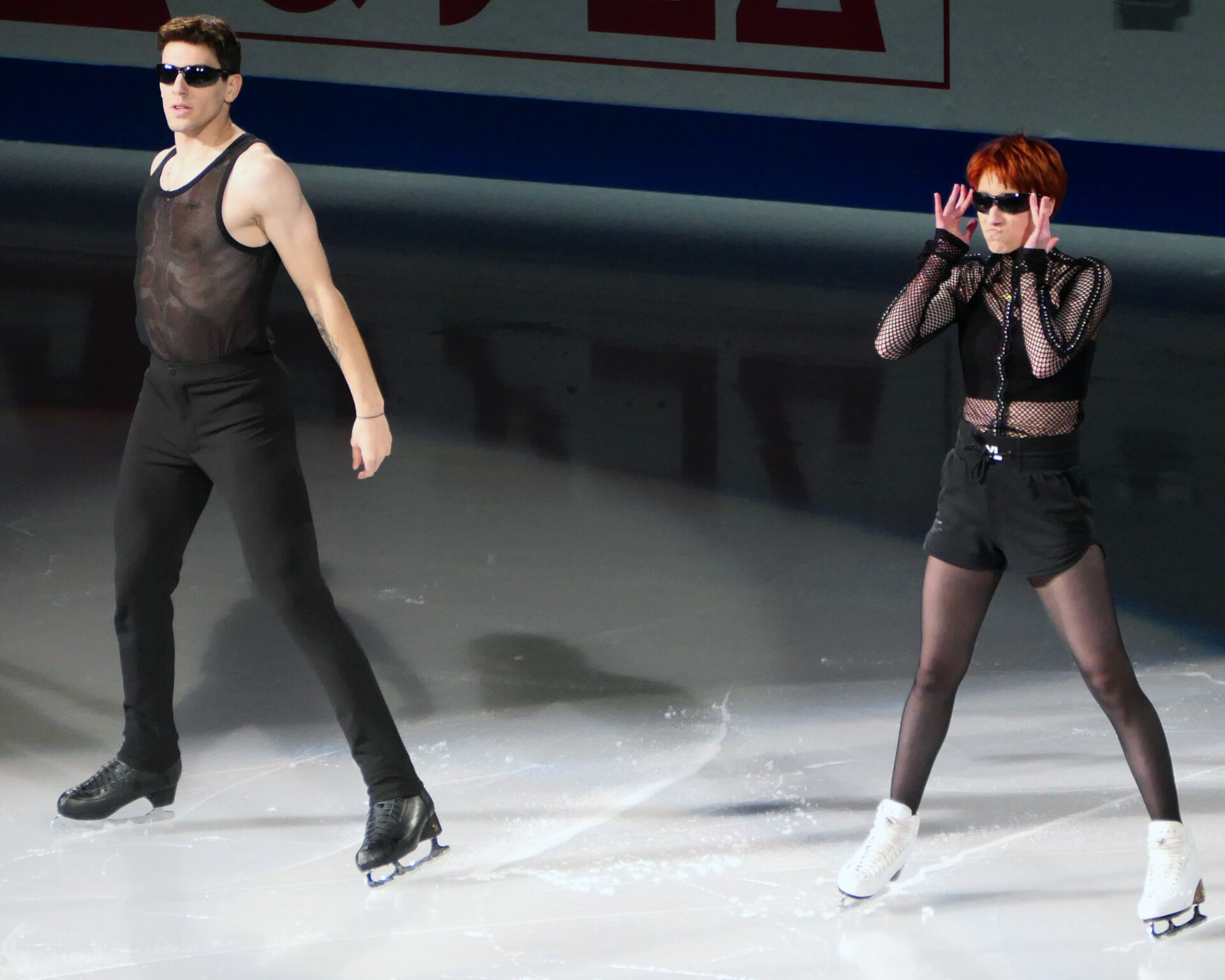
For a long time, techno has been pushed into the box of “repetitive,” “not musical enough.” Except on ice, Brissaud and Lopareva prove the opposite: this pulse is an advantage. It becomes structure, tension, precision. “We choose movements and elements that explore contemporary sides and ‘highlight’ musicality.” And honestly, that modernity feels good. Above all, it raises an essential question: the legitimacy of electronic culture.
Legitimacy, precisely, is everywhere, in sport as in music. Some disciplines are seen as more “noble” than others, just as some musical genres are judged more “respectable.” Their signature is therefore not insignificant. Without necessarily presenting it as a manifesto, it broadens the audience. It introduces electronic music to people who would never have come to it, it even surprises younger audiences who think they already know everything, and it builds a bridge between two worlds that rarely look at each other.
That’s their strength. They’re not just putting electro on figure skating. They’re translating club energy into a sporting and artistic language, with a real sense of style and era. And when it works, it becomes a cultural moment that stays with you.
So no, this season, the Olympic gold may not be what followed us the most. But Brissaud and Lopareva won something else: a trace, their own. The kind you replay and send to a friend with a “have you seen this?” And if they keep pushing the codes the way they promise, “We embody generational youth, we’re shaking up the rules, and we won’t stop until our name is known for it,” then their story is already moving beyond the ice.
credits : E Geoffrey_Brissaud_2024_Worlds_Gala_3 vgeniia_Lopareva