

No products in the cart.
There was a time when the most important question in a club, a rave, or a festival was simple: *how’s the sound?*
Today, it is often replaced by another one, more visual, more trendy: who’s playing? bOiLeR rOoM stage? What does the stage look like? Will there be lasers?
At many electronic music events today, sight has overtaken listening, which was supposed to remain sovereign. By staring at the DJ, we have gradually stopped paying attention to the sound.
This shift is the result of several deep transformations within the electronic scene, starting with the starification of DJs. Once anonymous, shy, or almost invisible figures, they have become headliners, brands, sometimes idols. Their physical elevation on stage, their isolation behind monumental booths, their constant exposure on screens have all helped re-center the experience around their persona rather than what they produce.
When DJs massively entered the festival circuit, this dynamic became even stronger. Unlike live bands, often mobile and embodied on stage, the DJ is fundamentally static. To compensate for this immobility, the industry shifted attention toward the background: giant screens, light shows, special effects, pyrotechnics, increasingly spectacular scenography. A visual arms race that, as scenographer Pierre Claude points out in an interview with *Les Inrockuptibles*, ultimately becomes a headlong rush. “The constant escalation of concert production scares me,” he explains—despite having designed some of the most striking stage setups of the 2020s.
Voir cette publication sur Instagram
The problem is not scenography in itself. Light, space, and staging are an integral part of the electronic experience. But when the show becomes the core of the event, sound ceases to be the priority. And that is precisely where something breaks. This is where phones rise excessively and the desire to show a moment overtakes the desire to actually live it.
Because paradoxically, we’re supposed to be there to listen and dance, yet we end up watching and filming. Yet how many large-scale festivals and clubs truly invest today in sound systems worthy of the name? How many prioritize visual effects, oversized fees, and spectacular production over acoustic quality? We don’t have the answer, but the comments from ravers unhappy with the sound speak volumes.
Sound becomes almost secondary because the audience’s attention is elsewhere—captured by sometimes fanatical love for the DJ, by the narrative built around their persona, by consumption in the broadest sense, alcohol included, and by an environment designed to be seen before it is heard.
This drift is not inevitable; it is already being contradicted by other models. In free parties, for example, the experience is often radically different. In front of walls of sound—sometimes raw, sometimes imperfect—the DJ almost disappears. It doesn’t matter, as long as the sound is there. Listening becomes collective, physical, almost primal. Sure, saturation is sometimes part of the folklore (lol), but still…
This philosophy is also defended by figures like DVS1, who repeatedly states that “the soundsystem should be as big as any DJ on the lineup”. in an interview for *Electronic Beats* (the sound should be a headliner too).
This vision took concrete form with *Dark Skies*, an installation developed for the HORST festival by architects Leopold Banchini and Giona Bierens de Haan in collaboration with DVS1. More than 900 square meters of sound system suspended above the crowd, erasing the stage–audience hierarchy, removing the DJ as a focal point, and transforming the dancefloor into a democratic, multidirectional space. No one is relegated to the back. No one is too far from the sound. The body is put back at the center—not the star.
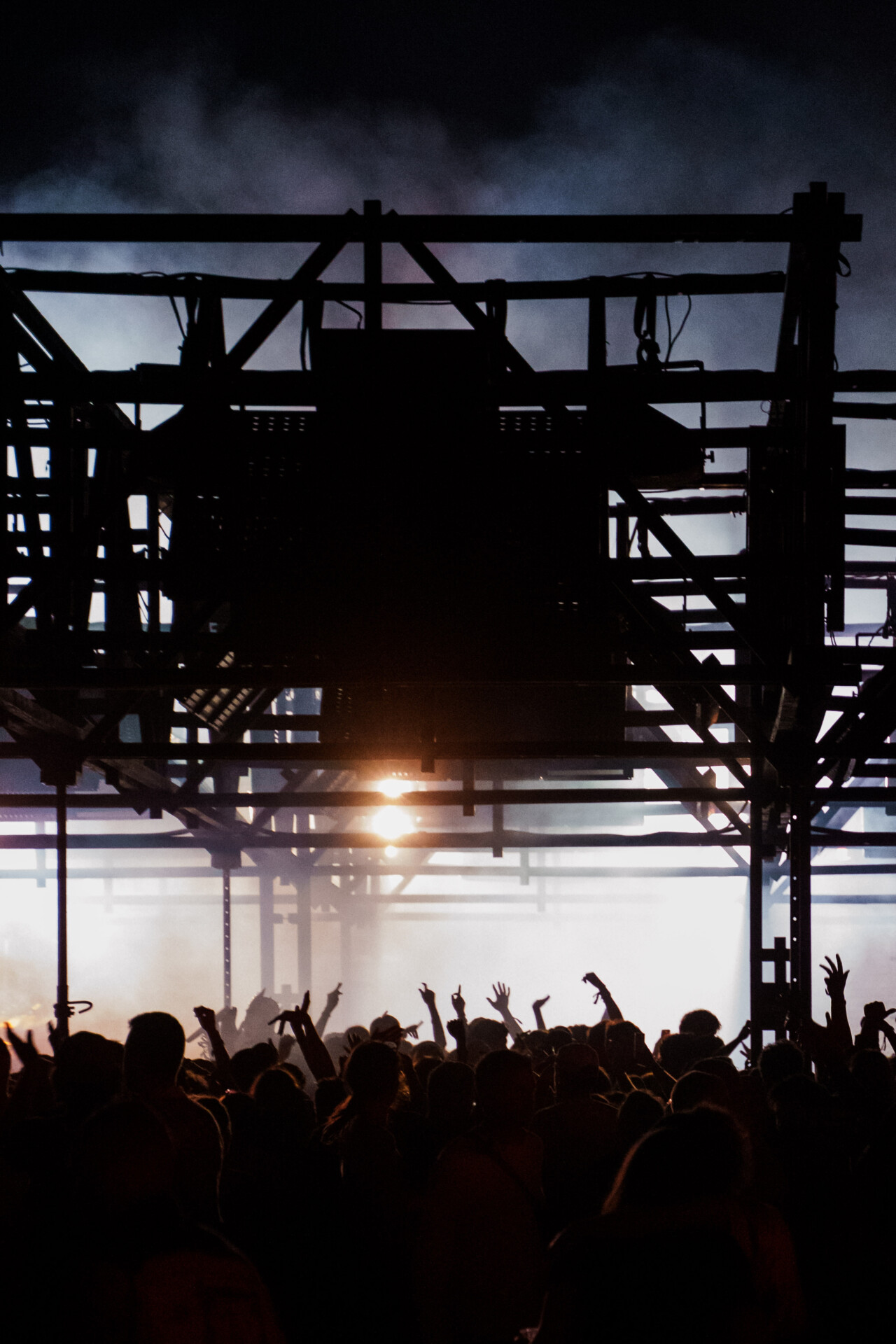
DVS1 continues this logic with *The Wall of Sound*, a concept deployed notably in Amsterdam with Josey Rebelle, Richie Hawtin, or Samuel Deep, where the sound system becomes the structuring element of the event—long before the names printed on the lineup.
Voir cette publication sur Instagram
These initiatives are not anecdotal. They signal a gradual return to the idea that sound is not a support—it is the subject. And this return is all the more necessary because the electronic scene has, in recent years, contributed to lowering its own standards. By conditioning audiences to mediocre, compressed, aggressive, or poorly tuned sound, we eventually distort their taste.
DJ Playr1 puts it bluntly in a video that went viral: bad DJs ruin an entire scene because they lower expectations. Feeding an audience nothing but musical fast food makes any more demanding proposal harder to appreciate. And this logic applies just as much to artistic programming as to sound quality. When the sound is bad but the show is spectacular, the audience gets used to it. They accept it. They stop asking for better.
Voir cette publication sur Instagram
The result is a scene that is increasingly unsustainable. Economically, because only the very big names (DJs, agencies, etc.) survive this race for visibility. Artistically, because risk-taking decreases. Sensorially, because listening becomes impoverished. By constantly watching the DJ, we have forgotten to listen to what they were playing.
Putting sound back at the center is neither a nostalgic nor an elitist gesture. It is a cultural necessity. It means rethinking priorities, budgets, spaces, and expectations. It means remembering that electronic music was born to be experienced with the body before being consumed with the eyes.
We just want to stand in front of a real Front Left that doesn’t damage our ears—or the music.