

No products in the cart.
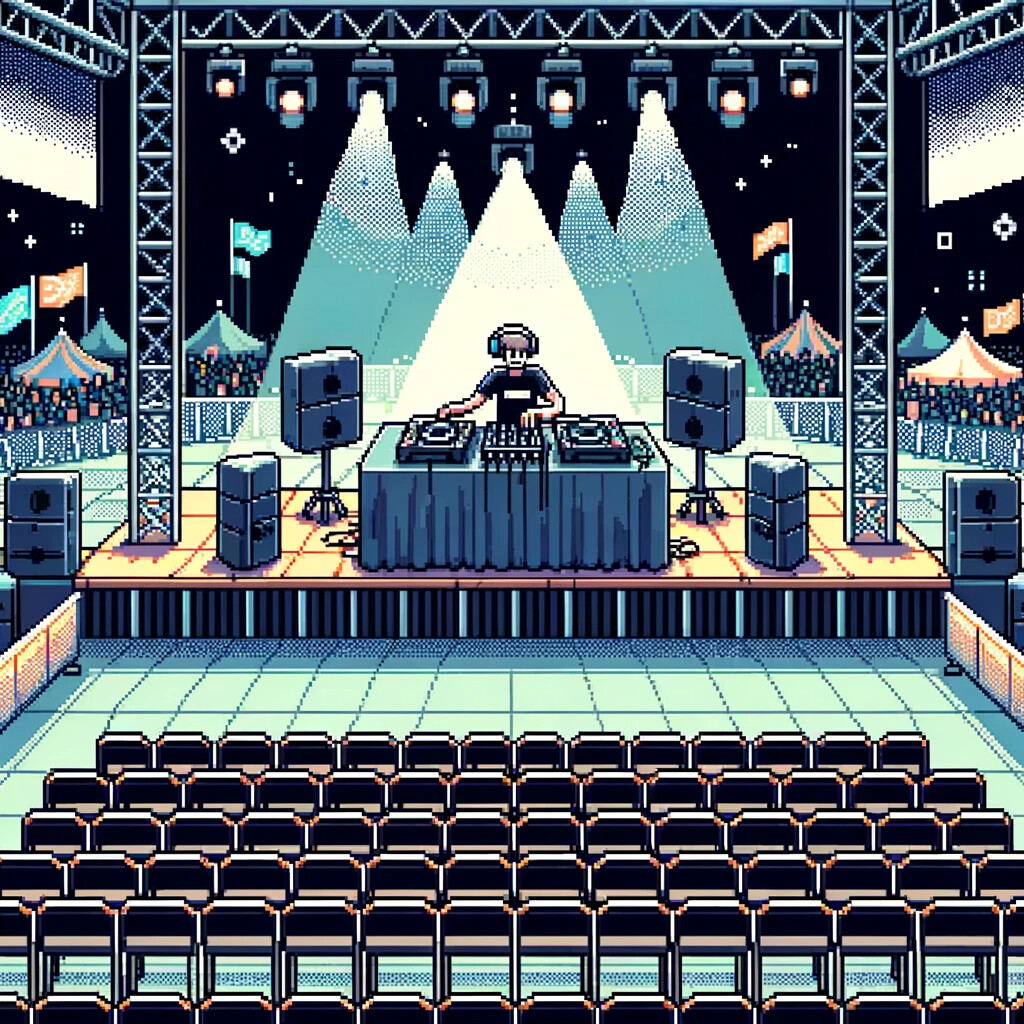
In today’s club and festival culture, the warm-up remains a blind spot. Too often perceived as a transitional slot before the “real” night begins, it is treated like background noise — something to drift through while waiting for the headliner.
That perception misses the point entirely.
A warm-up is not decoration. It is not foreplay. It is a discipline of its own. Opening a night means reading a room that is still empty or slowly filling up. It means accepting that the energy is not at its peak — and resisting the urge to force it. It requires building tension without burning it, creating movement without triggering the sprint too early. It demands patience, musical depth, and a strong sense of narrative control.
An old role
None of this is new. As early as the heyday of New York discos in the 1970s, DJs like Larry Levan were already shaping the arc of an entire night by carefully building intensity, often starting with slower, groove-heavy records before gradually taking the room somewhere else. At that point, this was not necessarily a separate role within a line-up, but the very idea of warming up a dancefloor in stages was already embedded in the art of DJing.
In Chicago, Frankie Knuckles belongs to that same long history of DJing as the patient construction of sound, stretching records out and working the continuity of the dancefloor over time. Here again, we are looking less at a clearly codified role than at a way of thinking about nightlife as a continuous movement.
Then, as clubs grew bigger, nights stretched longer, and line-ups became more crowded, the function became easier to identify. In the 1980s and 1990s, with the consolidation of residencies and the rise of house, techno, and Balearic club culture, opening a night gradually started to emerge as a specific craft. Not everywhere in exactly the same way, and certainly not according to any perfectly smooth timeline, but enough for a vocabulary and a set of expectations to slowly form around the practice of warming up.
Warm-up as the science of restraint
A good warm-up cannot underplay, but it cannot overplay either. The goal is neither to bore people nor to explode too early. It is about drawing people in without overwhelming them, and creating direction without pretending to resolve everything in the space of an hour.
The task is all the more complex because it relies on a kind of restraint that today’s logic rarely rewards. In a scene structured by immediacy and by the search for the track that will blow up, the art of holding back and taking your time has become almost countercultural. And yet that is often where a DJ’s real quality lies: not only in understanding what a room wants, but what it is capable of receiving at any given moment.
Residency culture is a constant reminder of this. A DJ’s role also depends on their time slot and the place they occupy within a collective narrative. Opening is not about playing worse, softer, or slower. It is about playing differently.
Why it is often a trap for young DJs
Paradoxically, this complex task is often given to young DJs — sometimes competition winners or emerging local talents offered visibility through early slots. The intention is positive. The outcome is more complicated.
For a developing artist, the pressure to stand out is intense. The room is not yet full. The crowd is not fully engaged. The temptation is strong to push the BPM too early, to drop the most impactful tracks, to prove one’s value immediately. Not out of ego, but out of fear of being overlooked.
The warm-up then becomes a showcase, when it should function as architecture.
Its role is not to reach the peak, but to make the peak meaningful.
On social media, warm-up DJs are rarely highlighted. They are often missing from promotional posts, barely tagged in recaps, sometimes publicly criticized for playing certain tracks “too early” or pushing the tempo “too high.” It is a paradoxical pressure. These artists carry one of the most delicate responsibilities of the night, yet receive little of the recognition.
And yet, some of the most respected figures in electronic music are known for their mastery of opening sets. Their strength lies in subtlety, in pacing, in restraint. They build carefully. They privilege coherence over impact. They understand that a night is not a sequence of climaxes, but a progression.
Revaluing the warm-up is not just a programming issue. It is a cultural one.
Revaluing the warm-up is not only a programming issue. It is also a collective responsibility. Arriving earlier at a club or festival changes the experience. There is more space, more room for listening, less saturation. You are supporting an artist through one of the most demanding exercises in the craft. And above all, you experience the night as a complete narrative rather than as a succession of drops.
In Paris, a club like ESSAIM even keeps around a hundred tickets aside, even when advance sales are sold out, for people who arrive as early as 11 p.m.
A successful night is not a compilation of moments designed to blow up online. It is a curve, a construction, a breathing organism. And without solid foundations, even the best headliner cannot fully tell their story.
The opening of a night is not a waiting room. It is the first chapter, and we should all give it another chance.