

No products in the cart.
There’s always this slightly ridiculous debate about lyrics in techno. Some of my friends who are not into the genre at all used to tell me:
“There are no lyrics, I don’t see the point. I don’t feel anything when I listen to this kind of music.”
And from this misunderstanding of “techno” in its broadest spectrum often comes the opposite idea: if there are no lyrics, then it’s real techno. A bit purist, I’ll admit. But it is also a constructed imaginary: electronic music is body music. Music that is not told through words but lived through sound, built in opposition to whatever dominates culture at the time. It’s literally in the term counterculture, it exists to challenge a hegemonic culture. But with all the mutations and evolutions of electronic genres, is it still necessary to question the legitimacy and purity of the genre through this lens? And above all, why do we almost automatically associate lyrics with mainstream culture, pop music, or even a betrayal of the “electronic spirit”?
In reality, the relationship between electronic music and lyrics has always been far more complex than that.
“Wait, I’m supposed to pay attention to the lyrics?”
While browsing Reddit, I came across hundreds of discussions showing just how divisive this subject is among electronic music listeners.
Some people say:
“They’re essential. I need them.”
Others:
“As long as they’re not terrible, I don’t mind.”
But the most interesting responses are the ones reflecting this strange relationship electronic music has with lyrics:
“Wait, I’m supposed to pay attention to the lyrics?”
That sentence genuinely makes me laugh because it summarizes the debate perfectly. Are we even listening to the lyrics when they are there?
In a huge amount of electronic music, lyrics are not really meant to be the center of the track. They float in the mix. They become texture, another form of percussion and looping. At some point they may even become nothing more than additional sounds. Many listeners do not even try to understand what is being said.
“I’d rather not have lyrics, but if there are any, I’d prefer them to be very subtle, like in most house or techno tracks.”
The issue is less about the presence of lyrics in electronic music than what they symbolically represent today. Yet this opposition quickly becomes contradictory once you dive back into the history of electronic music.
Because some of the most important works shaping the electronic imaginary relied precisely on voices, repetitive phrases, or lyrics that became inseparable from the music itself. Mezzanine probably contains some of the most beautiful lyrics ever written in a work associated in one way or another with electronic music. You have to search for the meaning, project yourself into the intentions. It is not straightforward storytelling, but it is sublime.
But that’s precisely the point: Massive Attack is never entirely classified as “electronic music” in the strict sense. We call it trip hop, an experimental fusion of soul, dub, rock, jazz, and electronic music.
Same paradox with Kraftwerk. It is difficult to imagine their music without their absurd, robotic, mechanical repetitions:
“Machine machine machine machine…”
Even there, the lyrics almost felt forced to embody the machine in order not to sound too pop.
And yet, you cannot really say Kraftwerk made techno. But it is impossible to deny their massive influence on modern electronic culture. Repetitive loops, machinic coldness, minimalist hypnosis, the very idea of music built on repetition and trance: a huge part of techno comes from there too.

So where does this “no lyrics dictatorship” come from?
In a Radio France article about Juan Atkins appearing at the 2026 edition of Nuits Sonores, Pierre Evil describes the sound of the Detroit pioneers:
“Robotic music, powerful basslines, hammering kicks, frantic tempos, no dominant melody… The matrix of techno and all its ramifications was forged through the synths and drum machines of Cybotron, his duo with Richard Davis, in the early 1980s. ‘Hard music from a hard city,’ as Underground Resistance would later summarize. Detroit artists carry the bad reputation of their city and try to turn it around by making harsher, more intense, more powerful music.”
I stop at “no dominant melody” and at the symbolism itself: hard music for a hard city. If that is not strong storytelling, it is even more than that, it is musical representation. Without a dominant melody, which I assume could mean a voice, what remains is substance far more than form. That is the message.
And on the other hand, when talking about Underground Resistance, I cannot help but think about “Transitions”:
“There will come a time in your life
when you will ask yourself a series of questions.
Am I happy with who I am?
Am I happy with the people around me?
Am I happy with what I’m doing?
Am I happy with the way my life is going?
Do I have a life or am I just living?”
If those are not transcendent lyrics, I do not know what are. And if Underground Resistance is not techno, well, we could go in circles forever.
With other pioneers like Jeff Mills or Basic Channel, voices exist too, often fragmented, repetitive, drowned inside the machines, but they are not really lyrics anymore.
At some point I end up thinking that in techno the message is much more metaphysical. The message is techno itself. Explicit or not, what matters is a kind of primal feeling, as if we were participating in some ancient ritual.
I do not think I will ever solve this dilemma, but there is one thing I still believe for sure: remixes should be separated from the rest.
A Huge Difference: The Remix
There is an important difference between:
an electronic track originally designed with vocals, and a techno remix of an already existing pop song. When a DJ takes a famous pop vocal and throws it into a techno track, of course it works. Who does not dream of a solid beat, a warm bassline, and Mylène Farmer on top? It is absolutely brilliant, and we are allowed to enjoy it.
But deep down, that is not techno. It is simply a remix with a good beat, a warm bassline, and Mylène Farmer on top.
The Real Debate Might Not Be Lyrics. It Might Be Popification
Saying “it’s not techno if there are lyrics” is obviously simplistic. It is much more complicated than that. It depends on where you position yourself, what influences you are talking about, what kind of techno you mean.
But it still reveals something deeper: a fear that electronic music could lose what makes it different. In short, that it would stop being countercultural and lose its physical relationship to sound and dance.
So the debate quickly goes beyond lyrics themselves. Otherwise we would have to exclude Kraftwerk, part of Italo Disco, New Wave, trip hop, and even some foundational house and techno records made by pioneers. That would make absolutely no sense considering how much these genres shaped the modern electronic imaginary.
The real issue is what happens to the voice and the lyrics inside the track. Do they serve trance, rhythm, hypnosis, the physical relationship to sound? Or do they recenter everything around storytelling and a hook designed to be instantly memorable? At what point does the voice become more important than the sonic space it inhabits?
I’ll leave you with that, because I am not capable of answering the fundamental question:
what is techno?
When you hear it, you know.
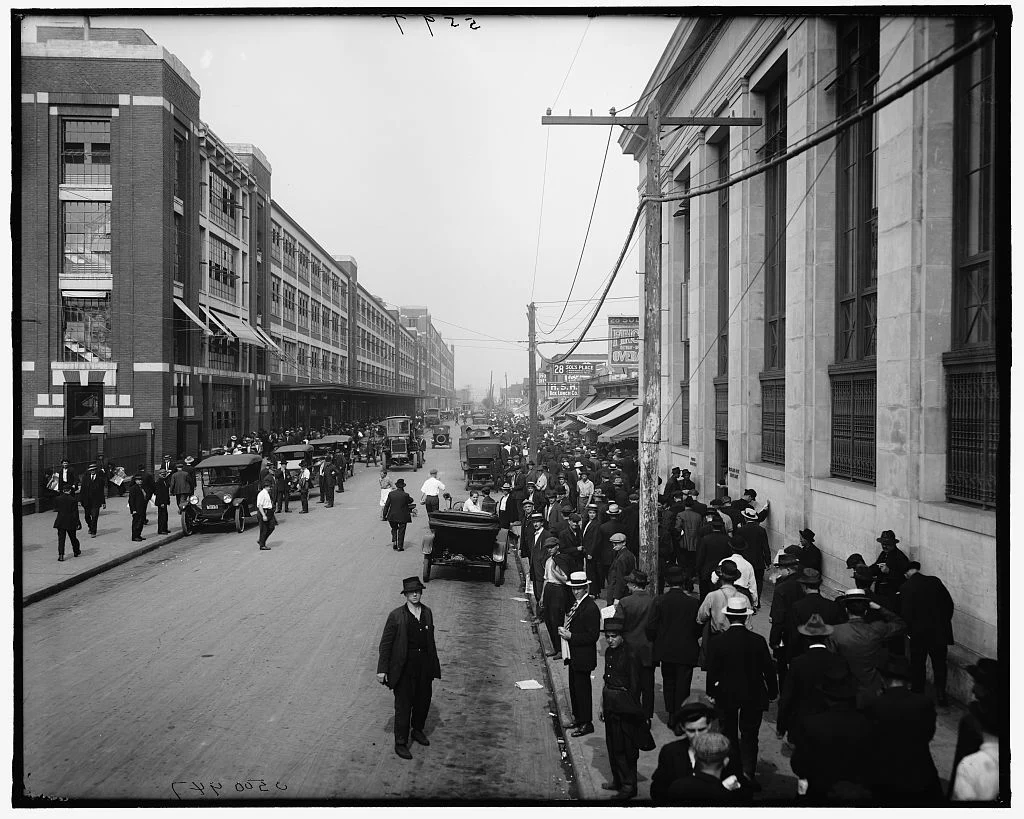
Photo Cover : [Four o’clock shift, Ford Motor Company, Detroit, Mich.]