

No products in the cart.
We Dance to Their Tracks, But Who Knows Their Names?
In a club, the spotlight almost always goes to the DJ. On social media, it is the same thing. Everything revolves around them. And some people are starting to get tired of it.
And no, we are not talking about boomers or bitter people in the scene, but about the very people without whom DJs would be… nothing.
Today, the focus is on producers.
We often forget that without producers, there are no tracks, and without tracks, there are no DJs. And it feels important to point out that the opposite is not true.
A bedroom, a home studio, hours spent alone in front of a screen, tiny decisions, failed attempts, sounds reworked until exhaustion.
And sometimes, at the end of it all, a track that works, that makes a crowd react, that feeds a set, a viral video, a career — without the person who made it getting much back from it.
That is what the 29 responses to our survey on the realities of producers in today’s electronic music scene reveal. The sample is not meant to represent the entire industry. It speaks of fatigue, frustration, and a sense of disconnect between the value created by music production and the concrete recognition that actually comes back to producers.
Producing a Lot, Earning Little
The first fracture is economic. Among respondents, producing is a regular activity, sometimes a central one, but rarely enough to make a living. Out of the 26 people who answered this question, 17 say they produce regularly without it being their main source of income. Only 7 say production represents a significant or main part of their income. The figure gives a fairly clear picture of the paradox: production feeds the scene, but far less often does it feed the people producing.
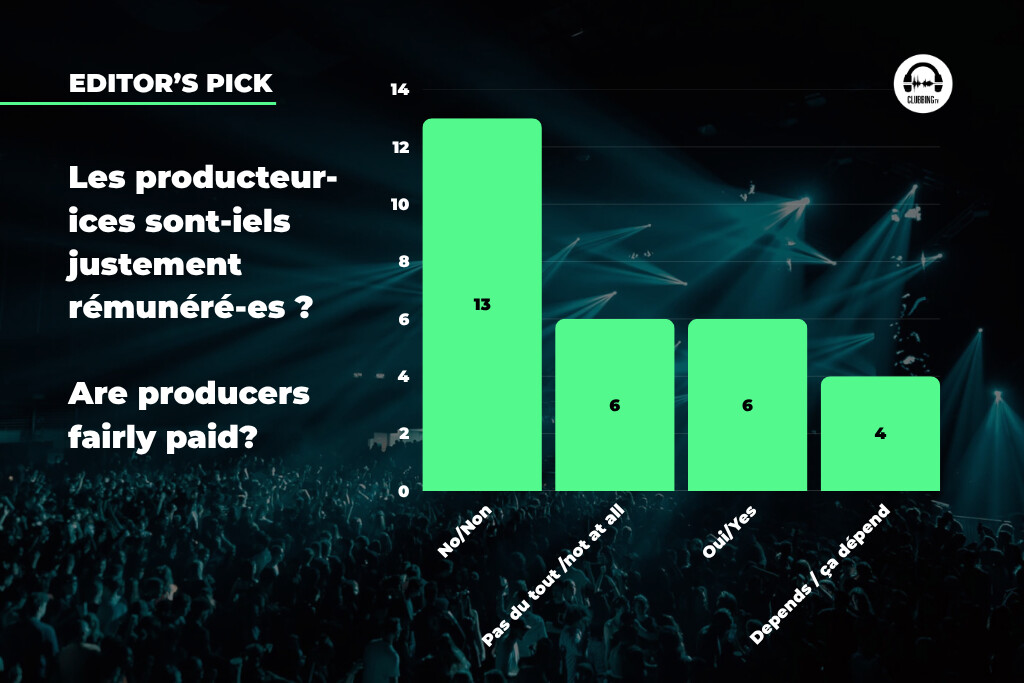
This imbalance also appears in how remuneration is perceived. Nearly two thirds of respondents, 66%, believe producers are not, or not at all, fairly paid. In the open-ended answers, the same realities keep coming back: time spent in the studio, equipment, software, mixing, mastering, promotion, distribution, low or uncertain income. Producing requires investment before even knowing whether the track will be listened to, played, bought, or properly identified. One respondent sums up this weariness in one blunt sentence:
“Everything I create is at a loss.”
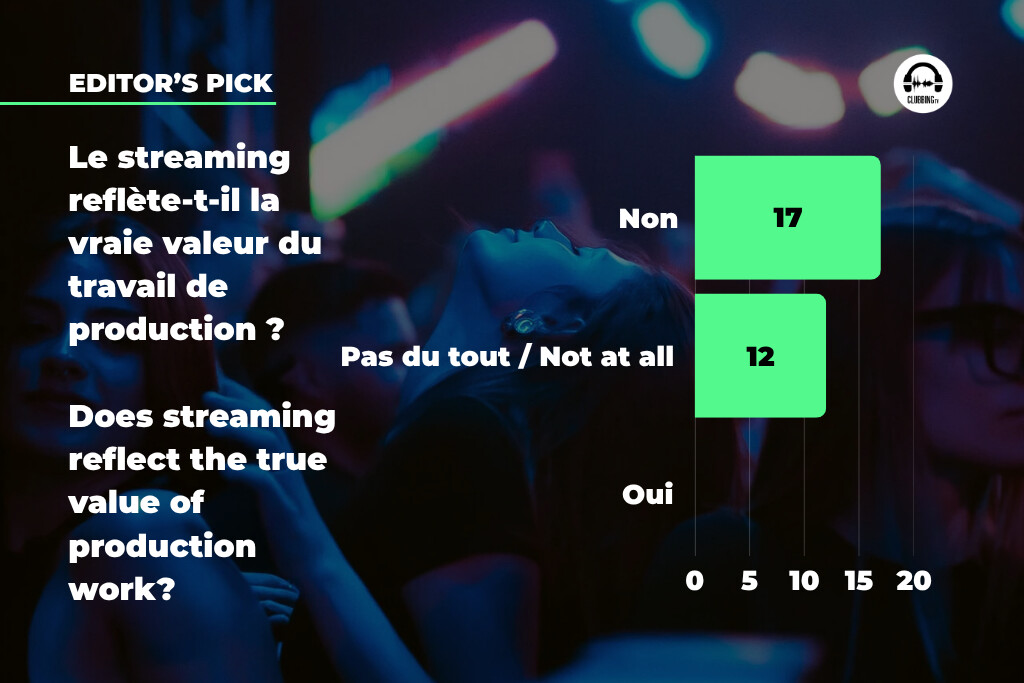
Streaming concentrates a large part of the problem. When asked whether the current model reflects the true value of production work, not a single respondent answers positively. 17 people answer “no”, and 12 “not at all”. Streaming appears as an almost mandatory showroom, useful for existing on the radar of the public and the media, but unable to properly pay for the work. Denis Carter Underwood puts it this way: “Streaming works more as a promotional tool than as a real source of revenue.” Emilio Menardi, for his part, says he has “a few hundred thousand streams on Spotify” without it bringing him “much money.”
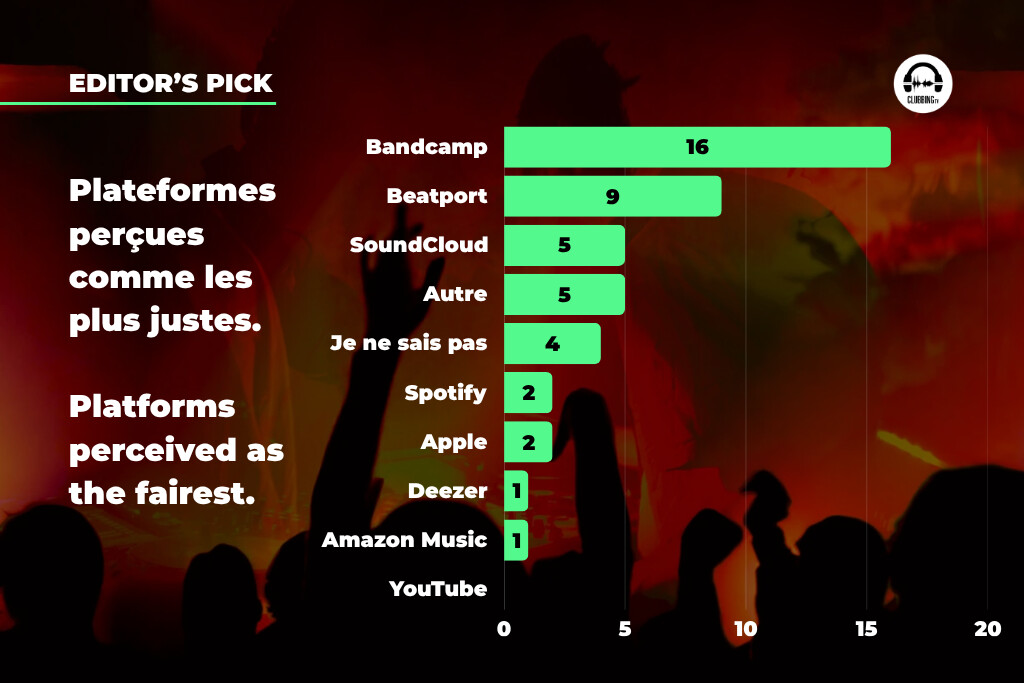
In this landscape, Bandcamp comes up as a relative exception. 16 respondents out of 29 cite it among the platforms they perceive as the fairest or most rewarding, ahead of Beatport, SoundCloud or Spotify. The platform seems to embody a more direct relationship with the listener, where buying a track still carries both symbolic and material value. It does not fix everything, but it gives the feeling that a simple gesture still exists: paying for music and allowing the person who created it to receive a clearer share of that money.
When Tracks Travel Without Their Makers
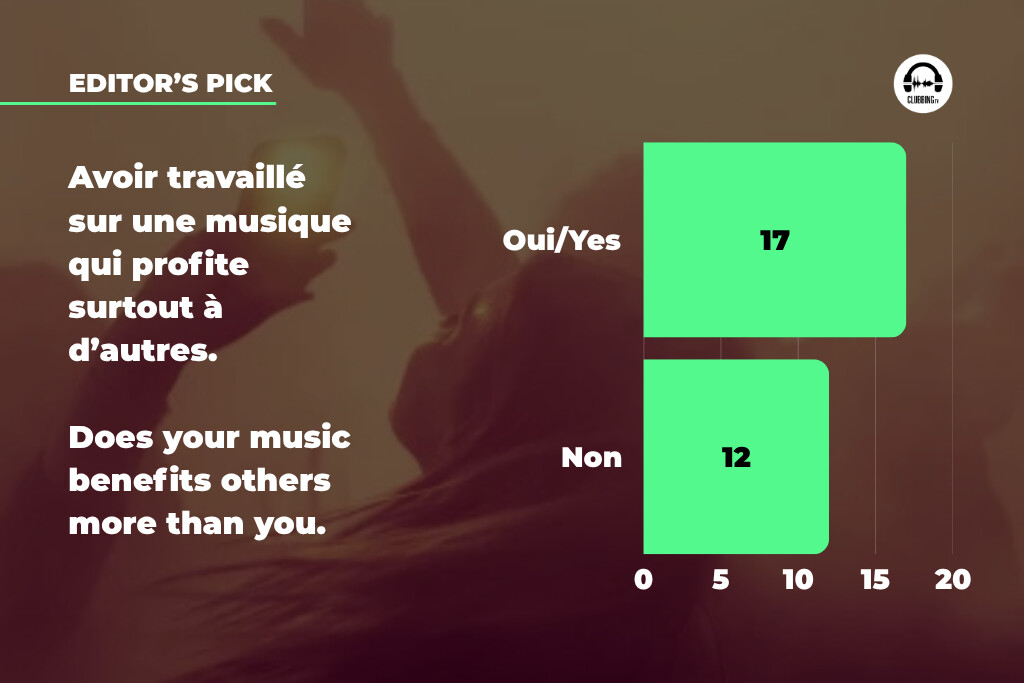
The other major wound is credit. In electronic music, a track can travel far. It can be played in a club, replayed at a festival, appear in a story, open a podcast, become the buzzing moment of a filmed set. But its name does not always travel with the same ease. 17 respondents out of 29 say they have already worked on music that generated visibility, opportunities or income mainly for others. This figure touches on something deeply problematic in the scene, something we have already talked about: the difference between circulating a track and naming the person who created it.
Nicolas points to the problem very simply:
“The audience does not always realise they are listening to music made by third-party producers when they listen to a DJ.”
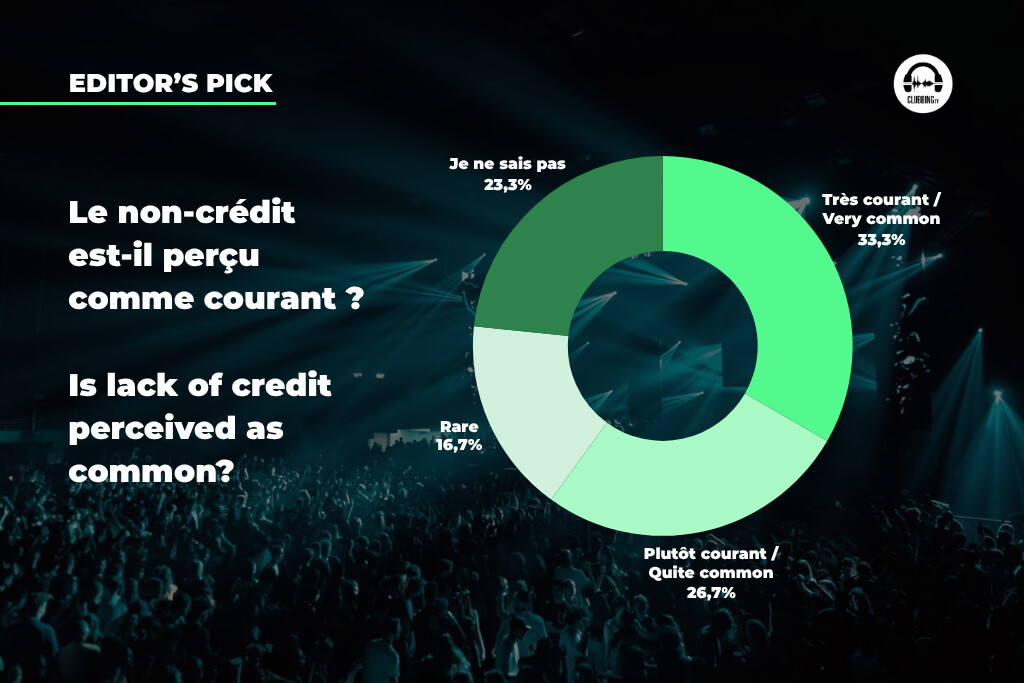
In some podcasts published without a tracklist, he adds, “the only name that appears is the DJ’s.” This observation comes back in several forms throughout the survey. When a track is played without being credited, the artist loses more than a mention: they lose a chance to be discovered, and therefore booked. Credit should be mandatory.
In practice, the experiences described often follow the same scenario. A track produced in someone’s bedroom ends up living elsewhere — in a set, a podcast, a reel or a club video — but the name of the person who made it disappears precisely when visibility arrives. One respondent describes the scene very clearly:
“A DJ plays your track in a club, the crowd reacts, the applause comes, they boost their reputation […] and meanwhile you are watching it from home without your name being mentioned even once.”
Others mention podcasts published “with no playlist”, where “the only name that appears is the DJ’s”, which leads the audience to believe that the person behind the decks is also the one who created the music. Several testimonies also mention tracks played or downloaded by very well-known artists “who never mentioned my work”, videos where “many comments are asking for the name of the track” without the producer being credited, or online DJ sets “without a tracklisting.” For some, this erasure can go further: tracks being reused, unofficial remixes presented as originals, or proposals to re-release an already released track as a collaboration, as if the visibility of a better-known name could reconfigure ownership of the track.
The question does not simply oppose DJs and producers. Many of the people who responded are both. They know what it means to dig and build a set. But they also know what studio work represents. Their frustration is aimed more at a culture of visibility, where the person playing the track is much more easily identified than the person who composed it. One anonymous response puts it this way:
“It means appropriating and capitalising on other people’s work… without producers, there are no DJs.”
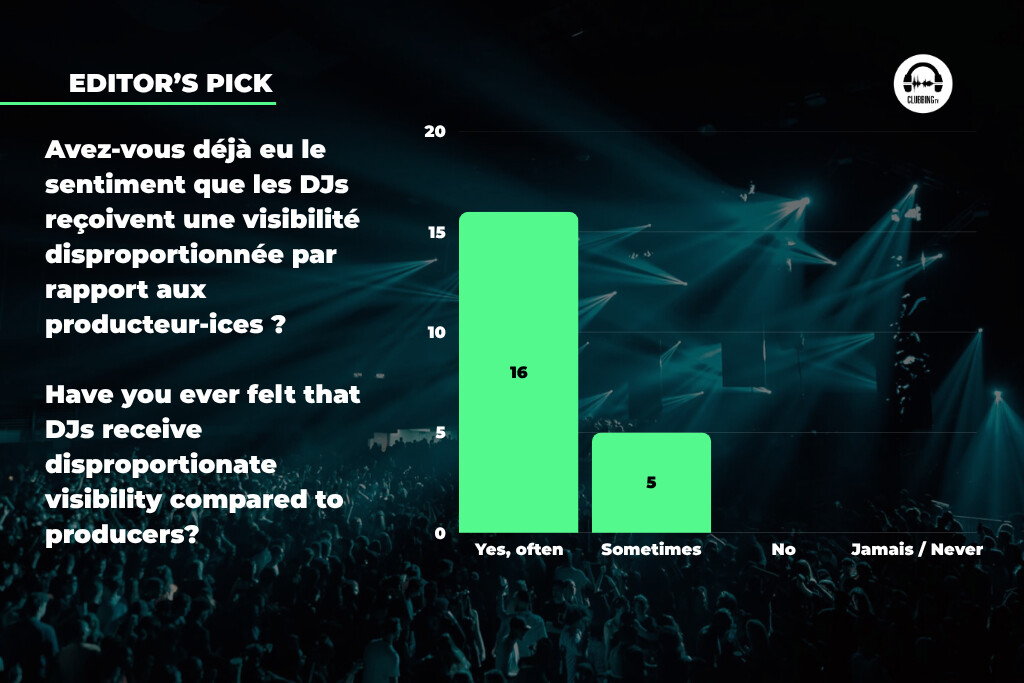
This invisibility is widely felt. 90% of respondents think producers are treated as invisible labour, either often or sometimes. The word labour is harsh, but it captures the feeling running through the survey. Being essential to making the sound, while remaining secondary in the way the scene tells its own story.
A Scene Obsessed With Image
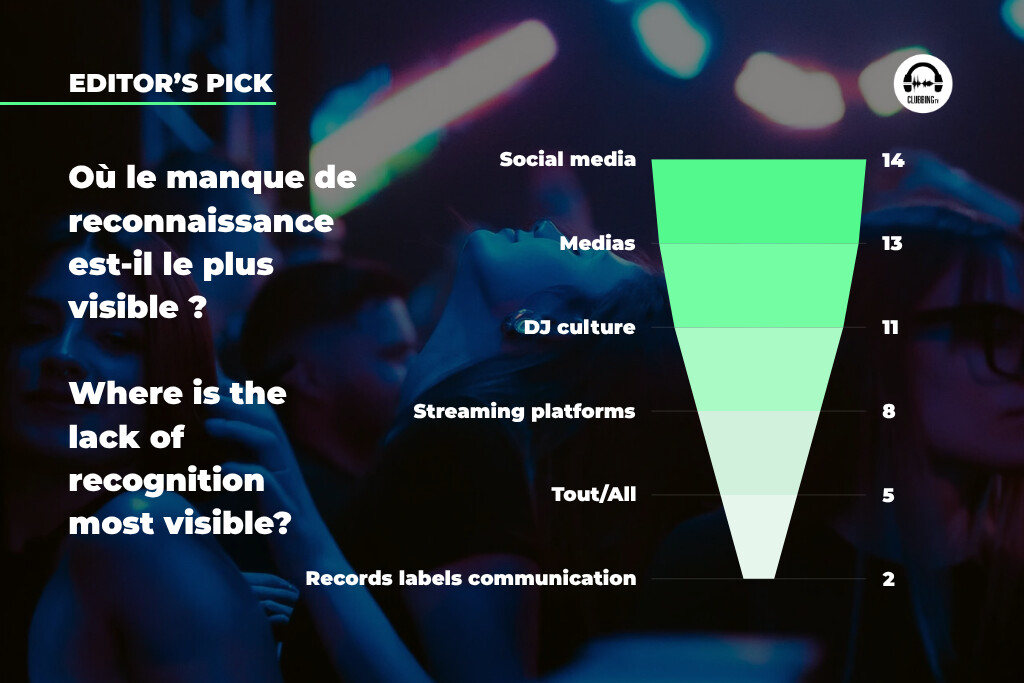
The lack of recognition also plays out in the way the electronic scene presents itself. Social media is the most cited space when respondents identify where the erasure of producers is most visible. Media comes just behind, followed by DJ culture. These answers tell the story of an era in which music increasingly has to produce images in order to exist.
The studio, however, does not fit easily into that logic. Production work is slow, repetitive, sometimes solitary. It does not always give people, or followers, a spectacular video. It is made of details, doubts, sounds shifted by a millimetre, headphone listening, version 12s that will never come out. It is discreet work, and that makes it difficult to value within the scene.
Emilio sums up this tension bitterly: “The number of followers on social media has become more important than the quality of the music.” Many producers feel that making good tracks is no longer enough. You also have to know how to make yourself visible, understand platform codes, and constantly feed a story around yourself. You have to sell yourself. Music sometimes becomes part of a larger package, where image, social media and the ability to capture attention weigh more than the sound itself.
This relationship to image also changes the way careers are built. A track can be powerful and still remain barely visible if the person who produced it does not have the right channels. Conversely, a filmed set, a viral clip or a very strong social media presence can create recognition faster than years of production. To be clear, the survey does not condemn visibility itself. Rather, it reveals the problem of a scene where the least spectacular but most important musical work often remains the least rewarded.
Labels, Contracts, Platforms: An Opaque Value Chain
Labels occupy an ambivalent place in the responses. Some producers see them as necessary support systems, able to bring artistic direction, a community, distribution and credibility. Others see them as a grey area, marked by unclear contracts, income that is hard to track and promotion that is sometimes insufficient. When asked whether labels do enough to protect and highlight producers, only 2 people out of 28 answer clearly “yes”. Half answer that it depends on the label.
This nuance matters. Respondents do not describe all labels in the same way. Some mention serious, attentive structures that support artists with respect. But the survey also shows how dependency on visibility can weaken producers. When releasing on a label becomes a gateway to an audience, a network or bookings, it becomes harder to refuse an unbalanced deal.
Aloys describes this mechanism very well:
“At the time, you tell yourself it is important to accept unequal deals in order to benefit from visibility or an audience outside your own. But when you add it all up, you do not really move forward in the end.”
The sentence captures a logic of erosion that often comes back in the responses. Each compromise can seem acceptable in isolation. Over time, the accumulation creates a feeling of stagnation: a lot of music released, a lot of energy given, little concrete return.
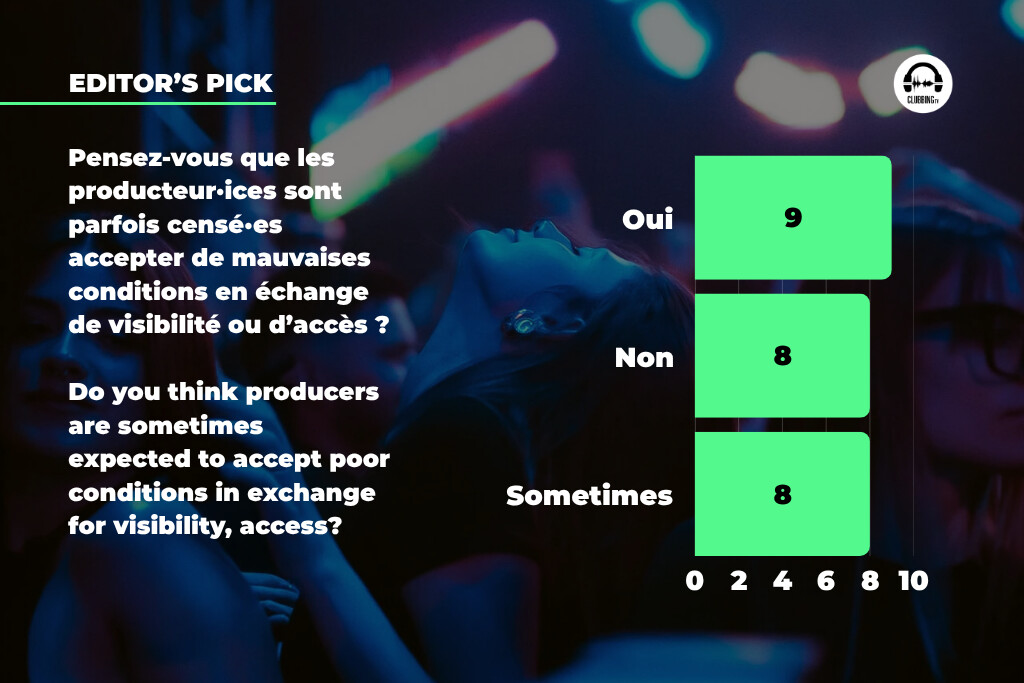
Platforms also contribute to this opacity. Between streaming, digital distribution, copyright, sales, royalties and contracts, the value chain becomes difficult for many artists to read. When the money arrives, it arrives late, sometimes in small amounts, sometimes without a clear enough explanation. When it does not arrive, you often need to know where to look, who to follow up with, which rights to claim. For producers already caught between creation, promotion, day jobs and personal life, this administrative burden adds another layer of fatigue.
Rights Are Collected, But Where Do They Really Go?
On the question of rights, the answers bring out the same criticism: producers are not only asking institutions to collect more, but to better explain what they collect, how they distribute it, and why part of electronic music still seems to slip through the cracks of the system. “I would like to know exactly how rights are calculated and distributed,” says Denis Carter Underwood, pointing to statements that are often opaque and delayed. This demand for clarity also appears in more direct answers: “Having more details about the income they pay us each year would help, it is pretty obscure…” or “Much, much, much more transparency. There is no clearly defined scale.” What comes through is the same frustration: artists feel their music is circulating without being able to precisely follow the value it generates.
The problem seems particularly sensitive in clubs and festivals, where the real identification of tracks played remains a central issue. “The system for detecting tracks played in clubs and festivals should be improved,” writes one respondent. Nicolas says that when he joined SACEM, he was told about the installation of devices capable of automatically identifying tracks played and better distributing the collected funds. His assessment today is much more bitter: “At the moment, collection works well, but redistribution leaves much to be desired.” Aloys goes even further, directly questioning the logic of the system: “Is it normal that today, in clubs, SACEM payments are sent to the top 100 or 200 most played tracks of the month rather than to the tracks that were actually played?” We are in a scene where DJs often play independent, rare, self-produced tracks, or music released on small labels. Redistribution based on general charts can make invisible precisely the artists that clubs bring to life every weekend.
Ultimately, the messages addressed to SACEM, BUMA and other collective management organisations revolve around one demand: to catch up with the reality of electronic music today. According to the people surveyed, this means simplifying procedures, better detecting the tracks being played, making calculations readable, speeding up payments and treating independent producers as fully legitimate rights holders. Some say it with anger, others with fatigue, but if institutions collect in the name of music, they also need to be able to find the people who actually make it.
The Invisible Exhaustion of Producers
The most intimate part of the survey concerns exhaustion. 83% of respondents say they have already felt emotional or creative fatigue linked to a lack of recognition. 16 people out of 29 say it happens often. Lack of recognition also affects the way artists doubt themselves.
Denis Carter Underwood describes the solitude of the job:
“It is a deeply solitary job. You spend hours alone in a studio making decisions no one will ever see.”
This sentence brings production back to its reality. Before being a file sent to a label, a track is a series of invisible choices. When those choices are neither recognised, named nor paid at their fair value, motivation can wear down.
One anonymous response adds an essential dimension:
“Being a woman and having to make 200 times more effort to be taken seriously.”
In a scene where technical legitimacy is still too often associated with men, lack of recognition does not affect everyone in the same way. For some people, it adds to other forms of exclusion, imposed doubt and credibility that constantly has to be proven.
The Toxic Rules of Production
The unhealthy norms cited by producers often resemble the same injunction: accept less than what your work is really worth, in the name of visibility that guarantees nothing. Several respondents talk about working for free or for exposure, a logic described by some as so normalised that “artists contact producers offering visibility as a currency.” For them, the absurdity is obvious: “In no other technical profession would people accept that.” This pressure also appears in live performances that are “very poorly paid for supposed visibility,” releases “on labels without contracts,” or “unfair contracts” that you are expected to accept in order not to disappear from the landscape.
Others point to an economy where producers sometimes have to pay to be heard:
“Having to pay to be highlighted or included in Spotify playlists, only to receive nothing in the end,” writes Manah.mp3,
who also denounces the “unhealthy business of music influencers” around playlists. Labels and intermediaries come up often in the responses, with criticism around splits, mastering paid by artists, or “a total abandonment of broadcasting rights in favour of labels.” Aloys sums up this imbalance: some labels “take 75%” while asking artists to finance their own mastering, while the difficulty of getting gigs pushes people to accept unfavourable deals “hoping to sign three more bookings.”
Behind these economic practices, the responses also reveal more violent power dynamics: having to “stay silent at the risk of ruining your career,” dealing with “constant male ego,” sexism, blackmail or the fear of being replaced. Scorch’s phrase perhaps best captures this feeling of being trapped: producers are too often expected to “accept total precarity because there are so many guns pointed at their heads.”
So What Do We Want?
Moneyyyyyy!
In the responses, a healthier ecosystem first looks like a scene where recognition no longer depends only on image, network or the ability to become visible on platforms. Several respondents call for music to be put back at the centre, with “DJs highlighting tracklists,” signed contracts for label releases and a minimum obligation to credit — “at least tag the artist bro.”
For Denis Carter Underwood — a very good contributor, thank you <3 — this would mean “a system where producer credit is mandatory and non-negotiable across all platforms, all formats, all sets,” but also remuneration that allows an independent producer to live without needing “10 million streams a year to pay rent.” Others imagine more concrete solutions around rights: “if SACEM did its job properly and actually redistributed to producers, things would be better,” writes Nicolas, while Axel suggests “an AI that recognises every play of the music on social media or in clubs and pays the artist.” The desire for another model also comes with a critique of the race for numbers: Manah.mp3 calls for a return to “something less visual and quantitative, but more qualitative,” and Océane argues for “more open-mindedness, more authenticity, less of a race to look like everyone else.” Behind these proposals, what is being asked for is a sustainable ecosystem that would not only pay better, but also be clearer, fairer, more curious, less obsessed with social performance and more attentive to the real work behind the tracks.
Producers want to be named when their tracks are played. They want tracklists, tags, understandable contracts, more transparent distributions, more protective labels, more attentive media, and platforms less disconnected from the real value of musical work. The demand seems simple, but it touches the entire balance of the scene.
Electronic music was built on circulation: tracks passing from hand to hand, club to club, set to set. That circulation is part of its beauty. It allows sounds produced in a bedroom to resonate in front of hundreds of people. But it should not erase the people who created them.