

No products in the cart.
French Article
From Cerrone’s monstrous creatures to Daft Punk’s robots and those wonderfully bizarre music videos with colours that practically give you a headache, disco and electronic music have always had a taste for the strange. Kitsch, science fiction, psychedelia, absurd choreography and otherworldly samples: this offbeat aesthetic tells a story of artistic freedom. A look back at a visual legacy as extravagant as it is fascinating, where weirdness has found its place and never really left.
If there’s one thing, just one thing, that still connects electronic music in all its forms, it’s certainly its history, but above all, its very particular taste for weirdness. Let’s take a moment to revisit a performance that perfectly captures this slightly surrealist spirit.
In 1978, on the set of the British television programme The Kenny Everett Video Show, the dancers of the Hot Gossip troupe performed to Supernature, Cerrone’s track released a year earlier. Outrageous costumes, theatrical choreography and movements that were certainly open to interpretation. All of this unfolded in a rather dystopian atmosphere, echoing the song’s universe, inspired by H. G. Wells’ The Island of Doctor Moreau, where nature turns against humanity and its experiments. In short, it’s weird, wildly extravagant, almost disturbing, and a far cry from the glamorous disco we might expect. Yet this performance reveals another side of the genre: its fascination with artifice, eccentricity and the fantastic, even venturing into full-blown science fiction. Another recipe for disco, in a way, whose ingredients would resurface decades later in electronic music videos and other visual representations of the genre.
Disco Loves a Little Madness
This taste for extravagance can be traced back to disco’s very origins. Mirror balls, bell-bottom trousers and the glamorous image popularised by Saturday Night Fever may have become its defining symbols, but a wilder side of disco was taking shape in the underground clubs of 1970s New York. Black, Latino and queer communities gathered in these spaces to dance, connect and, above all, express themselves freely, away from discrimination and social conventions. At David Mancuso’s Loft, and later in clubs such as Paradise Garage, bodies could move freely and identities could be expressed. Disco wasn’t just about music. It was a culture of experimentation, with a carefully measured touch of too much. These spaces of expression helped extravagant, provocative and deliberately artificial aesthetics flourish.
Ballroom culture and voguing, fertile grounds for expression at the crossroads of fashion, music and dance, also played a major role in shaping this universe, until their influence eventually spread into music videos. Throughout the 1970s and 1980s, ballroom houses became central to Harlem and New York’s ballroom scene. As Dorian Corey, mother of the House of Corey, explained in Paris Is Burning: “In ballroom, you can be whoever you want to be. These are our Oscars, our chance to be a superstar.” And that’s exactly the kind of energy we’re talking about: that combination of glamour and outrageous self-expression that helped shape the wider visual culture surrounding disco!
Quirky Disco
A few years later, we find this same offbeat freedom, only pushed even further and deeply rooted in club culture, with Deee-Lite. In 1990, the New York group released Groove Is in the Heart, a track as unlikely as its music video, blending funk, house, disco and hip-hop into one enormous psychedelic collage. Loud colours, outrageous costumes, eccentric characters: everything is excessive and arguably in terrible taste, but we love it!
In a 2020 interview with DJ Mag, Lady Miss Kier explained that the people appearing in the video were friends they had met in New York clubs. She also designed the group’s costumes herself, embracing creative freedom to the point of refusing to conform to the music industry’s expectations. Because when kitsch is intentional, it can also become a way of asserting your individuality. It’s a genuine artistic statement, and one that really works.
It’s somewhere within this universe that we can place what we might call quirky disco: an offbeat aesthetic that borrows the glamour of the seventies while twisting it through kitsch and absurd humour. It’s not an officially recognised artistic movement, just another way of looking at disco: a little less polished, a whole lot stranger. And what’s fascinating about Groove Is in the Heart is that the video is ultimately a direct translation of the energy found in New York’s clubs. That touch of too much is, above all, an incredibly authentic window onto the dancefloor.
Michel Granger
Even the Future Has a Weird Side
Around the same time, another fascination was gaining momentum within electronic music: the future, machines and science fiction. And once again, artists were more than happy to let their imaginations run wild and create some seriously bizarre worlds.
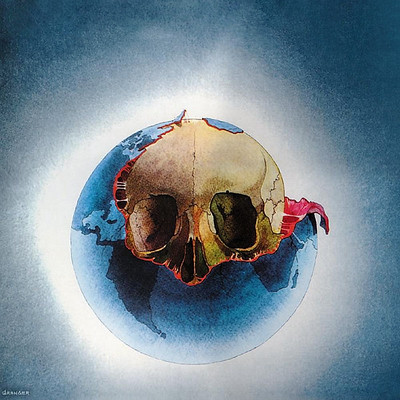
In 1976, Jean-Michel Jarre released Oxygène, an entirely instrumental album whose cover, designed by Michel Granger, depicts the Earth revealing a human skull beneath its surface. An unsettling, almost apocalyptic image accompanying a sometimes experimental soundscape of synthesisers and otherworldly sounds. Meanwhile, in Germany, Kraftwerk were exploring their own fascination with technology, going as far as presenting themselves as human machines on The Man-Machine in 1978. Robots, mechanical gestures and somewhat cryptic messages: electronic music was building an entire futuristic imaginary world, giving tangible form to what the genre represented for many people at the time. Music that still existed somewhat on the fringes, but was steadily gaining ground.
French Touch would later bring these different worlds together and introduce them to a much wider audience. With Daft Punk, disco nostalgia and funk influences met machines, robotic vocals and a retrofuturistic aesthetic that would become iconic. The duo even went as far as transforming their album Discovery into a science-fiction animated film with Interstella 5555, released in 2003. In short, the music was taking on a face of its own, sometimes a completely improbable one, and that was precisely what made it so distinctive.
But while robots and futuristic creatures certainly helped shape electronic music’s visual identity, some directors would take the madness even further. More importantly, they would give it meaning.
In 1997, Michel Gondry directed the music video for Daft Punk’s Around the World. On a circular stage, robots, skeletons, mummies, athletes and disco swimmers (yes, all of them) perform a hypnotic and grotesque choreography. Yet behind this wonderfully chaotic spectacle, everything is carefully calculated. Each group of characters represents a musical element: the robots embody the vocals, the skeletons the guitar, the mummies the drum machine, the athletes the bass and the swimmers the synthesisers. Their movements follow the track’s loops, in a choreography created with Blanca Li. The video gives the music a physical form and becomes one of the strangest and most famous music videos of the decade.
Gondry would continue exploring this idea with The Chemical Brothers‘ Let Forever Be in 1999, where dancers multiply inside a kaleidoscopic universe. Ultimately, what these deliberately extravagant videos reveal is a desire to make images an extension of music itself, even if that means abandoning any sense of realism. And that’s just so cool, because yes, to be weird is to be cool.
So, has weirdness become one of the defining visual signatures of certain strands of electronic music? Even in today’s most contemporary or underground scenes, we can still recognise that same desire to push the boundaries of musical representation.
What might look like bad taste can also express genuine artistic independence. After all, why should everything we create have to be aesthetically flawless? Absurdity definitely has its place in art, and some artists have even made it their signature. If kitsch and weirdness have left such a lasting mark on electronic music, perhaps it’s because the freedom to experiment has always played such an important role in its evolution. And if the result sometimes looks a little ridiculous, so what? That’s part of its charm.
SHANA BIZE