

No products in the cart.
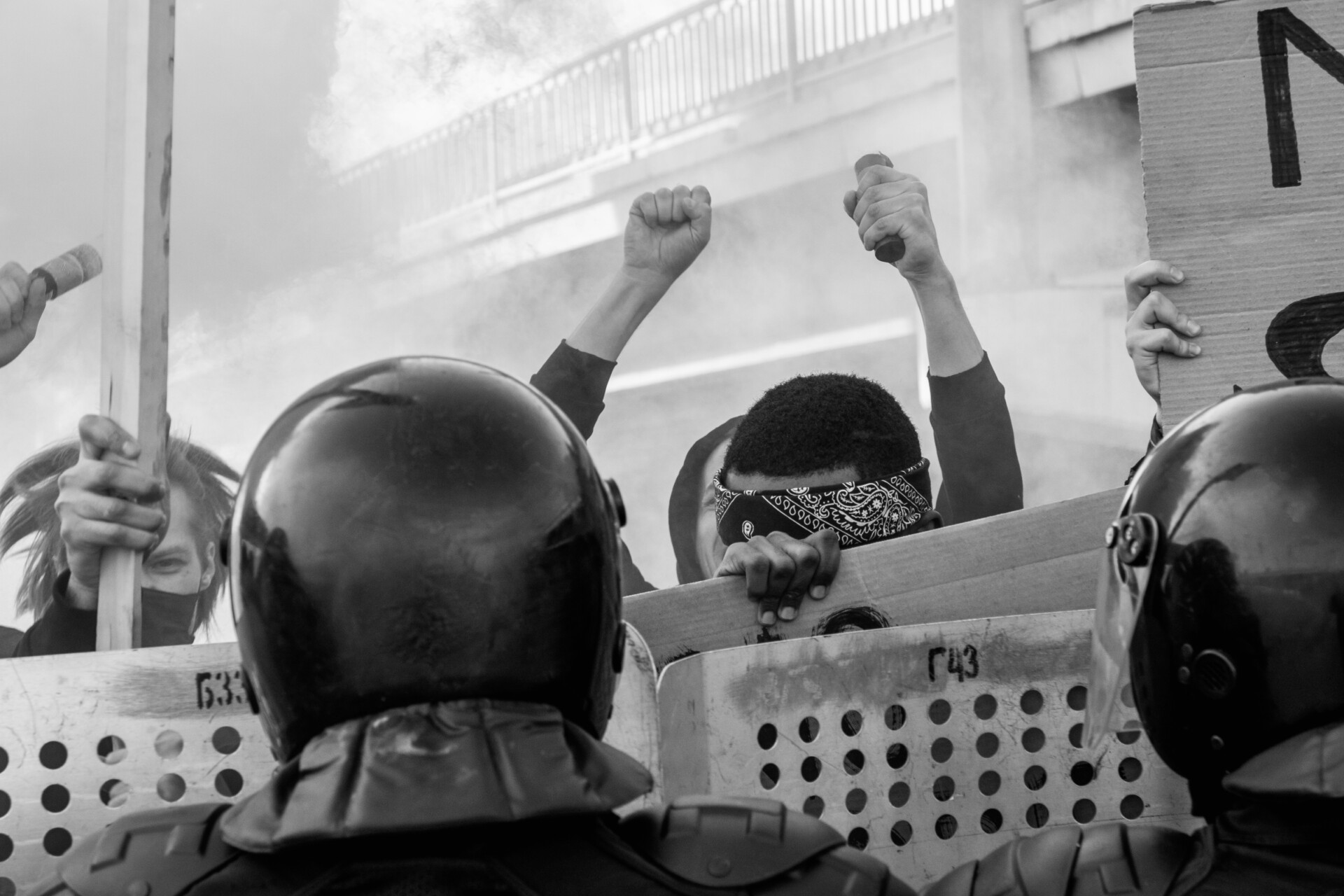
As social anger takes over the streets of France, electronic music must not forget what gave birth to it: freedom and the power of collective action. From its earliest queer dancefloors to free parties, nightlife has always maintained a deep connection with struggles for emancipation. Today, as the slogan “Siamo tutti antifascisti” echoes through the demonstrations, it is time to remember that our spaces are not disconnected from the battles shaping our societies.
The anger is in the streets. So must be the techno.
For several weeks now, France has been experiencing a new wave of protests. High school students, university students, workers, trade unions, collectives and citizens are coming together around demands that go beyond individual concerns. The cost of living, the deterioration of public services, inequalities, violence and the growing fear of the far right gaining ground are fuelling a climate of anxiety. The striking clashes between police officers and protesters have sparked a real debate in public opinion: can a revolution happen without resorting to some form of violence?
History speaks for itself. Few social movements have achieved victory without some degree of radicalism. But we are no longer in 1789. There are many other ways to wage a battle.
Here is my opinion, my personal statement: we need to use the forms of soft power available to the people. Symbols can be created differently and strike just as hard as the storming of the Bastille. We are a generation under attack in an information war. Propaganda, disinformation and outright fake news are circulating about the movement, both in France and abroad. The battle is taking place in the streets, but also online and among generations that do not understand us. It is also a symbolic war.
And in my view, our community has a responsibility to create a strong and impactful message.
A clear message of opposition should have been delivered during the Techno Parade (a missed opportunity, if you ask me). But here we are, at a crossroads, and it is about time this counterculture actually did its job as a counterculture. Let’s express our opposition through dance. Let’s throw a huge, sarcastic rave in front of the Élysée Palace. Let’s create a symbol, one so powerful that it cannot be distorted.
Let’s Give Resistance a Body, in the Streets and in Our Clubs
History has already shown us that music can shake the world. That it can carry demands and bring communities together. The goal? To channel anger creatively. That is the message of a generation that, beyond its courage, can make a powerful impact both here and internationally.
Without claiming to replace political action, music, and techno in particular, has the power to make itself heard. History has proven that too:
Rock Against Racism
In 1978, as the British far right was gaining ground, the Rock Against Racism movement organised a huge anti-racist carnival in London, featuring artists including The Clash and Steel Pulse. Punk and reggae came together in a shared fight against racism and exclusionary rhetoric. Thousands of people marched before gathering around a stage. The concert became a demonstration of solidarity and a way to respond to division through a mass gathering.
Reclaim the Streets
In 1996, in London, the Reclaim the Streets movement transformed a stretch of motorway into a huge protest party. Thousands of people gathered around sound systems, dancing and protesting. This time, the party itself was a political action: a symbolic occupation of public space, questioning who the city belongs to, who has the right to use it… and above all, how!
Act Up Has Already Done It in Clubs
In Paris, as early as the 1990s, Act Up used house music to raise funds for its fight against AIDS, but also to send a powerful message: we exist, we organise, we stand together.
In 2003, the organisation joined forces with PASTT to organise House Balls at the Rex Club. Behind the decks, Dimitri from Paris, Patrick Vidal, Roussia and other DJs took part in events whose proceeds supported the associations.
Of course, partying does not make disease disappear, nor discrimination or political indifference. But it became a tool for mobilisation, one that brings us together rather than divides us. And we desperately need that.
You Can’t Stop a People Who Dance.
These events remind us that we can make a powerful impact, and that music can oppose violence with something other than violence. (Whenever possible.)
You can’t stop a people who dance. How can violence be justified against a crowd that chooses celebration and solidarity to express its anger? And if repression is unleashed upon them regardless, the contradiction will be exposed once and for all: those who claim to defend order will have to explain why they chose chaos.
I realise that what I am describing here is a humanist ideal, and I am fully aware that, in reality, there are times when defending ourselves, or even going on the offensive, may be necessary. But to me, the bright future we all aspire to deserves better than the image being imposed upon our generation today. Let’s not forget that there are several battles to fight, and that the most important one in every social movement is, and always will be, the battle for public opinion.
This is not about pretending that a few tracks or dancing parades have been enough to overthrow regimes or make injustices disappear. It is about understanding that music can give physical form to protest in the streets and bring momentum to its message. That it can make a struggle impossible to ignore through the sheer noise it creates, produce images that resonate across generations, and transform an individual feeling of powerlessness into collective strength.
We can create different images. Different narratives. And that is an incredibly dangerous power.
Stand Together. Stand Our Ground. Be Seen.
“Siamo tutti antifascisti.”
We can chant this slogan in the streets, make it echo through our clubs, and incorporate it into our creations. But let it be backed by action. Let our clubs genuinely defend the communities they claim to welcome. Let our lineups make room for diverse voices. Let our events support initiatives built on solidarity, and let our artists have the freedom to express their political and social commitments in one way or another.
In the Face of Absurdity, We Still Have Dance.
As crises continue to unfold, as the future feels uncertain and public debate sometimes seems condemned to endless confrontation, responding through music, or even simply going out and enjoying ourselves, might seem futile. What’s the point of dancing when so much is going wrong?
Because preserving these spaces and moments is essential. The dancefloor is a sanctuary, one we should be extending everywhere.
We do not have to choose between anger and joy. We can make one the very reason to defend the other.
This is not about completely idealising partying, nor about claiming that every dancefloor is a revolutionary act, because that simply isn’t true. It is about recognising that we can stand up to the brutality of the world. We can create different images and different narratives. And it is also up to our scene to ask itself what it wants to do with that power.
We Will Keep Dancing.