
No products in the cart.
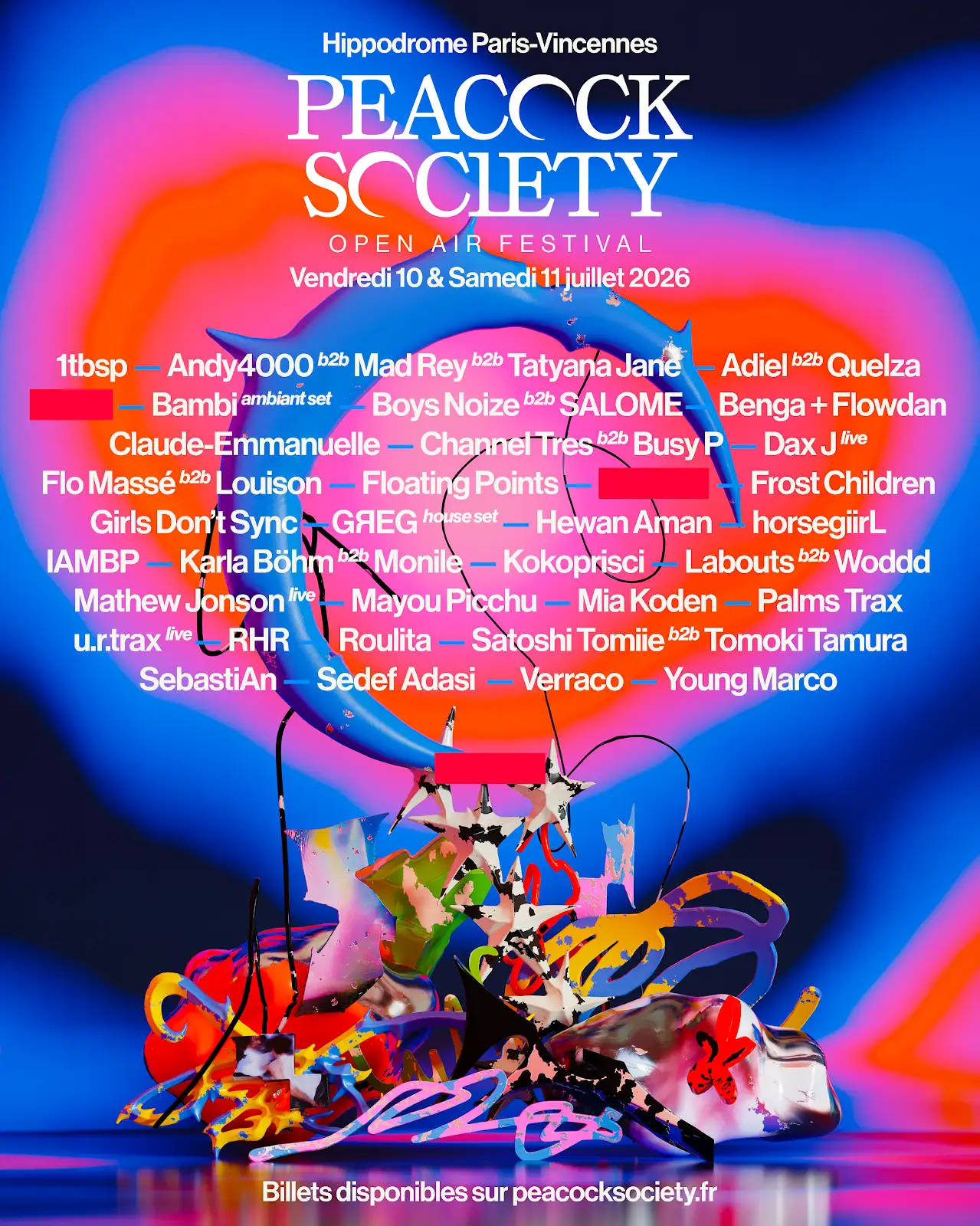
For its 15th edition, Peacock Society returns on July 10 and 11, 2026 to the Hippodrome Paris-Vincennes with an ambition that goes beyond the standard electronic festival formula. More than a sequence of sets, the Paris event seems intent on building a kind of temporary city for the weekend — one where club culture, local infrastructure, headline names, prevention work, scenography, and free circulation between stages all coexist. In other words: less a line-up to consume than a territory to inhabit.
At some point, too many festivals started announcing artists and little else. A stack of names, a few font sizes to tell you who matters most, a vague reference to “the experience,” and the job is supposed to be done. What makes Peacock Society 2026 more interesting than the average festival announcement is that it is at least trying to move the centre of gravity elsewhere. Yes, there are headline acts. Yes, there are exclusives, one-off back-to-backs, and stage curations by institutions of French club culture. But what this 15th edition is really trying to sell is something larger: the idea of a collective space, almost a parallel society, in the middle of Paris.
For a long time, the word “society” in Peacock Society could feel like a neat branding flourish. In 2026, it starts to look more like an actual programme. The festival talks about collective experience, free movement between aesthetics, the coexistence of different audiences, the celebration of local scenes, and a visible attention to harm reduction, consent, hearing care, water, transport, and waste. Put more simply, Peacock seems keen to remind people that an electronic festival is not only a place where DJs perform, but also a place where ways of living together are either rehearsed — or not.
The setting matters here. After first settling into the venue last year, Hippodrome Paris-Vincennes now clearly becomes part of the festival’s identity. And the site says something on its own. Originally built for horse racing, monumental in scale yet still close to central Paris, the racecourse allows Peacock to play with a productive tension: grandeur and intimacy, heritage and futurism, urban access and open-air escape. Across 40,000 square metres, the festival promises an environment where scenography is not just decoration, but a way of shaping how people move, pause, get lost, and stay.
This claimed “return to roots” does not really mean going backwards. It is better understood as a return to Peacock’s original promise: bringing different currents of electronic music into conversation rather than sealing them into genre silos. Both days are structured less around rigid categories than around friction points. On Friday, HorsegiirL sits alongside Adiel b2b Quelza, Dax J live, u.r.trax live, Frost Children, and the Yoyaku takeover. On Saturday, Floating Points, Young Marco, Boys Noize b2b Salome, Sedef Adasï, GЯEG, Palms Trax, and the Rinse France and Busy P curations sketch out a landscape that moves from techno to leftfield house, from rave pressure to French electro lineage, from UK-rooted energy to more hybrid club forms.
But again, the most interesting thing is not just the list itself. It is the way Peacock frames certain stages as cultural statements. There is something very telling in the decision to hand one entire stage to Yoyaku on Friday, then give another to Rinse France and a special curation to Busy P on Saturday. Those three names tell three very different but equally important stories about how electronic music has taken shape in France: the record shop-label that became a point of reference for minimal and house diggers, the radio station that helped define an emerging generation of artists and listeners, and the French Touch figure who turned curation into a form of national export.
In other words, Peacock is not just saying it supports the local scene. It is choosing to put the structures behind that scene on stage. That is a meaningful distinction. Plenty of festivals claim to care about local culture. Here, that care is made visible by giving space to the labels, radios, and figures that actually produce circulation, taste, memory, and continuity. In a festival economy still obsessed with top-line headliners, that kind of gesture stands out.
The festival also seems to understand that surprise no longer comes only from booking bigger names, but from making people collide differently. That is where the back-to-backs become more than poster bait. Adiel b2b Quelza suggests a highly controlled, magnetic kind of techno dialogue. Channel Tres b2b Busy P opens up something looser and stranger between house, rap, rhythm, and French club history. Boys Noize b2b Salome sounds less like a marketing move than a real clash of textures. And Benga + Flowdan may be one of the most historically charged combinations on the line-up — a direct reminder that dubstep and grime are not footnotes to electronic music culture, but part of its core architecture.
Another one of Peacock’s better instincts this year is refusing to treat its politics of care as an afterthought. Questions of gender-based and sexual violence prevention, harm reduction, hearing protection, safe spaces, water access, transport, and drug checking awareness are not hidden in the small print. They are part of the festival’s self-description. And that may be where Peacock is most convincing politically. Not in abstract slogans, but in the quieter insistence that a festival should also be judged by how it protects, informs, receives, and takes care of people.
That is not a side issue. At a time when many festivals like to market the idea of “community” without fully accepting what that implies, Peacock seems to be saying something more serious: if we call this a society, then we also have to talk about the infrastructure of care. About rules, mutual attention, and the conditions that make celebration feel possible rather than extractive. That does not weaken the fantasy. If anything, it makes it more believable.
There is also something very specifically Parisian about this edition, and in a good way. Not Parisian in the sense of arrogance, but in the sense of convergence. Peacock Society is trying to make several histories of nightlife exist side by side: authorial techno, selector-driven house, harder rave, French electro, UK pressure, queer energy, diasporic sounds, labels, radios, record shops, global touring artists, and local networks. That mix is not always tidy, and that is exactly why it feels alive. A living festival is not a perfectly coherent object. It is a space where different worlds agree, briefly, to dance next to one another.
In the end, that may be what Peacock Society is really after in 2026: not simply filling a venue, but staging a reduced model of what an adult electronic culture might look like. A culture that still believes in euphoria, but not only in euphoria. One that knows its history, gives space to its local intermediaries, remains capable of surprise, and understands that a dancefloor is never just a dancefloor. It is also a way of imagining society.
For two days in Vincennes, Peacock is not just promising a party. It is promising a live test: to see whether, in an era crowded with interchangeable formats, a festival can still feel like a vision.