
No products in the cart.
We thought we would get flying cars and microwaves that cook full meals. Instead, we got AI tools making “music”. And on top of that, they are tools that threaten the work of artists who, let’s remember, are often already precarious. Then they package AI music as a magic box.
Article en français.
You type a few words, choose a vibe, and a song appears. Something that sounds strangely familiar, without always knowing why.
Well, that is the uncanny valley, music version.
Spoiler: magic needs ingredients.
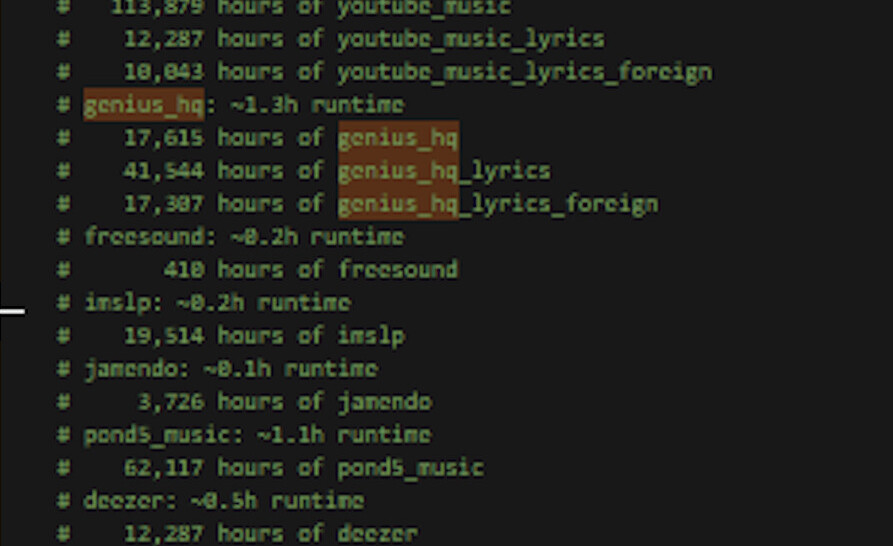
According to 404 Media, an independent media outlet without AI slop that you can support, by the way, files from a Suno hack reveal that the music generation tool allegedly scraped millions of songs, lyrics and audio files from YouTube Music, Deezer, Genius, Pond5, Jamendo, Freesound, IMSLP, Musescore, as well as podcasts via RSS.
Suno confirmed to Resident Advisor that a security breach took place in November 2025, while saying that the incident mainly involved outdated source code and that no sensitive personal information had been compromised.
What the leak makes visible
Until now, the debate mostly stayed abstract on the surface. We already knew that Suno was accused of training its models on copyrighted music. The company had even acknowledged in legal filings that its training data included music files accessible online, while defending the practice under fair use.
But this leak gives a much clearer sense of the scale.
404 Media says some files mention more than 113,000 hours of YouTube Music, 17,000 hours of Genius, 12,000 hours of Deezer and 62,000 hours of Pond5 Music. Other elements suggest that Suno was also looking for acapella versions on YouTube to train vocal generation.
Beyond the numbers, which are already pretty insane, we are talking about years of songs, voices, productions, lyrics, arrangements, mixes and artistic decisions turned into AI flesh.
The open internet is NOT permission
Because a track is available to listen to online, it somehow becomes available to be scraped and used to train a commercial tool.
But listening to a song on YouTube is not the same thing as building a machine capable of producing music from millions of existing works.
The work was not abandoned.
Behind the data, there are people. Artists who paid for studio time. Producers who spent nights working on one sound. Real singers. Writers. Engineers. Labels. Entire scenes that built musical identities before watching them become AI training material.
Our AIs are still very far from the sensitivity of Markus in Detroit, and more importantly, they are learning from worlds already made by other people.
Creating, or industrialising what already exists?
We have spoken before with artists who use AI as a tool, as an assistant. We’ll let you hear Delaurentis and Joachim Pastor share their own vision of AI.
Artists are already experimenting with these technologies, just as they once did with samplers, drum machines or Auto-Tune.
But then the questions remain.
Who gave consent? Who gets paid? Who can refuse? Who is credited? And who is building a company, and making money, from the accumulated work of people who were never invited to the table?
Suno says it wants to help users create new songs, not copy existing artists. Fine. But even if the final output does not reproduce a specific known track, the model was still built from a huge corpus of human music.
And that is not neutral.
It learns ways of singing, producing, writing, mixing and creating emotion. Then it sells the possibility of generating, in a few seconds, something that looks and sounds like human work, without going through the humans who made that language possible.
Independent artists are the most vulnerable
You could think this case mostly concerns the majors, because they are the ones making the headlines. Suno is being sued by Universal Music Group and Sony Music, while Warner has left the lawsuit after reaching a deal with the company.
But independent artists are often the least protected in this kind of story.
Majors can sign licences and negotiate very well. Small labels, niche producers, library music composers, vocalists, local scenes and artists without legal teams do not always have the means to know whether their work has been used. Even less to defend themselves.
And we always come back to the same point: the most precarious artists are the ones being taken from and left unprotected.
AI music can quietly absorb the catalogues of smaller artists, then sell the tool back as a creative revolution. And honestly, the fact that the app was praised by Diplo should have been a massive red flag already.
The fact that DJs and producers are starting to call out people who use AI in unethical ways is a step forward. We invite you to listen to and follow H4RRIS.
Another extraction sold as progress
The scene already knows this story.
Platforms promised access, then artists discovered micro-revenues. Social media promised visibility, then artists became videographers, community managers and personal brands. AI is now promising infinite creation. But infinite for whom? And built on whose work?
The future of music cannot be based on the idea that everything online automatically becomes exploitable. If these tools truly want to be part of music creation, they need to accept some very simple rules. We can list them, even if we are not data experts:
ask for permission, pay people properly, document the data used, allow artists to refuse, credit clearly.
Suno sells a machine capable of generating songs in a few seconds. The leak mostly reminds us that those few seconds are built on decades of music made by humans. So let’s tune our instruments and get ready to fight and regulate the T-800s of sound.