

No products in the cart.
Line pour l’article en français : https://clubbingtv.com/fr/le-retour-du-vinyle-cest-pas-pour-tout-le-monde/
It’s April 24th, pre-opening at Amnesia Ibiza.
Back to the 90s. For a few hours, time feels suspended and I no longer feel like I belong to the same era. I stop for a moment to watch Sven Väth behind the decks. Record after record, he handles vinyl with impressive precision. A calm, methodical mastery, slightly mysterious to me as someone who isn’t so familiar with the “collector” object. At that moment, I’m fascinated as much by the vinyl as an object itself as by the music.
For my generation, Gen Z, vinyl DJing feels more like an old school aesthetic than something actually practiced by most DJs I know. We see it more often in pixelated archive clips reposted on TikTok than in actual clubs. And yet vinyl seems to be everywhere again: in marketing campaigns, festivals, vinyl only events, vinyl exclusive releases. Records have become the symbol of a musical era we regret not having lived through, at least for the younger generation among us.
Vinyl also evokes authenticity, technique, rarity. Playing vinyl is often perceived as proof of artistic credibility, almost like proof of belonging to a certain vision of club culture. In short, it’s part of club culture itself.
A Brief Historical Reminder
In the 70s and 80s, pioneers of hip-hop and house used vinyl not only to mix but also to scratch and loop. At the time, the object itself was part of the performance. Its physicality contributed directly to the sound of a set. Vinyl was also a real cultural identity marker: every DJ had their own collection, carefully built around rarity, limited pressings and unique editions. You had to spend hours every week in record shops, digging through crates, searching for the hidden gem, the unreleased test pressing, or one of the 300 copies of a record that nobody else would have. Your selection was part of your identity and your value behind the decks.
Vinyl ruled the DJ industry.
In the 90s, CDs marked the first major shift. New players allowed DJs to transport more music more easily while still preserving some similarities with traditional turntables through pitch control.
Still, many remained loyal to vinyl, especially in hip-hop where scratching remained impossible on CD. Others defended the warmth of analog sound or simply refused to abandon what they considered the essence of DJing itself.
But it was really in the early 2000s that DJing entered a completely new era. With the first Pioneer DJ CDJs and later software like Serato or Traktor, digital technology completely transformed the practice. Downloading music became easier, cheaper and infinitely faster than building a record collection you had to hunt down in shops and physically carry everywhere for gigs. USB sticks progressively replaced vinyl crates and controllers made DJing accessible from a simple bedroom setup.
DJing became massively democratized.
But this democratization also changed the relationship people had with vinyl. Little by little, 12” records stopped being the standard tool of practice and became cultural objects instead. Vinyl kept a special aura among electronic music enthusiasts, collectors and DJs attached to a “pure” vision of mixing. And today we are witnessing a true vinyl baby boom. Or rather, the return of its image and everything it symbolizes.
In an era where digital DJing becomes increasingly accessible, instant and automated, vinyl starts symbolizing something rare again: time, technique, patience and total commitment to music. But then why did this practice feel so foreign to me even though it was the foundation of DJing only three decades ago and now seems to be coming back absolutely everywhere?
Vinyl only sets, digging videos and turntables are reappearing in festivals, marketing campaigns and social media feeds. But behind this cultural and symbolic revival lies a paradox: the more prestigious vinyl becomes again, the harder it becomes for younger generations of DJs to actually practice it and the more the art of vinyl DJing itself slowly disappears.
An Art Form Becoming Economically Inaccessible While Aesthetically Celebrated
Vinyl is making a massive comeback among consumers and collectors with exploding sales numbers:
- 2018: 16 million vinyl records sold in the United States
- 2021: 27.9 million units sold
- 2024: 43.8 million vinyl records sold
- 2025-2026: projections continue rising beyond 50 million annual units
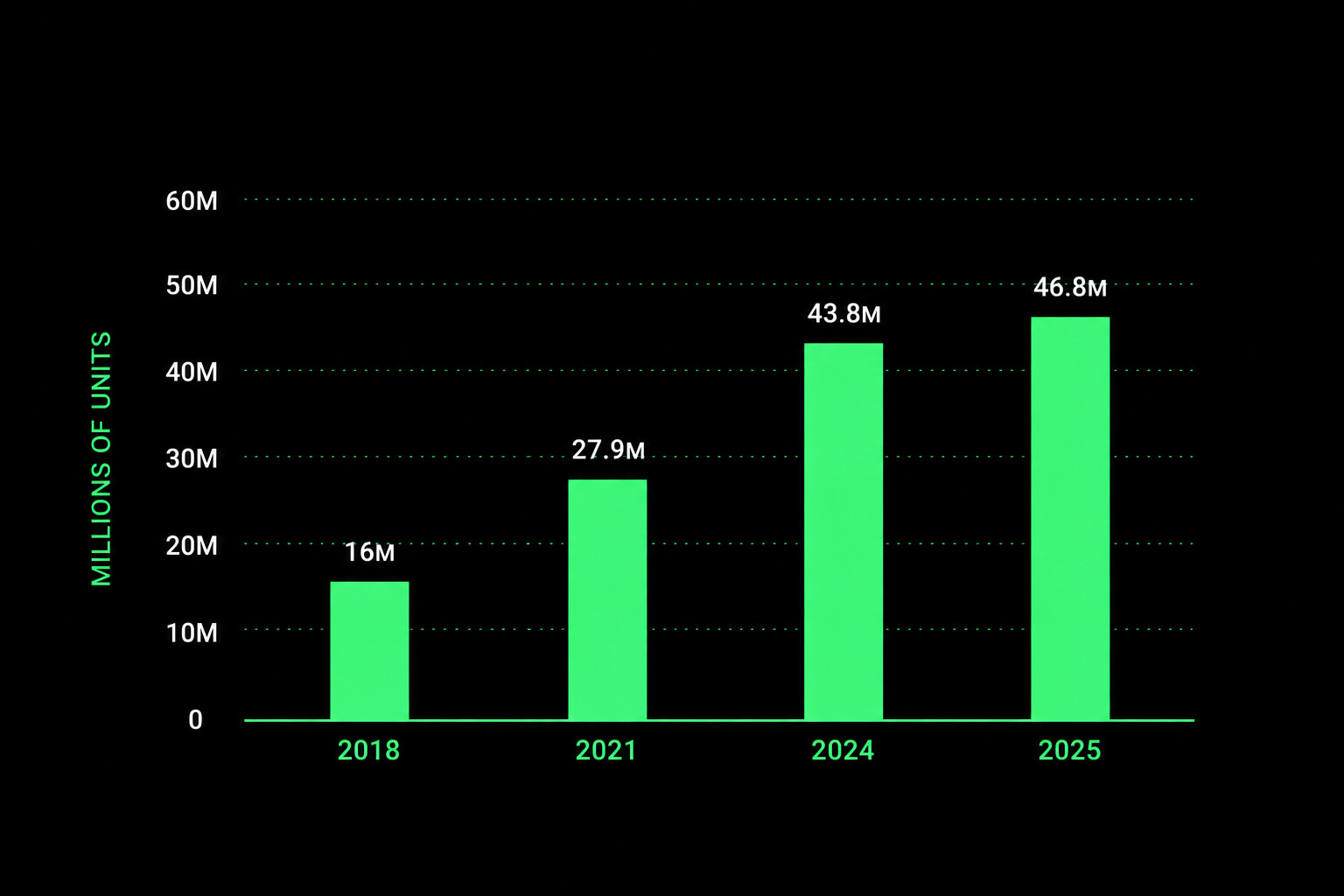
According to the Recording Industry Association of America, vinyl sales even surpassed CD sales in the United States for the first time since the 1980s. The global vinyl market, now estimated at nearly 2 billion dollars, continues to grow despite the overwhelming dominance of streaming for consumers.
The actual practice of vinyl DJing, however, feels increasingly inaccessible for DJs with limited resources. Especially when even collectors and casual consumers rarely use records for their original purpose anymore: listening to music.
According to a study by Luminate, around 50% of people who bought vinyl records in the United States do not even own a turntable to play them. 41% of buyers owned a record player without really using it, while 7% owned none at all.
Vinyl is therefore making a massive comeback as a cultural, decorative and symbolic object, but much less as an actual practice. Yet this practice has not disappeared. It has simply become an industry built around the economics of rarity and, by extension, something slightly elitist.
The Vinyl “Shadow Economy”
In an article about the explosion of vinyl only labels, Pitchfork describes the existence of a vinyl “shadow economy,” meaning a parallel ecosystem made up of small independent labels, specialized record stores, mastering studios and pressing plants that continue operating on the margins of the traditional music industry.
Distributor Above Board estimates that 20 to 30% of the labels they distribute are vinyl only. In London, iconic record store Phonica Records explains that around 30% of its stock, nearly 150 new releases per week, is available exclusively on vinyl. Some releases are pressed in only 300 or 500 copies.
This rarity obviously has economic consequences, but it also becomes part of vinyl’s cultural value itself.
As Pitchfork writes:
“Culturally, the vinyl-only boom represents the opposite of commercial electronic dance music’s insatiable drive for success and exposure: It is the secret handshake to EDM’s fist-bump.”
Vinyl therefore becomes the philosophical opposite of streaming and digital DJing. A clash between instantaneity, accessibility and quantity versus slowness, selection and effort.
Fabian Bruhn, founder of the Aniara label, perfectly summarizes this tension:
“An experience that is ubiquitous can’t be precious at the same time.”
Rarity and Transmission
And this is where the real issue begins.
Streaming, CDs, USB keys and vinyl can absolutely coexist in the same era, each with its own economy. The real problem may actually be transmission. Because the very rarity that gives vinyl its cultural value today is also what progressively distances younger generations of DJs from actually practicing it. It is becoming a sort of elitist craft slowly fading away. The object itself will probably survive, but the intangible cultural heritage that vinyl DJing represents may disappear.
Some underground releases pressed in only 300 copies become almost collector’s items. Prices explode on Discogs, imports become scarcer and building a coherent collection now requires a huge economic and technical investment. It is much harder to be self-taught with vinyl than with a USB stick. Between turntables, cartridges, needles, limited pressings, transporting records and the technical opacity of the process itself, (goodbye sync), getting started becomes far more difficult.
The problem is therefore not vinyl’s comeback itself. On the contrary, this underground culture still sustains a deeply human and artisanal independent ecosystem.
Stefan Mitterer, founder of Sex Tags Mania, also highlights how enriching the process can be:
“It’s a nice process. You learn a lot, you don’t learn nearly as much when you make an MP3.I know how heavy 500 records is to carry. (…) It is a way of calculating your labor.”
It’s a beautiful quote, no doubt about that. And it’s true: the difficulty is probably what creates vinyl’s entire aura. But this celebration of constraint also creates another consequence: vinyl progressively becomes a more elitist and purist practice.
We end up back at the classic phrase:
“You are not a real DJ if you don’t mix on vinyl!”
But if nobody truly passes this knowledge down to younger generations, then vinyl risks becoming more of a distinction object than a living cultural tool.
So yes, keep defending vinyl.
But also teach younger people how to use it. Lend your collections. Share your stories about carrying heavy crates across cities and trading records with strangers so Gen Z people like me stop looking at vinyl like it’s a dinosaur.
Sources : https://www.musicbusinessworldwide.com/50-of-vinyl-buyers-dont-own-a-record-player-data-shows
https://www.lamusiqueestatoutlemonde.com/le-vinyle-fait-son-grand-retour-analyse-dun-phenomene/
Photos credits : Envato Elements