
No products in the cart.
We know how this usually goes: independent culture eventually gets absorbed and transformed for the benefit of a small number of people. It is built slowly, by people who give their time, who organise parties without expecting to make money, who take risks on names by circulating them before the industry knows what to do with them. Then it gets swallowed. Brands and the “big players” of the scene capitalise on it.
That is why we wanted to talk about Community Radio Index, because it is time for media to speak more about independent initiatives than established brands.
Article en français.
A map to find what platforms make invisible
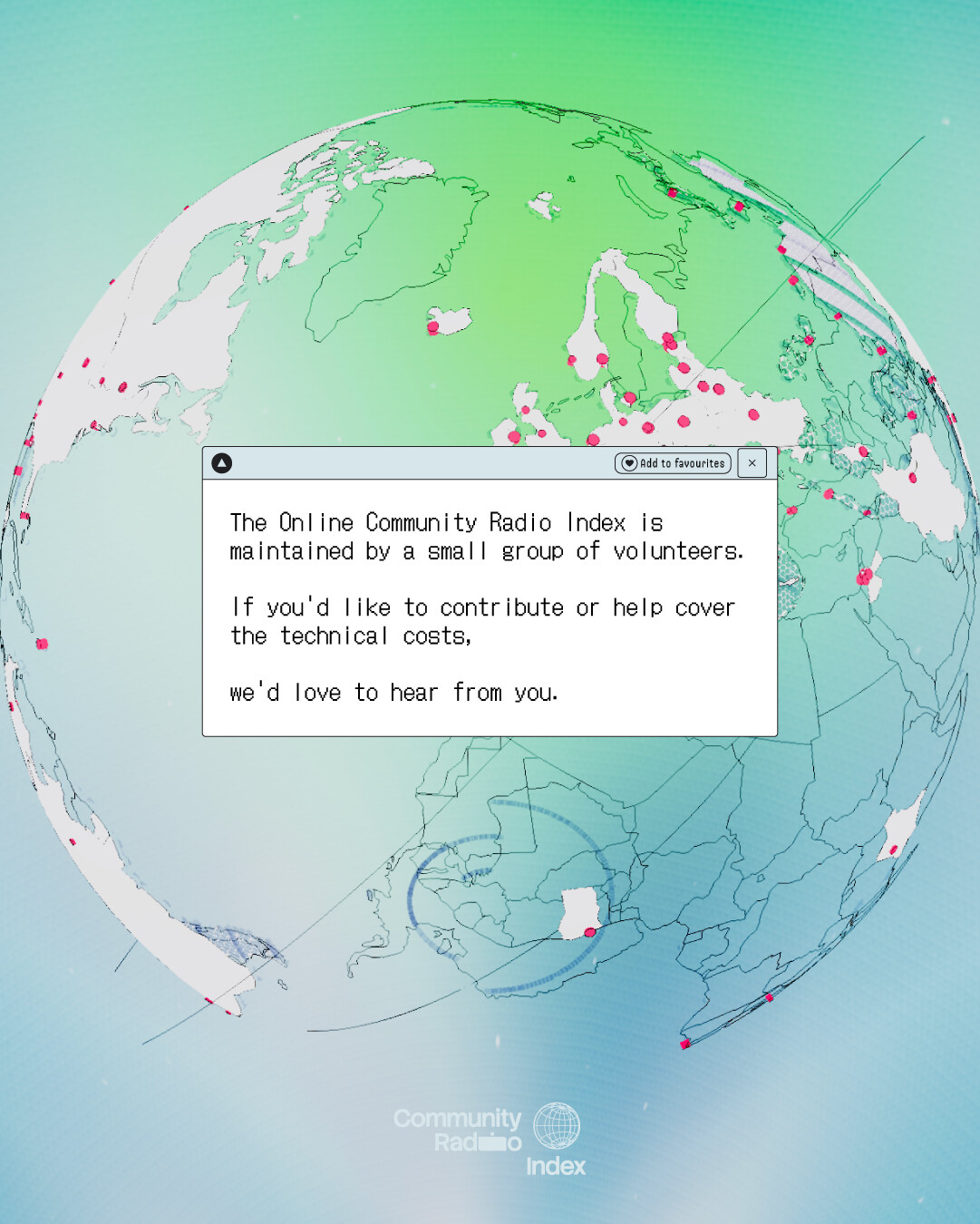
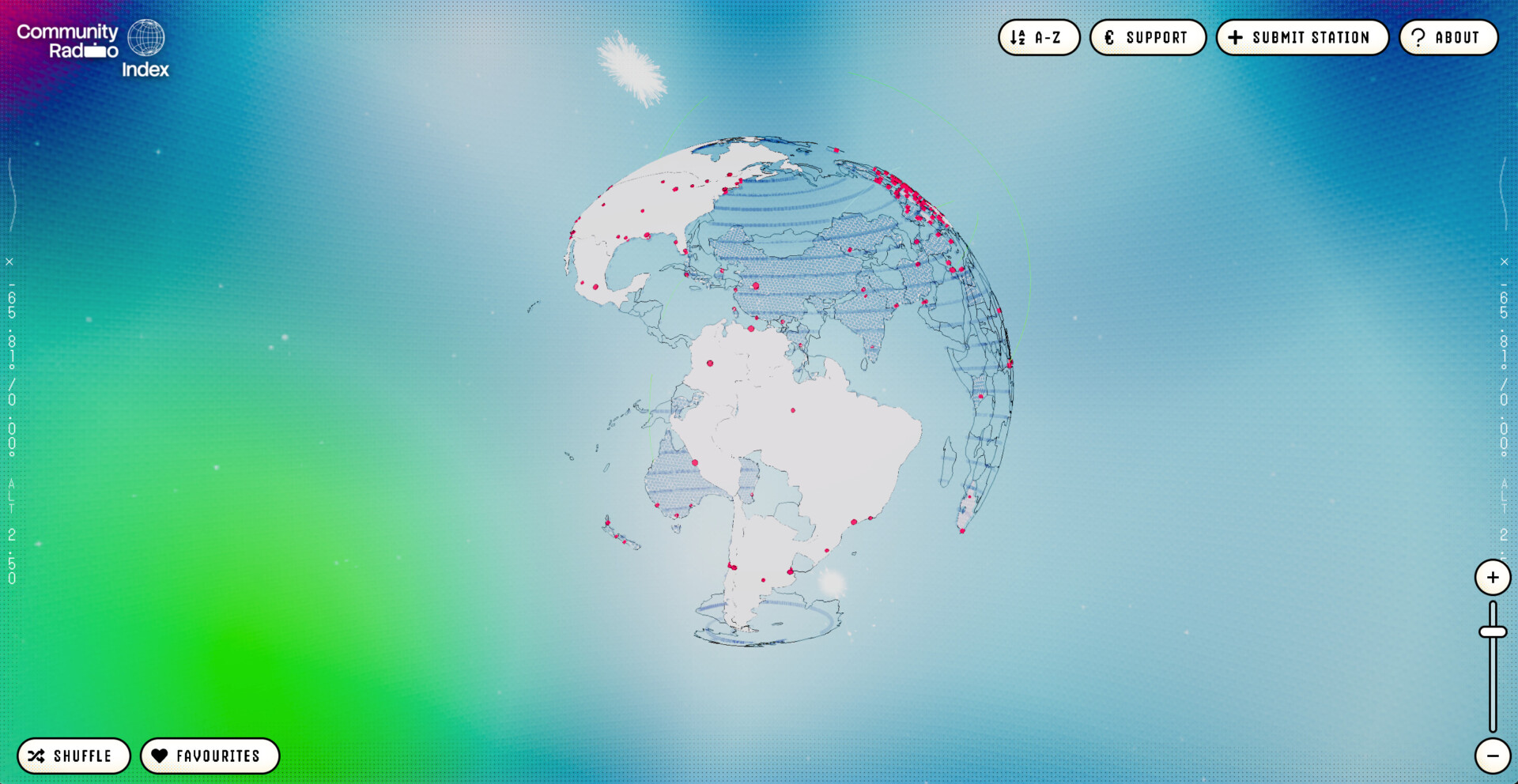
The project presents itself as a map of online community radio stations and the cultures that have developed around them. But behind the tool, there is a deeper idea: making visible a musical infrastructure that often exists outside dominant circuits, outside standardised recommendations, and outside the attention economy that now shapes a large part of the way we listen.
Community Radio Index is carried by four people, each responsible for a different part of the project. Robbie Makes Radio, best known for his work with Hong Kong Community Radio, developed the front-end interface. He works with radio stations to create digital broadcasting platforms and is currently building tools designed to simplify the launch and running of independent stations.
Lukasopp built the station catalogue, the APIs that power the map, and the admin tools for submissions and data management.
Opium Hum, aka Michail Stangl, shaped the original idea for the Index and continues to grow the community around the project. For over 15 years, he has been a vital node in the global electronic music underground, best known as the former face and lead programmer of Boiler Room and as curator of Berlin’s legendary CTM Festival.
Nov3c, a Bristol-based audiovisual artist, contributed additional visuals, including the oscilloscope. For this project, they routed modular stereo into the Sosci oscilloscope as X/Y inputs, generating live cyclical patterns. Selected loops were then used in the skybox and intro.
Their starting point comes from something many DJs and managers have probably felt at some point in their career: there are countless community radio stations, but no one can really see the full picture.
As the project’s creators explain, the first objective is to add a layer of visibility to an ecosystem that is already very active, but widely scattered.
“There’s so much good work being done, but it’s spread across platforms and social media profiles, and combined with how algorithms curtail reach and the often very dynamic nature of volunteer work, people just don’t get to explore what’s really out there.”
What platforms make difficult to see, the Index tries to make navigable.
Scenes that exist before they become profitable
These stations document local scenes, host artists before media outlets notice them, give space to minority cultures, diasporas, experimental music, queer collectives, and sounds that are too specific or too fragile to fit commercial formats. They allow communities to recognise themselves before being turned into a market. At Clubbing TV, for example, we have always cared about booking emerging artists across every part of the electronic music spectrum.
But much of this work remains fragmented. A website here, a stream somewhere else, an archive on SoundCloud, a schedule on Instagram, contributors who do not always have the audience needed to carry their work beyond their immediate circle.
For Opium Hum and Robbie Makes Radio, the problem is not only about discovering the stations. It is also about the way shows themselves sometimes disappear into archives without context.
“There’s also a curatorial layer missing, many great shows wither away in the archives because a SoundCloud upload can only provide so much context, and individual contributors often have limited reach. That’s something we hope to address in the near future.”
A community radio show is often a doorway into a world: a city, its scene, its ravers.
The difference between recommendation and discovery
Today, music discovery happens largely through private platforms. We know where to listen to music. But we ask ourselves less often, sometimes out of laziness or comfort: who organises what we get to discover? Who gives the context? Who puts us in front of the unexpected? Who lets a scene breathe before it becomes exploitable?
Platforms know how to suggest what already looks like what works. They read our habits, optimise our reactions, anticipate our supposed tastes. They can slide listening into a kind of repetitive comfort, where we are less surprised than confirmed. That is the algorithm, basically.
Community radio works differently. It offers moments. Routines. Appointments. A person behind the choice. A voice. A city. A community. A happy accident. A “track id?” that was not predicted by a recommendation model.
The creators of the Index put that difference :
“Algo-generated playlists have no immediacy, no moment to participate in, no routine. They’re built around trying to read your mood, which ends up influencing how you feel, you don’t come up against anything unexpected, you waterslide into curatorial slop, and what the algorithm expects you to like most eventually becomes mundane and repetitive.”
Community radio, on the other hand, keeps a part of the unknown alive.
“Community radio has plenty of ‘what is this?’ moments — and that’s precisely the joy of it. You can be launched into an entire musical world instantly, experience coherent world-building constructed from new and unfamiliar elements, and go down a rabbit hole that feels closer to being at a gig than anything a playlist can replicate.”
Put simply: a playlist can organise a mood, but a radio station can create a world.
It is a public space
Community Radio Index can obviously be read as a response to the standardisation of music discovery. It makes visible practices that partly escape the main circuits. It allows us to move through music differently, through stations, communities and geographies that platforms do not always know how to tell.
But its creators do not necessarily want to frame it as a frontal war against platforms.
They offer a more accurate image:
“If a city puts a park in a public place, is sitting in the park suddenly an act of resistance?”
Community radio stations are virtual public spaces where people gather. The Index is mostly trying to make access to those spaces easier, without imposing too many top-down rules on what they should produce.
“Community radio stations are virtual public spaces where people congregate and what we’re trying to do is facilitate the kind of emergent behaviour that happens when you create open, accessible infrastructure without too many top-down rules about what it’s for.”
This idea of a digital public space matters to us. A community radio station creates encounters. Someone discovers a local station, gets involved, makes friends, launches a show, meets artists, builds a project, crosses borders.
Doorways into worlds
To illustrate what this kind of infrastructure can produce, the creators of the Index mention Sound Camp’s Reveil project, a broadcast that follows sunrise across the planet through live sound recordings from natural environments.
They describe it as:
“A singular, internationally-received moment of joy, built entirely from individual human friendships and collaborations.”
That is the kind of thing open communication infrastructure can make possible. Not necessarily because it wants to “disrupt” anything, but because it leaves room for unexpected behaviours to emerge. In that sense, the Index is not only a map.
“The Index is just trying to make it easier to find the door.”
The real battle: surviving without selling out
Then comes the material question, the less romantic one: the struggle. How do these radios survive?
Many operate with very little, sometimes through volunteers, sometimes through public support, sometimes through hybrid models that combine radio, bar, venue, events, workshops or brand partnerships. In Europe, some stations can access funding more easily and build semi-professional structures. Elsewhere, many depend almost entirely on the energy of their volunteers.
The creators of the Index put it:
“In Europe, where more funding is available, it’s a little easier for stations to establish semi-professional structures. In other parts of the world, stations really run on the blood and sweat of their volunteers.”
The dependence on platforms is also real. Even community radio stations that think of themselves as alternatives often use SoundCloud, Mixcloud or other services to store, archive and share their shows. So the alternative is not pure. It is built inside a digital environment already largely dominated by major players.
“It’s also worth questioning what we even mean by ‘alternative infrastructure.’ A lot of these stations are already quite reliant on platforms like SoundCloud and Mixcloud for storage and archiving, so in many ways they’re built on top of well-integrated digital music infrastructure.”
The point is to understand what community radio can offer that platforms do not know how to create. Is it immediacy, participation, routine, human connection, cultural coherence, surprises, or scenes that are not yet readable through data?
The pay-to-play question
The more visible community radio becomes, the more exposed it can also become to commercial pressure. Some independent stations elsewhere in the ecosystem have already been criticised for paid placement dynamics or monetised artist broadcasts.
The risk exists. We have seen it more than once with infrastructures born to bypass dominant logics, which can end up reproducing forms of pay-to-play if they have no other way to survive.
On this point, the creators of the Index insist on an important distinction:
“We don’t think any of the stations we mapped engage in pay-to-play, and most brand partnerships are far from that.”
That does not mean the financial question disappears. Quite the opposite. If we want these radios to last, they need to be able to do so without losing the trust, editorial independence and relationships that give them value.
According to them, the real challenge is also to help stations share models and lessons.
“We do hope the Index can eventually help stations share learnings and blueprints that allow others to set themselves up with less financial and human cost.”
Doing more with less
They speak less about “making more money” than about “doing more with less”.
“The objective really becomes about how to do more with less, rather than how to get more.”
Hong Kong Community Radio, for example, existed as a physical station for a long time, but gained serious international traction when it went virtual. Without the costs of a permanent space, the station was able to focus on curation.
In a city like Hong Kong, where rents are extremely high, returning to the physical world from time to time often depends on networks of people willing to share spaces, such as a recent pop-up at Chungking Mansions.
These arrangements are fragile, temporary and sometimes precarious. But they are also part of the underground reality of certain cities.
Other stations, such as Moth HK or Refuge Worldwide, show how volunteer work, fundraising events, educational workshops and community organisation can become powerful resources.
“Volunteered labour can make all the difference, and stations like Moth HK or Refuge Worldwide have done a remarkable job mobilising volunteers, coordinating fundraising events, and organising educational workshops, which is genuinely inspiring.”
We do not think volunteer work should replace solid funding. But community radio also rests on a form of commitment that cannot be reduced to an economic model.
Maybe the real infrastructure is relationships
Maybe the real infrastructure lies in relationships. In friendships, invitations, shared spaces, people giving their time, people passing on knowledge, people opening a slot to someone who would never have been invited elsewhere.
The creators of the Index put it this way:
“In the end, the people who get the most out of community radio are the ones who participate thoughtfully, whose relationships in the music world are built on real friendships. Maybe that’s the real infrastructure, and maybe protecting that is what financial sustainability is actually in service of.”
This is why Community Radio Index could become important for what comes next: because it can help share methods, tools, models, mistakes, archives and networks. It can make launching or maintaining a station less costly, both technically and humanly.
As the project’s creators say:
“Right now, most stations are focused entirely on survival rather than experimentation and the real goal of something like the Index is to help shift that balance, so stations can think less about infrastructure and more about the creative possibilities it opens up.”
A necessary counter-map
Independent culture needs infrastructures that are not built to extract value until exhaustion. It needs places where music can exist without being immediately transformed into a campaign, a trend or sponsor-friendly content.
Major groups can buy festivals, sponsor stages, recover aesthetics and promise to support culture. Platforms can make us feel like everything is accessible, while mostly organising what becomes visible. But they will never replace the slow, local and stubborn work of the people building worlds around music.
Community Radio Index starts there, with people already organising. They are not promising an abstract revolution. They are building tools, maps, archives and entry points into scenes that big cultural machines often only know how to recognise once they can monetise them.
Mapping community radio becomes a counter-power gesture. So let’s focus, stop giving too much strength to the big players, start digging again for good sound, and allow ourselves the time and the right to be surprised.