

No products in the cart.
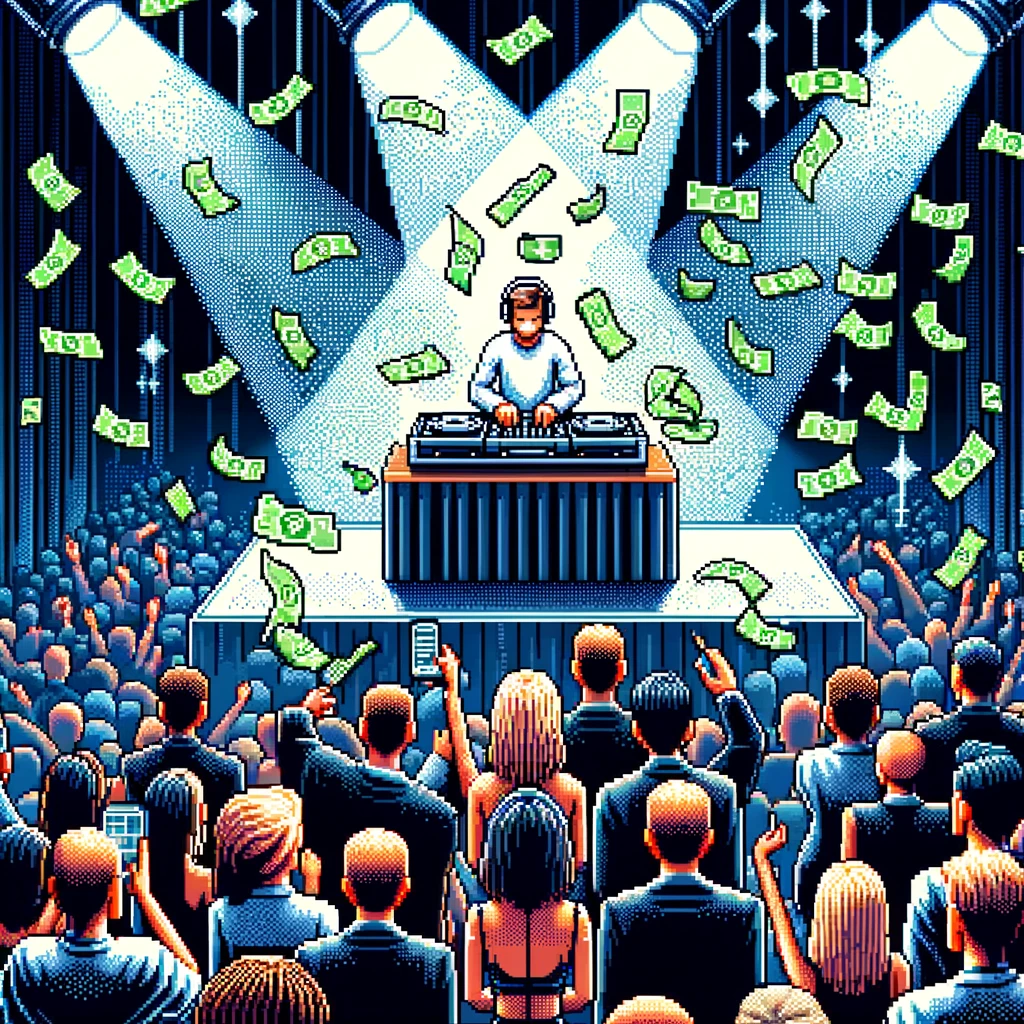
We already know what you’re going to say… Putting on an event is expensive because you have to pay the teams, technicians, DJs, security, venue, travel, accommodation and hospitality costs, communication, and so on. Yes.
Article en français.
We have worked in this industry long enough to know that you cannot put on an event with two power sockets and goodwill alone!
BUT. We also know that some events and promoters — clubs, festivals and others — manage to charge fair prices. And, strangely enough, the parties they put on are often much better than those with enormous productions or simply an outrageously expensive ticket.
We have all ended up accepting the idea that an expensive party must be a better one. Yet when we think back to the nights we truly loved, the biggest productions are not always the first ones that come to mind. And before remembering the very expensive wow effect, we remember the overcrowding, the terrible soundsystem, the endless queues or the bottle of water sold at an extortionate price.
When you think about it, today’s biggest productions still take inspiration from events that were originally organised with very little money. Yet those parties created new scenes, brought real communities together and gave birth to movements the industry now exploits in every possible way. If those events managed to leave such a mark without spending ridiculous amounts of money, how did we come to believe that partying now has to cost so much?
Why have we normalised DJs becoming so rich?
Yes, DJs should be paid. But it is still pretty wild that whenever we complain about this issue, most of the people who push back seem more concerned about millionaire DJs than underpaid local artists.
And yet, on one side, you have someone who admittedly sells tickets — but to whom, exactly? On the other, you have local artists who arrive earlier, promote the event without even being contractually required to do so, and do all of it for €200.
When did we decide this was normal, to the point of defending it so fiercely?
We talk about certain DJs as though they became rich simply because they deserved it. But when someone in their early twenties, or someone who has only just arrived on the scene, becomes a millionaire by playing sets, that money has to come from somewhere. And spoiler alert: if that person is also a producer, it is not coming from streams.
It comes from fees, which are paid by promoters, who get the money from… YOU! It is often offset by the price of drinks, VIP tables and everything else charged to the crowd once they are through the door.
You have contributed to that fortune every time you dropped €60 to watch a DJ play for an hour.
There is also an astonishing amount of hypocrisy in the way we talk about wealth. We rightly find it outrageous when a boss earns fifty times more than their employees, but there is complete silence when a star earns in one hour what teams working on-site for three days will not earn in several years.
The argument about job creation is even less convincing here. A major DJ may have a team, but rarely hundreds of employees whose jobs they need to fund. Yet we accept their fortune far more easily because they give us pleasure. We would rather protect the fee of an artist we love than ask how many people who love the exact same music will be left outside because they can no longer afford it.
We are not saying that an established artist should be paid the same as someone who is just starting out. We are simply asking why the unlimited enrichment of a handful of DJs, bookers and managers should be treated as essential. “Artists need to be paid” cannot be the answer to everything, especially when most artists on the line-up are being paid very little.
We could also talk about events that proudly announce colossal technical budgets when part of the crowd never asked for any of it. Perhaps a good soundsystem, enough room to dance and a decent number of toilets would already do the job. By constantly trying to produce spectacular images for social media, promoters make the crowd pay for a production designed to be watched through a phone.
Major DJs have far more power than they admit
EVERY time ticket prices come up, we are told that DJs have nothing to do with them. The promoter sets the price, the booker negotiates the fee and the DJ turns up to play. Everyone passes the responsibility on to the next person until, somehow, nobody is responsible for the €75 ticket.
Except that a major DJ can negotiate almost everything: their slot on the timetable, the size of their name on the flyer, their equipment, how many stars their hotel has, the make of the car picking them up, their dinner, the size of their guest list, and so on.
Surely they could also ask: “By the way, how much are people paying to get in?”
Artists can adapt their fees for projects they want to support. It already happens. Some accept less for a club they care about, a cause, a small-capacity venue or an event they consider important. What is presented as an absolutely non-negotiable amount can suddenly become very flexible when the artist has something to gain.
So yes, a very famous DJ could impose a maximum ticket price. They could ask for a percentage of the capacity to be made available at a lower price through solidarity tickets, for example. At the very least, they could ask the question.
If they do not, it is because the system works for them.
None of this absolves promoters who raise their prices whenever they think they can get away with it. But this habit of portraying extremely powerful DJs as vulnerable little creatures, entirely controlled by their agents and with no say whatsoever over their own careers, is becoming extremely tiring.
Poor people have already disappeared from many events
It started with festivals becoming holidays that had to be planned several months in advance. That was already true of Tomorrowland, but it now applies to most electronic music festivals in Europe.
Today, the same model is reaching clubs. When admission costs more than €20 — already a significant expense, but anyway — you still have to add drinks and transport, especially the taxi home if you are a woman. The total rises very, very quickly.
Many people can no longer go out every week. They choose one date a month, or fewer, and naturally go for a name they already know. When a single night takes up a significant part of your budget, you are less likely to risk spending it on artists you have never heard of.
Higher prices therefore reinforce the dominance of headliners. Events need famous names to sell expensive tickets, and tickets become even more expensive because those names need to be paid. We go round in circles and call it the market.
Meanwhile, local collectives are expected to remain patient and obedient.
“If you can’t afford it, don’t go”
This is probably the argument that annoys us most. What is this, your dad’s festival?
Who decided that electronic music belongs to whoever can pay the most? A sold-out event proves absolutely nothing about the quality of the party. It only proves that enough people were wealthy or determined enough to accept the price.
The most cynical part is watching our scene demand cultural recognition. When it needs to save venues or obtain public funding, it suddenly becomes a collective heritage born from marginalised communities and carrying a political history.
A choice has to be made. We cannot use that history as a communication tool while gradually excluding the people who helped build it.
Even early-bird tickets favour people with money
Early-bird tickets can sometimes be affordable, provided you can pay six months in advance and before you even know exactly what you are buying. That kind of purchase requires enough financial security to plan ahead. The people who most need a lower price often end up buying tickets in the final release.
There is nothing natural about this system. It was designed to trigger purchases quickly, create urgency and, by extension, charge more to those who arrive later.
It is communication. It is marketing. It is not an accessibility policy.
Ibiza: when everything becomes too much
Ibiza is probably where everything has gone furthest.
We will spare you another discussion about drink prices, which are hardly a secret, along with the VIP areas and the people who spend the entire night holding up their phones.
Today, Ibiza creates relatively little. The island watches what works elsewhere and resells it at a much higher price inside gigantic clubs. It is a tourism and commercial machine, but musically, it is no longer the reference point the industry claims it is.
Changes in residencies are revealing. DJs move from one club to another according to the $$$$ on offer, sometimes after years of speeches about their “Ibiza family” and their unique relationship with the venue. Clubs poach artists from their neighbours whenever they think they can attract their audience.
Everyone goes where the most money is — except when playing almost for free can bring prestige or visibility. In those cases, fees miraculously become negotiable.
Ibiza increasingly resembles what gentrification produces when it reaches the end of the process. It preserves the aesthetics and symbols of a culture while pushing out some of the people who kept it alive.
Eventually, we get bored…
Price selects the crowd long before anyone reaches the club entrance. As prices rise, some people stop coming and others go out less often. Little by little, dancefloors begin to look the same.
Yet the atmosphere of a party depends enormously on the people who are there and on everything that makes them socially, sexually and culturally different. When money becomes the main filter at the door, crowds become more homogeneous and parties become increasingly boring.
That may explain why some small events remain far more powerful and memorable than productions costing a thousand times more. They still welcome people who came to participate in the party, rather than simply consume it.
Nobody is asking teams to work for free
We need to repeat this because the argument will inevitably come back: making parties cheaper does not mean paying nobody.
Clubs are fragile and costs are rising. Many teams already operate with very limited resources, and some venues are barely surviving. We are not putting a small 300-capacity venue trying to pay its employees properly in the same category as a festival spending a fortune on three enormous names.
Free admission has to be funded. It can be financed through bar revenue, public funding, local authorities, partnerships or more profitable events. It will not suit every project.
But almost every event can ask where the money is actually going.
Would the crowd prefer another video installation or a ticket that costs €5 less? Do we really need ten headliners on the same day? Why is water priced like a cocktail? Why does the local DJ earn €200 while the artist playing after them makes €20,000? At what point do we decide that an artist is being paid enough?
These questions are rarely asked because raising ticket prices is easier than reducing margins, commissions or negotiating down a headliner’s fee.
The public has been remarkably obedient. We have accepted everything: pricing tiers, fees added at the last minute, tokens, cashless systems, overpriced bottles sold without caps and ever-expanding VIP areas. At every stage, we are told that all of it is necessary either for our safety or for the survival of the scene.
Maybe it is time to start demanding answers.