

No products in the cart.

You really thought we’d exhausted electronic music’s cultural heritage with a sauna, a speaker pushed into the crowd and Paris Hilton armed with a bucket of water? Of course not.
For this second perfectly useless history lesson, we’re going back to a time when Eminem could destroy someone with a single word and a photo of Nina Kraviz in a bathtub was enough to trigger an international sexist debate about her legitimacy as a DJ.
The potential for chaos was immense.
Article en français.
PEGGY GOU, JÄGERMEISTER AND THE DONATION THAT GOT A LITTLE TOO CLOSE — 2020
A campaign designed to save nightlife during Covid somehow turned into an improvised investigation into the business relationships between the people involved.
During the pandemic, Jägermeister launched #SaveTheNight, a €1 million initiative supporting clubs, artists, events and other parts of a nightlife industry brought almost completely to a standstill. Peggy Gou became one of the project’s ambassadors. In July 2020, she announced that a donation would notably go to Glasgow’s Sub Club, which was facing the threat of closure.
So far, so wholesome. Then people started looking at the companies behind everyone involved.
Independent outlet Selector reported that Usman Khushi, one of three directors of Outer Limits Ltd, Sub Club’s parent company, was also the sole director of Peggy Goods Ltd, Peggy Gou’s merchandise company. Industry watchdog account Business Teshno publicly highlighted the potential conflict of interest.
Jägermeister eventually stopped considering Sub Club as a beneficiary. According to the response reported by Selector, funding a club with business ties to people involved in the initiative risked creating “false impressions” and damaging the credibility of the project.
And the controversy didn’t remain confined to a few anonymous accounts.
A few months later, Folamour also publicly weighed in on Twitter, posting two messages aimed at Peggy Gou:
So yes: a campaign designed to save clubs during a pandemic had somehow pushed the electronic music scene into examining corporate records. But there were no consequences for anyone’s career, no sanctions, no collective memory… Until today…
EMINEM VS AFROJACK: “WHO?” — 2013
Probably one of the shortest and most effective beefs in electronic music history.
At the 2013 MTV Europe Music Awards in Amsterdam, Eminem received the Global Icon Award. Will Ferrell, in character as Ron Burgundy, told him that Afrojack had apparently been talking about him and asked whether he wanted to respond.
Eminem:
“Who?”
Burgundy repeated: Afrojack.
Eminem:
“Who?”
End of discussion.
The craziest part is that nobody ever clearly established what Afrojack had actually said about Eminem. Several outlets at the time even wondered whether Ron Burgundy had simply invented the beef for the joke.
The internet didn’t wait for the investigation to conclude.
Afrojack’s social pages were flooded with thousands of comments simply asking “Who?” Some fans even edited his Wikipedia page. Afrojack eventually joined in on the joke: alongside Snoop Dogg, he performed My Name Is, replacing Slim Shady’s name with his own.
One word. Thousands of comments. Almost no actual beef to begin with.
BEFORE “REAL TECHNO”, THERE WAS “REAL HOUSE”: DJ SNEAK VS SWEDISH HOUSE MAFIA — 2012
If today’s arguments about what does and doesn’t count as “real techno” are exhausting you, here’s some good news: we invented absolutely none of this.
In 2012, Chicago house legend DJ Sneak went to war with Swedish House Mafia on Twitter. He notably described their music as “fake shit” and argued that they simply weren’t playing house music.
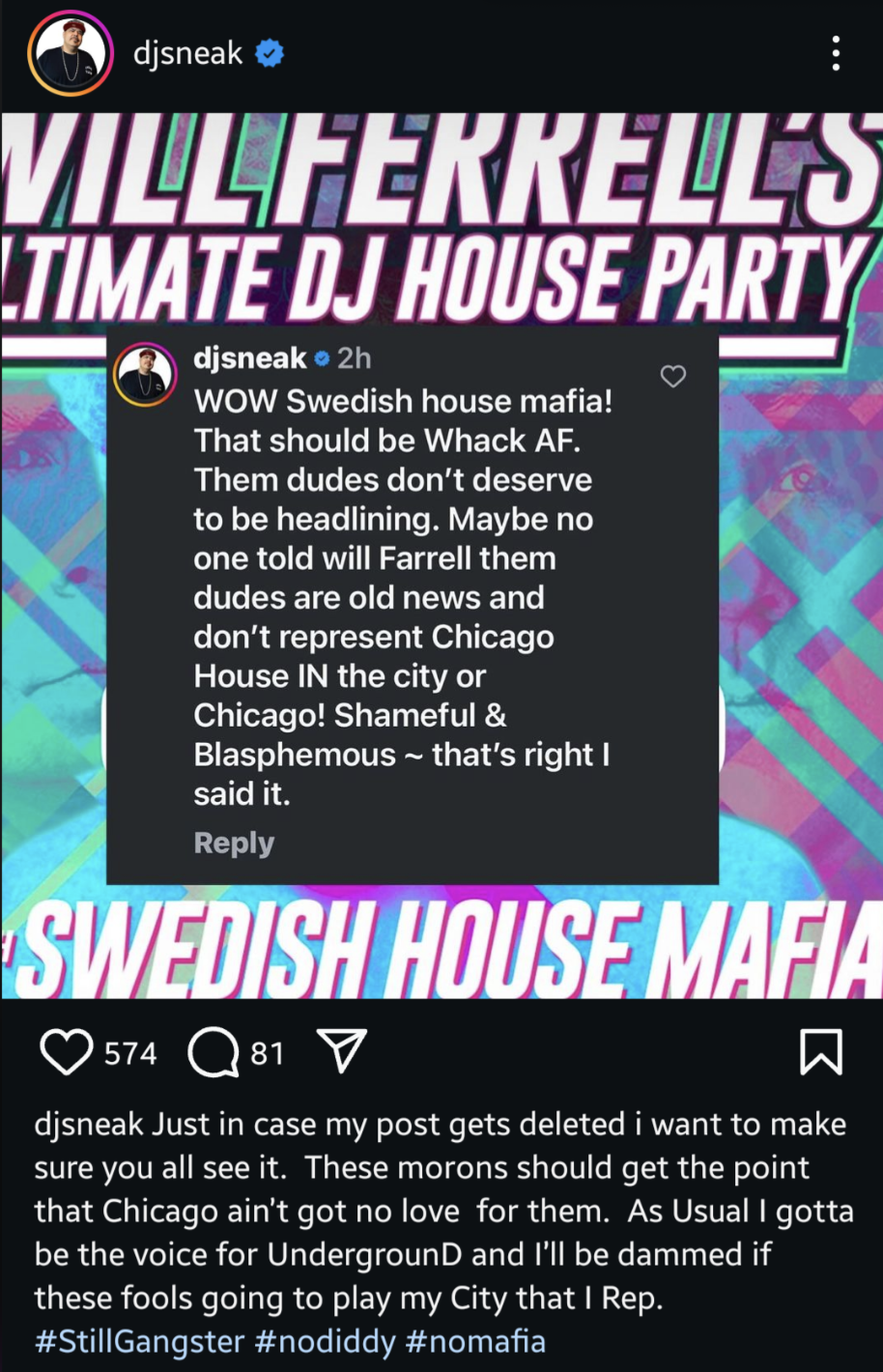
The conflict eventually involved Steve Angello and quickly turned into the eternal debate between underground credibility and commercial success. Sneak even mocked the group by calling them “Swedish Fish Mafia.”
Another accusation that feels extremely familiar today also emerged in the middle of the beef: Swedish House Mafia were essentially just pressing Play and reproducing the same sets.
A few months later at EDC Las Vegas, Steve Angello appeared to respond on stage by playing a track containing the sample:
“DJ on two turntables.”
There you go. Before real techno, there was real house. Before Instagram comment wars, there was Twitter. And your parents were already fighting over which music was allowed to be underground.
MACEO PLEX THROWS A CUP INTO THE CROWD… AND INJURES A WOMAN — 2021
A cup thrown “for fun”, a clubber left with a bleeding nose, followed by a defence that did very little to calm the internet down.
On December 3, 2021, Maceo Plex was playing at the legendary Warung Beach Club in Brazil. Footage showed him drinking from a cup before throwing it into the crowd. According to several eyewitnesses, it hit a woman in the face and caused her nose to bleed.
The story quickly spread online through Business Teshno and sparked controversy. Warung subsequently published a video apology from Maceo Plex. The DJ acknowledged that he had made a mistake, said any medical expenses would be covered and that the woman would receive lifetime VIP access to the club.
Then came part two of the drama.
Responding to the criticism, Maceo Plex stressed that the projectile was a plastic cup, not a glass. In the same message, he also mentioned that he would normally throw his headphones into the crowd for someone to catch. A clarification that, strangely enough, didn’t exactly reassure everyone.
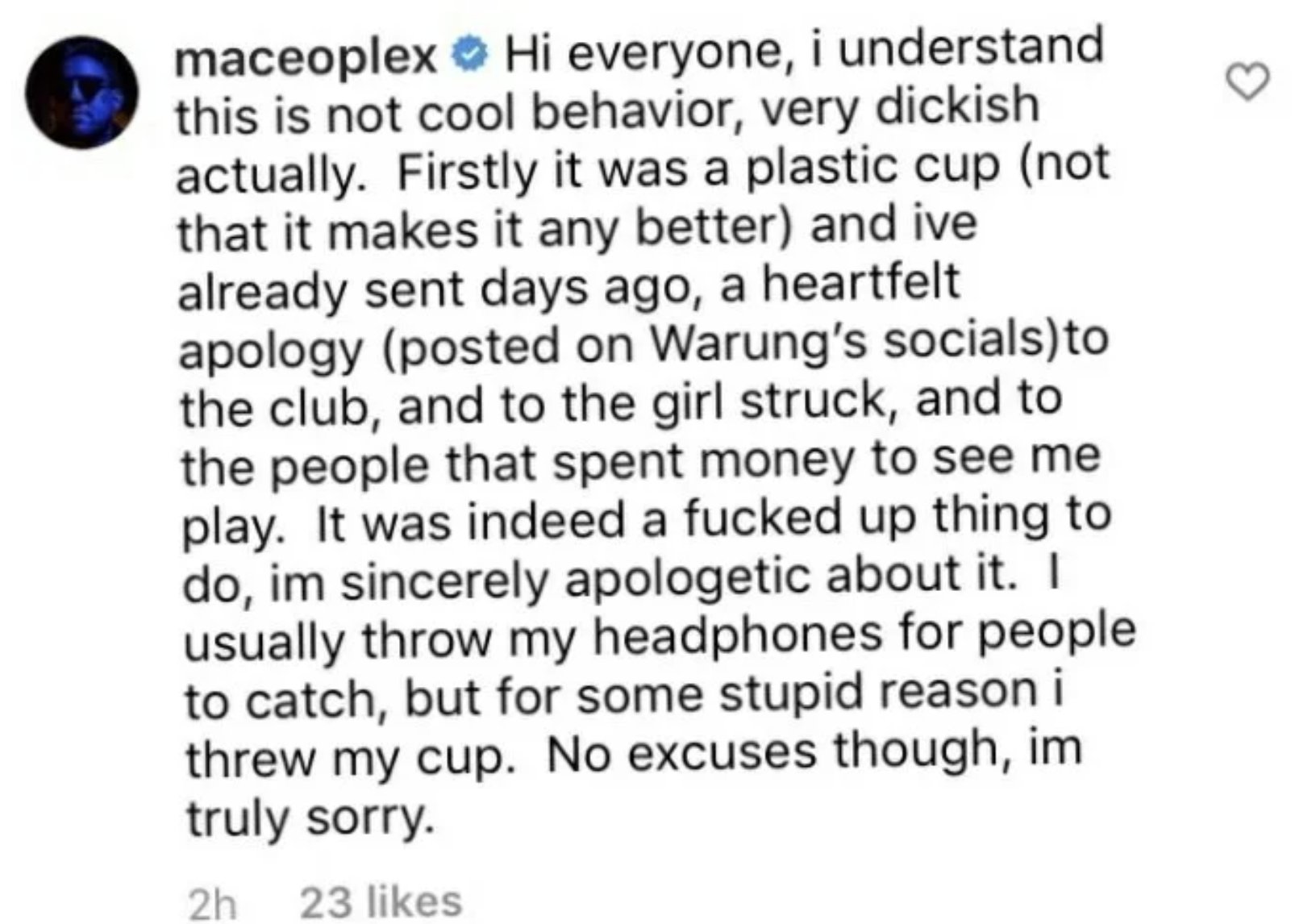
Ultimately, the material of the cup was never really the point: someone had been injured because an object was thrown from the booth into a packed crowd.
And the internet mostly remembered the strangely specific defence: yes, I threw something into the audience, but it was plastic — and normally, I throw my headphones instead.
NINA KRAVIZ AND BATHGATE: WHEN SEXISM WAS EVEN MORE CASUAL — 2013
A female DJ is filmed in a bathtub. Part of the scene suddenly decides this requires a debate about her artistic credibility.
In 2013, Resident Advisor launched its excellent Between The Beats documentary series with Nina Kraviz. The concept was to follow artists beyond the booth and show the reality of their lives on tour.
One sequence featured Kraviz giving an interview from her bath.
And the internet immediately became the internet.
Much of the reaction quickly stopped being about her music. Comments focused on her body, appearance and sexuality, alongside the idea that she was using her looks to advance her career. British DJ Greg Wilson himself published a lengthy piece discussing the video and the way Kraviz chose to present her sexuality. The episode quickly acquired a nickname: Bathgate.
FACT responded with an article whose headline perfectly captured what the controversy revealed: “what the Nina Kraviz furore tells us about sexism in dance music.” The publication highlighted comments about her appearance and accusations portraying her as practically a model pretending to be a DJ.
Thirteen years later, perhaps the most striking part of the story isn’t even the bathtub anymore. It’s seeing just how acceptable it still seemed to publicly ask whether a woman could be sexy, conscious of her image and still deserve to be taken seriously as an artist.
While male DJs built public personas around excess, ego and sometimes very explicit sexuality without their technical ability automatically being called into question, a few minutes of Nina Kraviz sitting in a bath had been enough to trigger a trial of her legitimacy.
HARDWELL: “FUCK THE DJ MAG” — 2016
The Hardwell of 2015 was already publicly criticising DJ Mag campaigns for soliciting votes using teams equipped with iPads.
By 2016, Hardwell had clearly had enough.
During a Revealed party at Amsterdam Dance Event, he took the stage while Atmozfears was playing. The new Top 100 had just been announced: Martin Garrix was No. 1, Hardwell had dropped to third place and Atmozfears hadn’t even made the ranking.
Hardwell took the microphone.
He pointed to Atmozfears and explained that he considered him a much better producer than himself, but that he didn’t have access to the huge festivals required to gain the visibility needed to enter the ranking.
Then came the conclusion:
“Fuck the DJ Mag.”
What makes the scene particularly satisfying is, of course, the identity of the person saying it. Hardwell wasn’t an outsider denouncing a ranking he’d never had access to. He had been voted the world’s No. 1 DJ by that exact same ranking two years in a row, in 2013 and 2014. The winner of the game was literally standing in front of the crowd explaining that the game was bad.
The great love story between Hardwell and the DJ Mag Top 100 had officially entered its divorce era.