

No products in the cart.

When we talk about clubs and festivals, we are not only talking about music or DJs. We are talking about memories that stay in the body and come back with chills, nights that mark a specific period in life, moments when people come to dance because they feel good, because they feel bad, because they are trying to forget something or find themselves somewhere.
Article en français.
Partying has always had this function: offering a space where people can let go and disappear a little. Obviously, this vital need to dance has been gentrified and capitalised on until it became an extremely lucrative industry. And the public, in return, has become more demanding.
But what our survey shows is not a public asking for more screens or more money for headliners. It is a public asking, first of all, for the basics to be respected. Vital and safety-related basics.
Out of 103 completed responses, nearly 8 out of 10 respondents say they have already witnessed or experienced problematic behaviour in a club or festival.
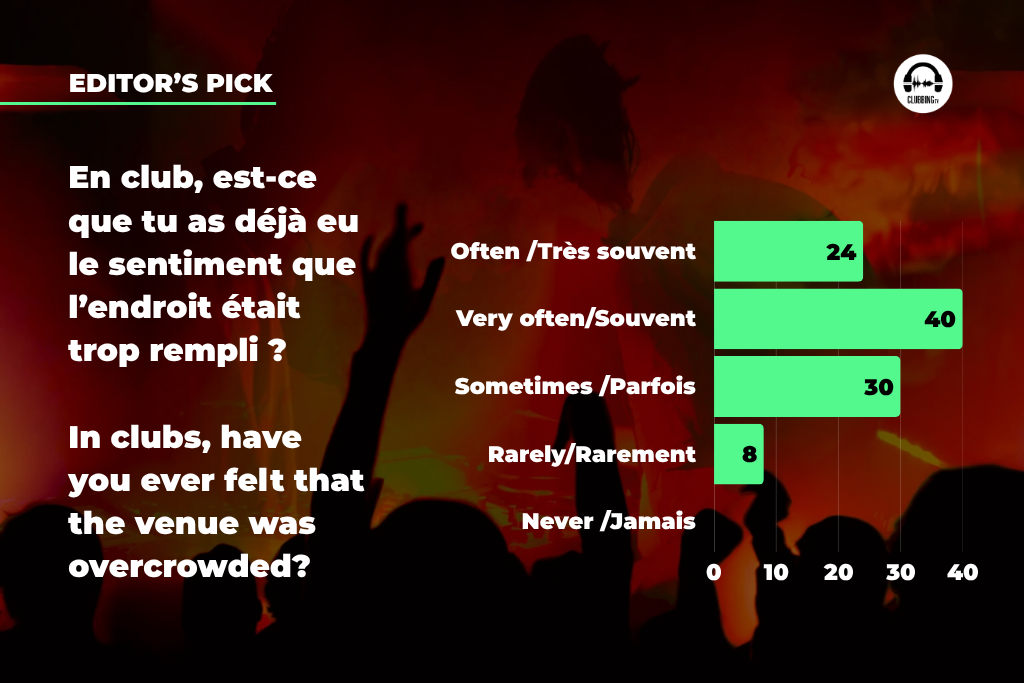
In clubs, 63% say they have often or very often felt that a venue was overcrowded.
In festivals, 88% say they have at least sometimes felt that audience comfort came after profitability.
And the economic question comes up everywhere, all the time: 94% think that the very high fees of some headliners probably or clearly have an impact on ticket prices, while 89% would like more transparency on how those prices are built.
What ravers are telling us is a fatigue with everything that damages these events. A non-exhaustive list: overcrowding, lack of water, poorly designed spaces, rising prices, sometimes aggressive crowds, unclear safety policies, repetitive line-ups, and so on.
Ravers still want to dance. But they no longer want their need to party to be used as an excuse to fill the pockets of people who do not care about them.
What they are asking for is absolutely not extravagant: more space, GOOD properly adjusted sound, care, safety, understandable prices, and the feeling of being considered as something other than a capacity figure to fill.
The people want AIR!
Dancing without being compressed shoulder to shoulder against a shirtless sweaty torso: is that possible or not?
In our survey, 63% of respondents say they have often or very often felt that a club was overcrowded. If we add those who answered “sometimes”, that figure rises to 92%. In other words, overcrowding does not appear to be an isolated incident, but an experience that has become almost ordinary for a large part of the audience.
One respondent describes a room “so packed that it took 30 minutes to cross it and 30 minutes to get a drink at the bar.” Another sums up a KI/KI night as “overcrowded x1000”, with people pushing, crossing the crowd without looking, and “impossible to find even the smallest spot to dance in peace.” In London, one night even became a safety issue, with two hours of queueing in winter, then crowd movements when the headliner started, triggering a panic attack in a friend.
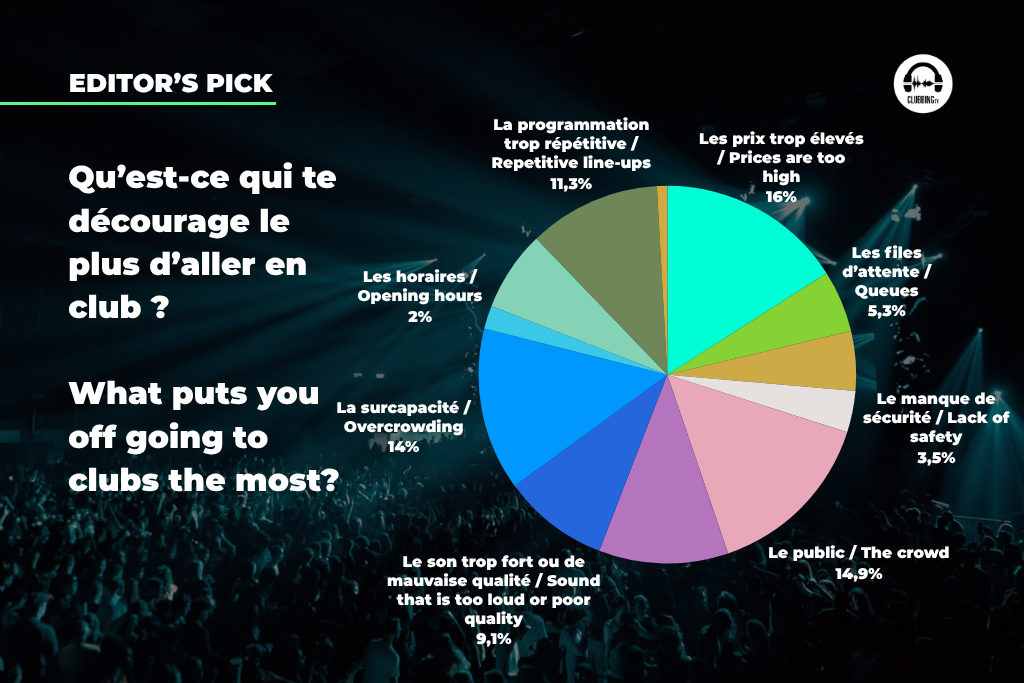
The figures on what discourages people from going clubbing point in the same direction. 65% mention high prices, 58% mention the crowd, 56% mention overcrowding, and nearly 46% mention sexist, racist, homophobic or transphobic behaviour. The fatigue therefore comes from several factors and from their accumulation: paying a lot for a night that is too crowded, in a crowd that can sometimes be aggressive or inattentive, with too few spaces to breathe.
On the other hand, and we will talk about this a bit more below, the good experiences mentioned by ravers are very concrete. What is needed: space to dance, staff who are present without being oppressive, a clean and well-adjusted sound system, a crowd that comes for the music, places to sit down, and well-managed crowd flow. In the end, the criteria for ravers having a good night are actually quite achievable for events.
Freedom, but not without safety
This is one of the most ambivalent topics in the survey. Why? Because safety still depends too much on the venue, the night, the staff or the collective.
Out of 103 completed responses, nearly 77% of respondents say they have already witnessed or experienced problematic behaviour in a club or festival. In clubs, only 17% say they “always” feel safe, while 43% say it depends a lot on the venue.
“The time I was assaulted at Virage. I was frozen, but I managed to go and speak to a security guard who did everything he could to help us find the guy who had assaulted me… I felt like I was being taken very seriously, they were not joking about it, but at the same time I also felt a bit pushed into walking around the club ten times while I could still feel his hands on me, trying to find a guy I never wanted to see again.”
“Positive point: security guards came to check on me with maximum discretion after seeing me in difficulty, and I had some lovely random encounters. Negative point: guys trying to kiss me or more, and girls stepping on me to get to the front just to show off.”
“Visiting Tokonoma and seeing the way they take care of their audience and make sure everyone is safe and happy created an amazing atmosphere. Free water points with lemon, fruit or cucumber, alert systems against predators, healthy food like fruit, carrots or energy bowls… Those small details help enormously.”
“Attempts to touch a friend who seemed not very receptive on the dancefloor because she had taken drugs. The performance of the techno experience by the new crowd: cliché masculine outfits for men, and they take up A LOT of space on the dancefloor.”
“I was once in a club with a friend. We wanted to go to the front to enjoy the sound system and be closer to the DJ. However, it was a night where a lot of people, men in particular, were not from the techno scene and were drunk. That night, someone grabbed my ass, one man asked me to kiss him twice within three minutes of conversation even though we did not know each other, and my friend had a man who would not stop hugging her. I had to pull her away by the arm so we could leave, he followed us, and I had to stand up to him while being seen as the ‘killjoy’ before he finally left us alone. It was a night where we obviously did not feel safe, but it was also the only night I went out without a male friend.”
“Going with my female friends to nights where we end up counting the number of very unpleasant men who come to ‘flirt’ but are just heavy, annoying and do not understand a no.”
It therefore appears that, for the ravers surveyed, feeling safe means being able to dance without constantly anticipating the worst, knowing who to turn to, and being certain that a reported problem will not be minimised.
Focus on what people want from festivals
The public wants events that are more practical to experience. The criticism focuses on everything that allows people to last several hours, or even several days, in decent conditions. 55% of respondents believe festivals are no longer really financially accessible, and that figure rises to 72% if we include those who say they are only accessible when they plan very far in advance. The cost of the pass is therefore only part of the problem: transport, accommodation, food, drinks and on-site expenses often turn the experience into a heavy budget to absorb.
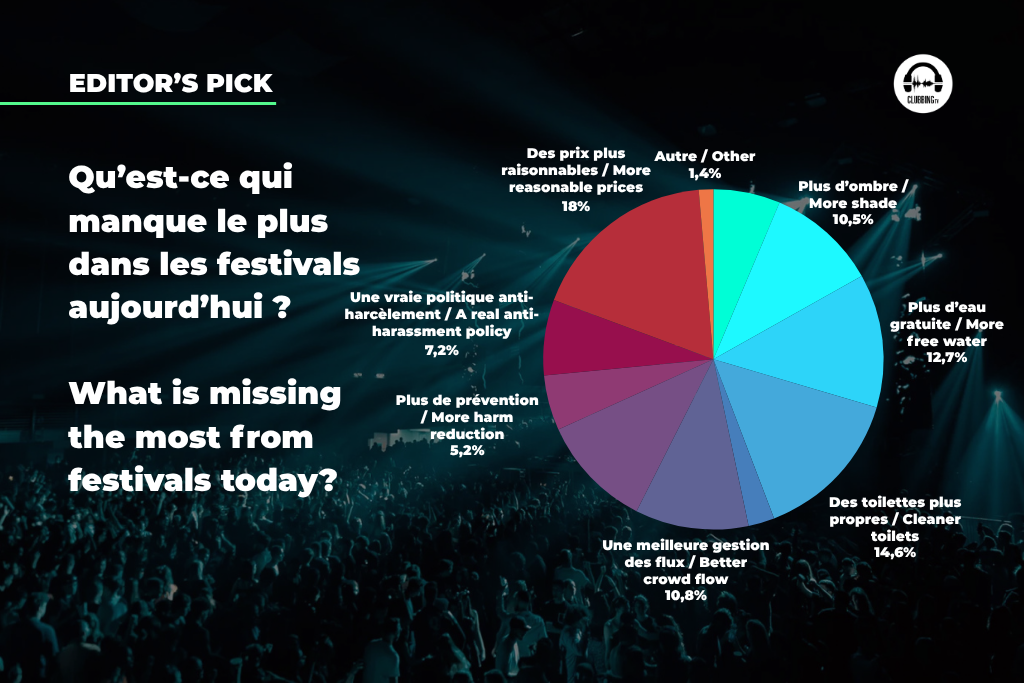
88% of respondents say they have at least sometimes felt that audience comfort came after profitability in festivals. When asked what is missing the most, the answers are very down-to-earth: more reasonable prices, cleaner toilets, more free water, more shade, better crowd flow management and rest areas. In other words, the priority demands are not about luxury or spectacular scenography, but about basic physical needs.
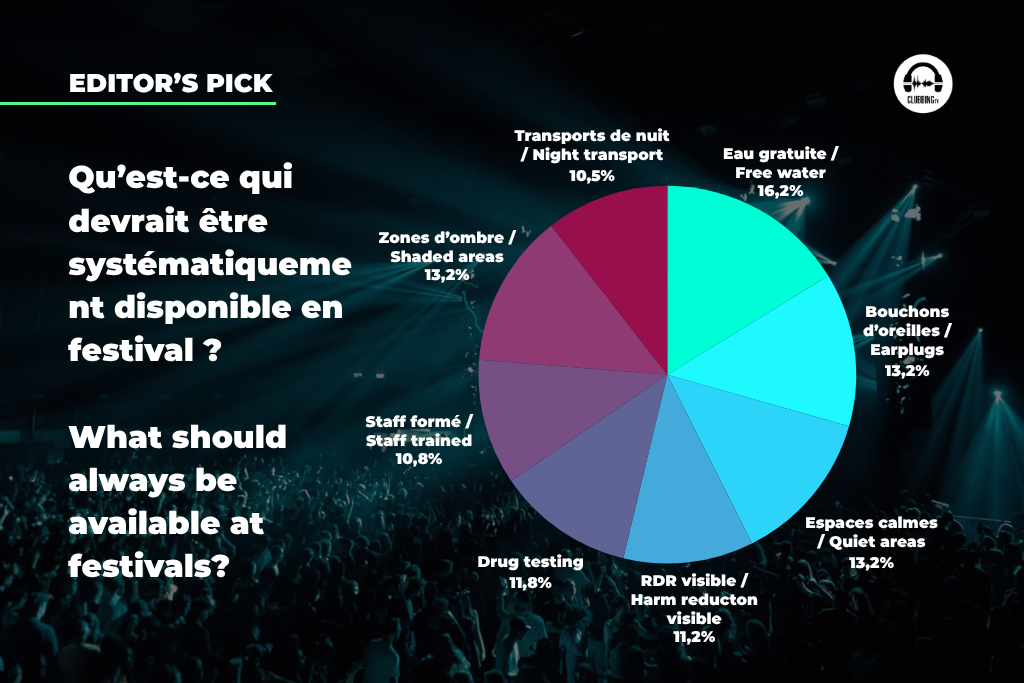
When asked what should always be available at festivals, 72% mention free water, followed by shaded areas, earplugs, quiet areas, visible harm reduction teams, harm reduction stands, the possibility of drug-checking services, staff trained on consent and harassment, and night transport.
Festivals therefore still hold a strong place in ravers’ imagination, but this affection is no longer enough to erase practical shortcomings. The more an experience is sold as total, immersive and communal, the more the public expects the organisation to follow through on the least glamorous but most vital details: water, toilets, shade, crowd flow, rest, prevention and the way home.
An audience that wants to understand what it is paying for
Out of 103 completed responses, 94% of respondents think that the very high fees of some headliners clearly or probably have an impact on ticket prices. And among those who answered the question, 89% say they want more transparency on how those prices are built.
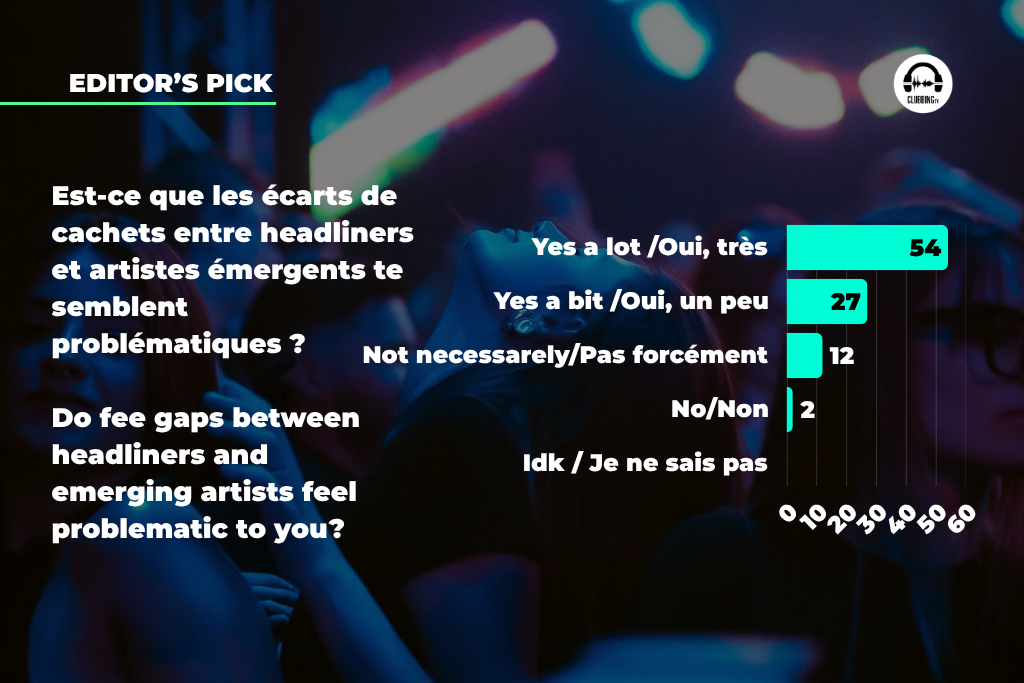
The ravers surveyed do not reject headliners, but many seem tired of seeing the economy of an event revolve around them at the expense of everything else. 81% of respondents find the fee gaps between headliners and emerging artists problematic, and only 6% would prefer a festival to spend a large part of its budget on a few major headliners. On the contrary, the majority say they would rather see a more balanced line-up, with more room for mid-level, emerging or local artists.
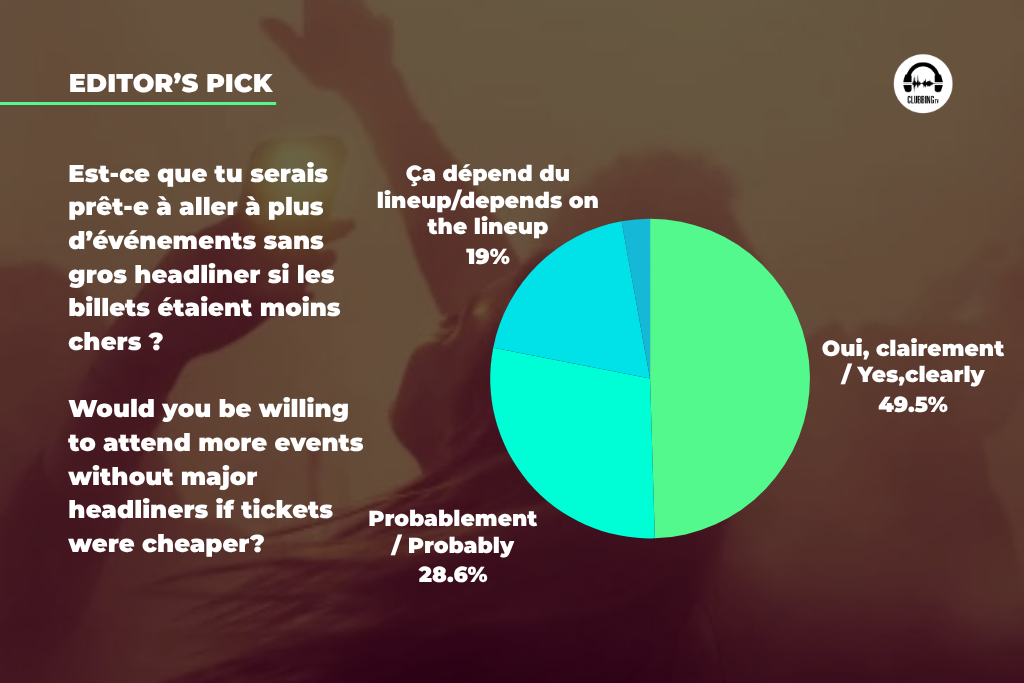
The public does not seem as dependent on big names as one might think. 76% of respondents would clearly or probably be willing to attend more events without a major headliner if tickets were cheaper. This figure challenges a logic that has become almost automatic in part of the industry: spend as much as possible to fill the venue.
For many ravers, a good programme is measured by the coherence of the night, the risk-taking, the discovery, and the feeling that the event has been designed as a complete musical experience.
This expectation connects with another strong signal: 87% of respondents feel that line-ups are becoming too similar, either clearly or sometimes. There is an impression of paying more and more to see the same names and the same drops circulate. When ticket prices rise, the public seems to expect something other than a copy-paste of line-ups already seen elsewhere. They want to feel that an event defends an artistic direction, takes care of its audience, gives space to discovery, and does not turn every night into a simple promotional product built around one headliner.
How far can the public be expected to absorb the cost of a market that is becoming too much? Ravers are not necessarily asking for the end of big fees, nor for the disappearance of big names. But they are asking for more balance, more clarity, and a programme that does not give the impression that the entire budget went into one single line on the flyer.
Ravers are not asking for perfect festivals. They are asking for festivals that think about what happens everywhere across the site. They do not only want festivals capable of selling a line-up, but festivals capable of taking care of the people who make it exist.
And the same goes for clubs, at their own scale. Frustrations often concentrate within just a few square metres: a room that is too full, a crowd that pushes, security that is hard to identify, heat that has not been anticipated, a price that seems to rise without clear justification. The dancefloor remains the heart of the experience, but people still need to be able to dance on it. When space disappears, the night changes in nature because it offers less surrender and more vigilance. It forces people to manage their own body and other people’s bodies instead of letting it go into the music.
Clubs and festivals sell more than access to a dancefloor. They sell nights, weekends, memories, sometimes even turning points in a life.
If organisers paid as much attention to their audience as they do to headliners, the experience would only be better.
Bonus : What ravers would say to clubs and festivals
At the end of this survey, we wanted to leave room for raw answers. Because beyond the numbers, some sentences say very clearly what the audience feels, expects, refuses to tolerate, or still hopes to see change.
77 people answered this question: “What would you say to clubs and festivals if you knew they would actually read your answer?”
- Thank you for what you do. We all know it is not easy to organise this kind of event, but do not cut corners on the essentials.
- Support local artists and future talent. Book a major artist from time to time, but only if they align with the underground mindset and play with passion, not just for money.
- Everyone who loves music wants to have the best musical experience possible. We pay to experience it, not to become a cog in another profit-making machine.
- Ask yourselves the right questions: what is your concept? What vibe do you want to create? What community do you want to build? The project cannot just be about lasers, big names and making money.
- I will keep supporting you and spending money on your tickets and drinks so you can keep going, but get rid of the Instagram crowd filming everything. They are destroying the atmosphere.
- Focus on organisation, flow and safety rather than profitability and big names.
- Book me, haha.
- We come for the festival, not for the headliner. Invest in quicker entry management: nothing kills the vibe more than waiting an hour in line.
- Stop opening every weekend. Make each opening feel more unique, like festivals do.
- Make the environment less artificial and avoid unfriendly or aggressive staff.
- Play more diverse sets in clubs, because it is getting boring.
- I come to hear a certain style of music. Honestly, I do not care who is playing if I know the music will be good. The experience, the crowd and the creativity matter more.
- Lower your prices. It is unbearable to pay €20 for a midnight-to-7am event when you still have to pay for drinks, cloakroom and the taxi home.
- Party culture is not a financial elite. Do not turn festivals and raves into a disposable trend emptied of its substance.
- Stop playing industrial and uptempo non-stop, it is exhausting. That is all there is now.
- Less overbooking.
- What interests me is what remains genuinely underground, as long as it exists and stays accessible. I am just as interested in established artists I have never seen as I am in new discoveries and pleasant surprises.
- It feels like arguing with a wall. They are there for money, we are there to consume. They will not stop as long as people keep going.
- Put on more hard music events.
- Thank you for making us dream. You are surrounded by people who admire you: take care of them and do not turn these spaces into places of self-destruction.
- Build coherent and progressive line-ups without putting everything on an artist’s popularity.
- I am an excellent DJ, I have never dared to take the leap, book me.
- Hear us.
- Put yourselves in the shoes of every type of guest you have. What does their experience feel like? Keep asking for feedback.
- Make crowds more responsible for their behaviour.
- Listen to people, both staff and regulars. Respect people the way you would like to be respected, and most importantly, learn from your mistakes.
- Keep prices accessible and do not focus only on wealthy audiences.
- Please, do not abuse prices, pay attention to safety and help people. I know it is complicated, but generally you are doing good work.
- Reduce costs and support emerging artists. Without emerging artists, there is no scene.
- Same thing.
- Take more artistic risks. Invest in underground venues.
- Do not gentrify our culture.
- It is better to have 10,000 people and a good atmosphere than 80,000 people, three quarters of whom are only there because it is trendy and not because they are passionate.
- Stop trying to make everything huge. We prefer smaller festivals with underground artists.
- To clubs: focus on lighting, but not too much. Too much light kills the vibe, especially at techno nights. Also watch out for overcrowding: we want more space to dance.
- Take political stances, whether environmental or economic. Defend the arts sector, push local policies to evolve, and encourage more inclusion and diversity.
- Listen to what we have to say if you want to survive.
- Good luck, especially in France. Everything is getting complicated. Do not take the easy route. Let’s be smarter and work as a team.
- First of all, thank you for giving us spaces of culture, encounters and freedom. Thank you to those fighting to help us discover artists or make incredible artists accessible. But shame on those who push capacity limits just to make money, who disrespect the audience, who lie about safety, no-photo policies, prices or the quality of the line-ups. We see you, and we will remember.
- Please stop making entry so expensive and let everyone enjoy themselves.
- Thank you for giving the world a place where we can escape for a few hours or a few days.
- Thank you for all the effort and work you put into organising these events. But would it not be better to prioritise artists who are just as good but less famous, rather than a headliner who can put you under financial pressure? Headliners attract audiences, but artistic diversity also makes an event original.
- Stop doing it for the money.
- Support artists with lower fees who are still very good artists. If fewer festivals and clubs booked huge headliners with outrageous fees, maybe things would change.
- Lower alcohol prices. Excessive prices also push some people toward other substances. There is a public health issue here and a compromise needs to be found.
- People just want to dance and have a good time. We do not need million-dollar headliners, fancy stages or fireworks. We just need a nice, safe environment with friendly faces and good sound.
- Repoliticise your events, stop videos and photos, and ban toxic behaviour.
- Big artists are getting away with organised robbery. But music works in cycles, so we hope for renewal or a wake-up call.
- Stop racing to have the biggest line-up if it means burning us with higher prices every year.
- Listen to us more. We complain a lot, but they pretend not to see it.
- To those who genuinely think about the participant experience: thank you. To those who only want to make money: it is sad to empty events of their substance when they used to be sources of joy, sharing and discovery.
- How do you justify these prices? Why advertise nights without major headliners less, when the difference in crowd between nights with and without them is obvious?
- Less policing always makes an event feel more relaxed for everyone.
- Look at what Berlin clubs did for years and learn from their successes, opening hours included.
- A trend explodes suddenly and then burns out, while a community is built and maintained over the long term. Today, we want real identity from parties, agencies and clubs. We want diversity of genres, not only what makes the most money at a given moment. Respect us and listen to us if you want us to keep coming.
- Pay more attention to safety. Between spiking and insistent people, it is not normal to feel forced to go out with male friends in order to feel safe.
- Some headliners do not necessarily deserve their fees. You should stop always prioritising them and highlight artists who are truly good at what they do.
- Party culture is dying, not because people no longer want to party, but because your economic interests push you to see us only as wallets while forgetting the artistic dimension of these events.
- We have no money, times are hard. Highlighting local artists allows us to know the scene we are part of and helps us go out more easily and for less money.
- Stop caring only about the bottom line. Get more involved. Participate in local politics, stop competing with other clubs and unite to keep nightlife alive and accessible. You are going to kill yourselves off, and the few that survive will be caught by real estate prices and new developments.
- In clubs, get rid of problematic guys who ruin the night for everyone, take up all the space and do not care about others.
- Never give up.
- Book fewer big artists and lower your prices. We will survive without certain major names, do not worry.
- Less uptempo, more psytrance, tribe, mentacore and acidcore.
- More prevention and harm reduction, fewer security guards acting like cowboys.
- Book more techno DJs and less hard techno, please.
- Stop with the no-photo/no-video marketing when we are going to be filmed in 4K by an army of videographers anyway. The point of no-photo/no-video is to have a space where what happens inside stays inside. If we are filmed and posted on Instagram without consent, especially when it is always the same types of people being shown, it is hypocritical.
- Stop agreeing to book overpriced artists. We are tired of paying.
- Paying three times more for a ticket just to stand behind the DJ does not belong to this culture.
- Creating club culture and a party space is not about reproducing an Instagram feed or rolling out the red carpet for problematic men. The moments would be more memorable if people tried to create a real moment, real representation, instead of profitability. It is depressing to simply “consume the party”. Let’s not forget where this culture comes from.
- Be less afraid of novelty, try things. I also stand with you: funding and economic models are getting harder and harder to sustain with everything constantly getting more expensive.
- Congratulations on all your work.
- To clubs: do not programme the main artist at 4am. I prefer parties that start earlier.
- Do not forget the values of electronic music.
- Stop being so generic. Book more live acts, do some real music digging, respect the roots and spread love.