

No products in the cart.
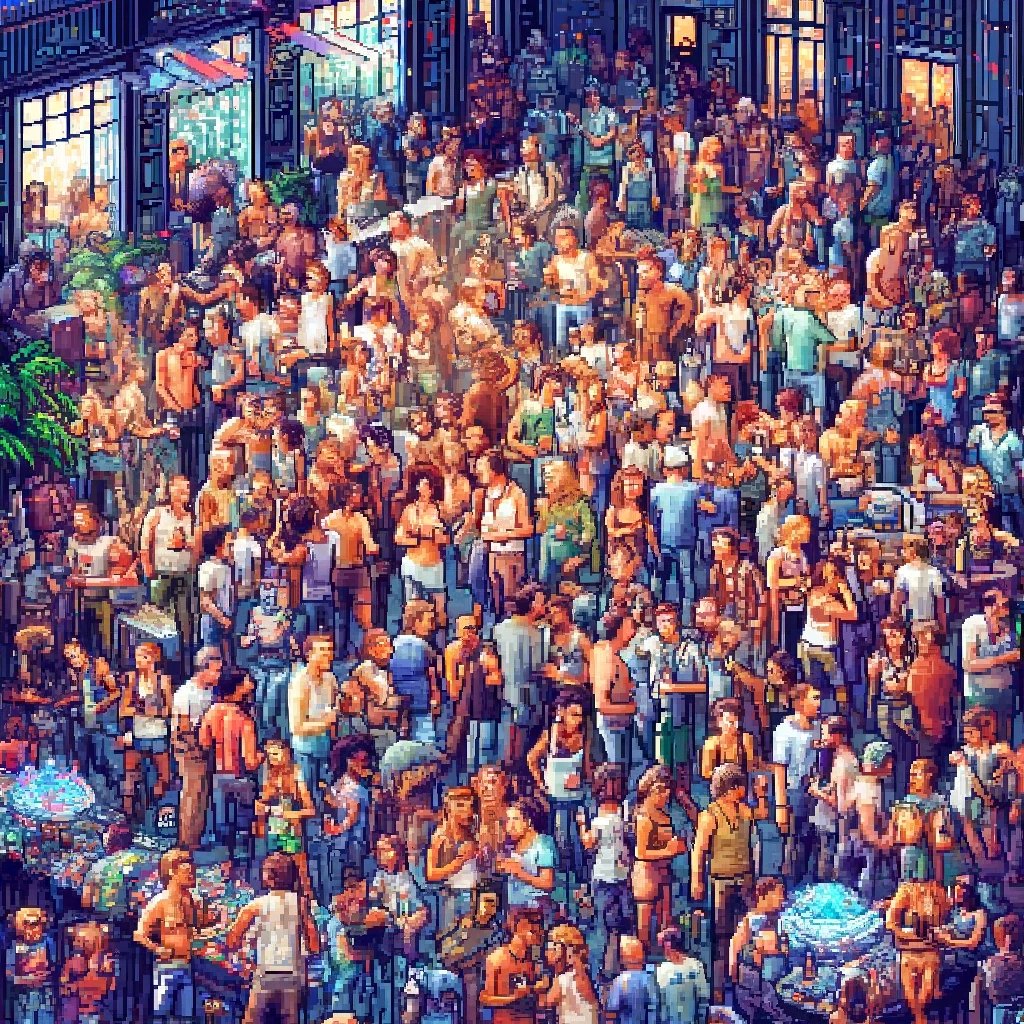
What if electronic music stopped trying to grow?
Article en français.
Over the past few years, we have talked a lot about growth. As if the electronic music scene only had two options ahead of it: grow or disappear.
This idea has settled everywhere. In the way we talk about artists, clubs, festivals, media, labels. A DJ has to break through. A festival has to go international. A media platform has to increase its reach. A local scene has to shine beyond its own borders. Even the words we use have started to sound like a fundraising pitch.
And in the meantime, we complain. We complain about uniform lineups, absurd fees, overpriced tickets, videos everywhere, soulless festivals, clubs turned into content platforms, artists calibrated for Instagram. We complain because we can clearly see that part of this culture is emptying itself out as it gets bigger.
What if we got the direction wrong? What if the future of this culture was not in gigantiiiiic formats, but in a form of strategic retreat? A voluntary return to the spaces where the scene can still breathe.
The myth of mandatory growth
What grows succeeds, and what does not export itself lacks ambition. Even worse: what does not become visible does not really exist.
We are pushed to grow before we have even had time to find our footing. Even the underground now needs a content strategy and a flawless visual identity. Artists share their new art direction more than their new tracks.
The vocabulary of the scene has gradually aligned itself with the vocabulary of the market. It is about brands, and fans turned into overconsumers. Of course, nobody lives on love and kick drums alone. You have to pay your team and your rent. But refusing the fantasy of infinite growth does not mean celebrating precarity. A scene that allows nobody to live decently is simply fragile.
Still, there is a difference between looking for economic balance and confusing every form of success with expansion. When you measure the value of a scene by its size, you eventually forget what made it important in the first place.
Big formats do not have a monopoly on the future
We often talk about the future of the scene as if it necessarily belonged to the biggest stages.
That vision is impressive, and it sells well, because it gives the impression that the culture is moving forward, taking up space, finally gaining the recognition it was denied for so long. And in some cases, it can create real collective moments. But let’s be careful: this is not about pretending that every big stage is empty, or that every small party is automatically exciting.
The future of a culture is not measured only by the size of its crowds. It is also measured by its ability to invent things, to protect spaces, to transmit practices, to allow artists to emerge before they look like what the market already expects.
And that work rarely — honestly, almost never — happens at the centre. It happens in the margins, in tiny clubs nobody influences. In rooms where the lineup is announced late, in places where music is not chosen to please an algorithm, in scenes where DJs do not need to stack up followers in order to be listened to.
These are often the places that keep the substance alive, because they maintain what big formats later recover.
Small does not mean secondary
The word “small” is often used as an excuse, or as a polite insult. Small club. Small media platform. Small scene. Small festival. Small collective. Except size has nothing to do with value.
A small club can take more risks than a large venue trapped by its own costs. A small festival can programme locally without needing to sell an international headliner at all costs. A small media platform can write about artists nobody is pushing. A small collective can invent codes that others will later copy with XXL budgets.
The small escapes some optimisation logics more easily. It does not always have the means to smooth everything out. It often operates with little, sometimes too little, but that constraint can also create a kind of precision. You cannot do everything, so you have to choose. Choose the soundsystem, please. You cannot buy attention, so you have to build a relationship.
What is small is sometimes simply looking for human accuracy.
The artists who do not want to become “global”
The same question applies to artists. Not every career has to aim for permanent internationalisation.
There are artists whose strength lies precisely in slowness, in loyalty to a territory, in a way of playing that does not immediately lend itself to virality. Artists who are not trying to imitate headliners, but to defend their own grammar. Their careers may be less bankable, sure, but for us, they are the ones doing the scene some good.
The market loves readable profiles. But a living scene needs people who are badly filed, or who cannot be filed anywhere. Artists absolutely need to stop becoming compatible with everything.
Small platforms as counter-power
The same goes for media, channels, radios, platforms, and so on. Big structures have their advantages, of course: reach, resources, access, distribution power. But sometimes they lose their freedom of tone, and the possibility of insisting on subjects that are not profitable.
Small platforms can look where nobody else is looking and refuse to become only the polished window display of the industry’s powerful players. Their role is not decorative. They create a real memory, a counter-narrative, sometimes even a safeguard. They remind us that a culture is not only told from its summits.
A scene that loses its small media also loses part of its ability to think about itself.
The collectives that invent before others recover
A huge part of what the industry later calls trendy often started elsewhere. In parking lots, basements, gardens, squats, backrooms, borrowed spaces, DIY formats, parties put together with second-hand gear, sincere volunteer work and far too many WhatsApp messages.
These spaces do not always have the means to look polished, but they are a necessity for many audiences. People organise because something is missing. These are often the collectives that change the codes. Then others take those codes back with more money, more light, more communication, sometimes erasing the people who created them. Electronic music knows this cycle very well: the margins produce, the centre recovers, the market cleans up, then resells.
Going smaller, here, means shifting attention towards the places where invention truly begins.
Big festivals talk about it, small ones do it
The same could be said of festivals. Big events have learned to speak the language of values. Inclusion, ecology, harm reduction, local roots, diversity, accessibility, parity, safe spaces. The words are everywhere. They appear in press releases, charters, campaigns, partnerships.
But some human-scale festivals did not wait for these topics to become mandatory before acting on them. They introduced solidarity pricing before inflation turned it into a communication argument. They worked with harm reduction organisations before harm reduction became industry language. They programmed locally out of conviction rather than opportunity. They thought about their waste, their audiences, their teams, their fees, their rest areas, because their model forced them to think about reality up close.
Big festivals often talk about these things very well. Small ones — obviously not all of them — have often been doing them for a long time.
Again, this is not about setting up one moral camp against another. Big festivals can do serious and sincere work. Just as small structures can reproduce violence, underpay people, welcome people badly, or believe they are exempt from criticism simply because they are independent. Small is not magic.
Slowing down is not giving up
“Go smaller” could sound like a form of defeat. It is the opposite.
It means looking honestly at what gets lost when a scene grows. At first, growth always looks like a victory: more people, more visibility, more opportunities, more resources. But we forget part of the audience when ticket prices rise. We stop taking risks in programming. And as media, we no longer dare to criticise when paid partnerships start taking up too much space.
Growth has a cultural cost, and that cost becomes hard to ignore when a scene keeps getting bigger while giving the impression that it is becoming poorer. There are more people, but sometimes less mixing. More images, but less memory. More visibility, but less transmission. More content, but less real experience. People talk a lot about community, while community requires something more than words on a post.
Depth rather than expansion
Maybe electronic music needs to recover some depth.
Depth is what you do not necessarily see in a thirty-second video. It is the link between a club and its neighbourhood. It is an audience that comes back because it feels responsible for the place. It is a respected warm-up. It is a programme that does not crush local artists under the same international names. It is a media platform that takes the time to explain instead of simply reposting. It is a collective that passes on its codes to new audiences. It is a festival that prefers to reduce capacity rather than raise prices until it excludes the people who made it live.
Depth is also a form of courage. Saying no to certain sponsors or events. Not programming only what sells. Not giving in to the temptation of permanent content. Refusing to turn every moment into a product. Accepting that a scene can be important without being massive.
Techno never needed 50,000 people to change lives. Neither did house. Neither did free parties. Many essential things happened in places that were too small.
Shrinking to breathe better
Electronic music does not need to abandon big stages, big festivals or big clubs. They are part of its ecosystem. They can offer powerful moments, fund careers, make scenes visible and create collective memories.
But they cannot be the only horizon for everyone.
If the whole culture starts running towards scale, it becomes a market like any other, with its brands, premium products, interchangeable headliners, speeches about community and spaces increasingly filtered by purchasing power.
In the end, going smaller does not mean becoming less important. It means refocusing attention. It means refusing the idea that you have to be huge to be relevant.
The future of the scene is in the places where something is still being transmitted.
What we call small is not small.
It is simply alive.