

No products in the cart.
Last year, our manual review of Ibiza line-ups showed an already familiar imbalance: in 2025, only 22% of DJs and artists booked across the island’s main clubs were women or non-binary artists. In 2023, that figure was 21%.
After several weeks spent reviewing the announced 2026 line-ups on Ibiza Spotlight, the picture has barely changed.
After removing duplicates, our provisional 2026 count includes 1,148 unique artists/projects across the line-ups analysed. Among them, 262 are women, non-binary artists, or projects including at least one woman, compared with 886 men or male projects. That represents 22.8% of the total.
In cumulative booking terms, the number is almost identical: 424 appearances by women or gender minority artists out of 1,893 total bookings, or 22.4%. But for comparison with 2025, we are using the deduplicated figure.
In other words: Ibiza does not seem to care very much.
Of course, there is a margin of error. This is manual work, based on publicly announced line-ups, Ibiza Spotlight listings, and corrections made along the way. Some dates are still incomplete, especially Circoloco, where part of August and September has not yet been announced. “TBA” slots were not counted. B2Bs were separated when two artists were named. Mixed projects were included in the women / gender minorities category when they included at least one woman or non-binary person.
But even with that caution, the imbalance remains massive.
The most balanced parties
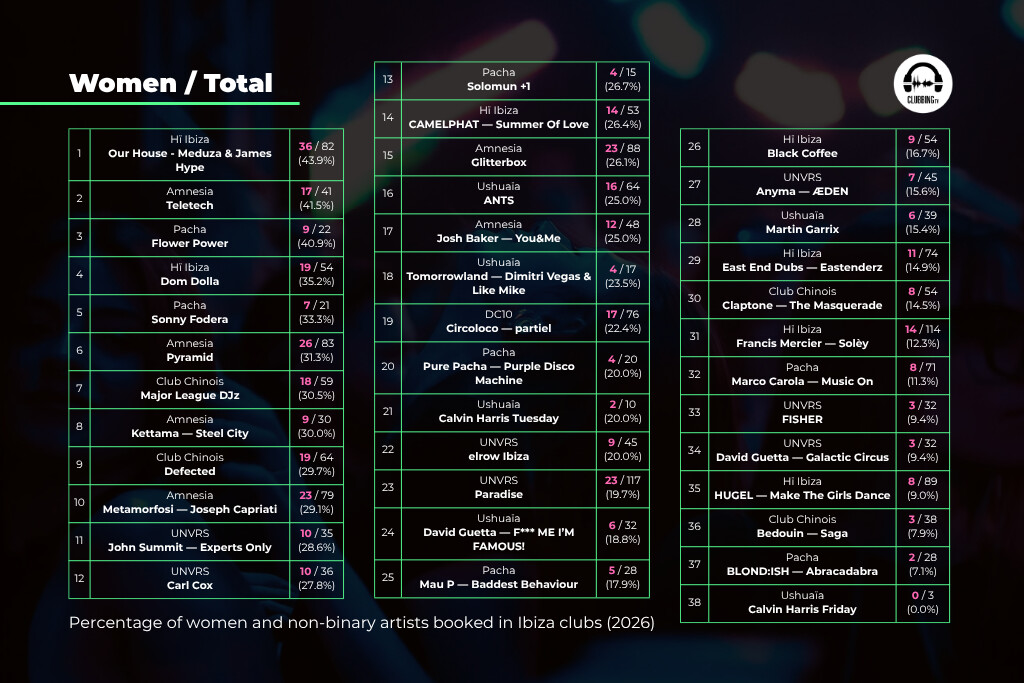
A few residencies clearly stand out. At the top is Our House by Meduza & James Hype at Hï Ibiza, with 36 women or gender minority artists out of 82 artists/projects counted, or 43.9%. It is one of the very few line-ups that comes close to some form of real balance. We are also very happy that the residency did not turn this into a marketing argument, so we tip our hat twice.
Next comes Teletech at Amnesia, with 41.5% — and given the number of accusations surrounding male hard techno DJs, we would honestly expect nothing less — followed by Flower Power at Pacha, with 40.9%. Dom Dolla at Hï Ibiza reaches 35.2%, while Sonny Fodera at Pacha comes in at 33.3%.
These numbers show that when the will is there, the artists are there too. There is no “pipeline problem”, no “but ThErE aRe NoT eNOUgH wOmEn dJ” There is no lack of talent. There are programmes that make the effort, and others that simply do not.
Among the strongest scores in this first 2026 analysis, we also find Pyramid at Amnesia with 31.3%, Major League DJz at Club Chinois with 30.5%, Kettama / Steel City at Amnesia with 30%, Defected at Club Chinois with 29.7%, and Joseph Capriati’s Metamorfosi at Amnesia with 29.1%.
These parties are not perfect. They are still mostly male. But they prove that a line-up at 30% or more is not impossible, even in Ibiza’s most visible clubs.
The line-ups still falling very short
At the other end of the ranking, some events remain overwhelmingly male.
Calvin Harris Friday at Ushuaïa shows 0% women or gender minority artists among the announced names. BLOND presents Abracadabra at Pacha falls to 7.1%, which proves that being a woman does not magically free anyone from bias. Bedouin presents Saga at Club Chinois sits at 7.9%, while HUGEL presents Make The Girls Dance at Hï Ibiza reaches 9%.
The name of that last party makes the figure even more ironic: “Make The Girls Dance”, but not really “Make The Girls Play”.
FISHER at UNVRS and David Guetta presents Galactic Circus at UNVRS are both at 9.4%. Marco Carola’s Music On at Pacha is at 11.3% — apparently women are welcome in the booth, just not behind the decks — Francis Mercier presents Solèy at Hï Ibiza is at 12.3%, Claptone presents The Masquerade at Club Chinois at 14.5%, and Eastenderz at Hï Ibiza at 14.9%.
In these line-ups, women remain the exception. The backbone of the programming is still overwhelmingly male.
By club, Amnesia stands out
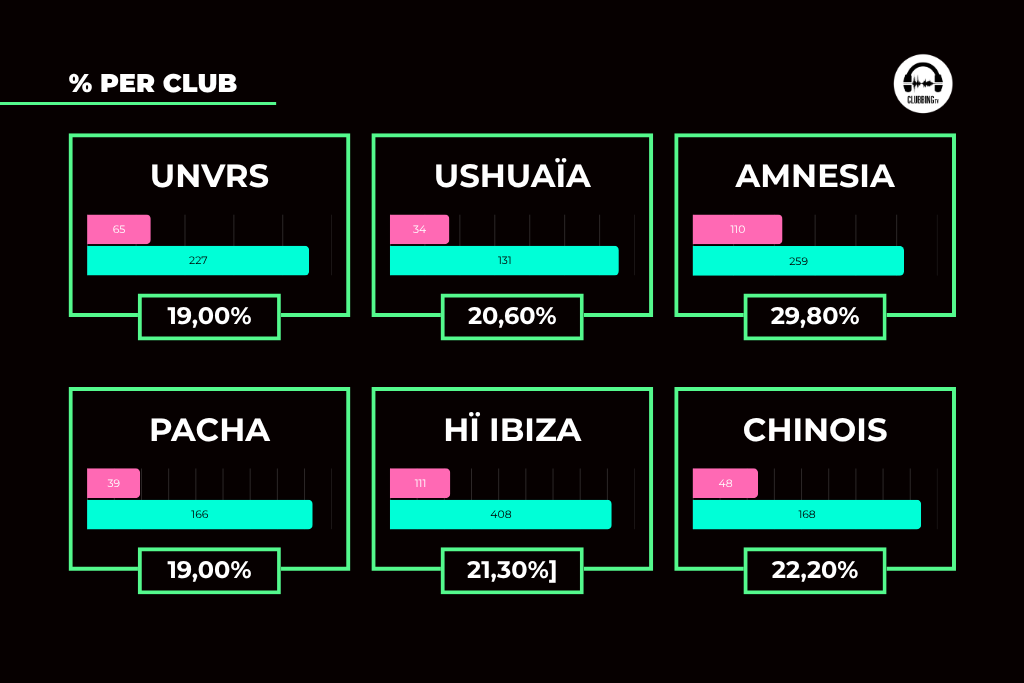
Looking at the numbers by club, Amnesia comes out as the strongest performer in this provisional review, with 110 women or gender minority artists out of 369 cumulative artists/projects, or 29.8%.
Behind it, Club Chinois sits at 22.2%, Hï Ibiza at 21.3%, Ushuaïa at 20.6%, Pacha at 19%, and UNVRS at 19%.
Again, some caution is needed, as not every club has the same number of residencies analysed, and some programmes remain incomplete. But the trend is clear. Among the major clubs, very few get close to 30%. Most hover around 20%.
2025: 22%. 2026: 22.8%.
This is the most important point.
In 2025, we counted 214 women or non-binary artists out of 980 booked artists, or 22%.
In 2026, 262 are women, non-binary artists, or projects including at least one woman, compared with 886 men or male projects. That represents 22.8% of the total.
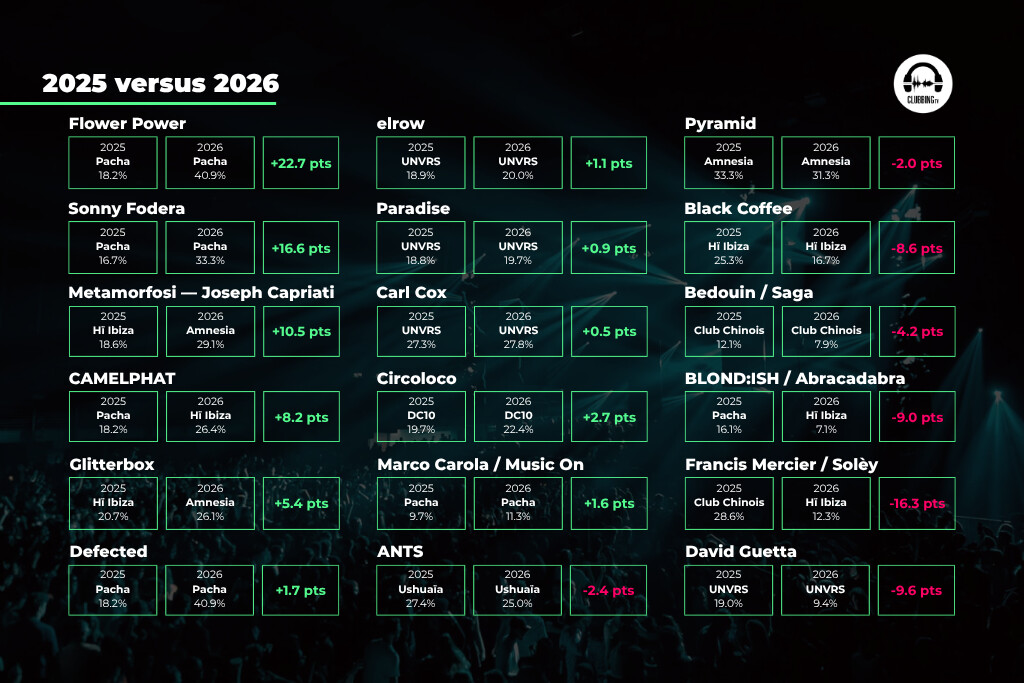
When comparing only the residencies included in both reviews, progress remains limited: the average moves from 20.8% in 2025 to 22.8% in 2026, an increase of just 2 points. Some parties have improved significantly, including Flower Power, Sonny Fodera and Metamorfosi. Others have dropped sharply, including Solèy, David Guetta, BLOND and Black Coffee. In other words, there are a few isolated improvements, but still no consistent structural change.
The progress is minimal.
Of course, we can welcome the fact that some parties are doing better. We can note that a handful of programmes go beyond 30%, even 40%. But the overall number tells another story: the industry knows how to make occasional efforts. It is much less willing to change its habits.
The issue is access.
Who gets invited back every year? Who is given the major slots? Who gets booked across several residencies? Who becomes a token? Who benefits from the network, the agents, the date swaps, the strategic b2b, the residencies between bros?
There is also another issue: some women still seem to be used as tokens to tick the diversity box without really opening up the field. The Smurfette phenomenon basically.
The same female names appear across several residencies, sometimes five or six times over the season, while dozens of other artists remain invisible. Of course, these DJs deserve their bookings. But Ibiza often prefers recycling the same profiles, women and men alike. The result is that even when the numbers improve slightly, the space does not really expand. It concentrates around a handful of names who become the acceptable exceptions within a system that remains overwhelmingly male.
That is where the imbalance is built.
So, “where are the women?”
Oh they are here! They are touring, producing, filling clubs, building scenes, labels, radio shows and communities. They already exist across every sound: house, techno, afro house, disco, hard techno, minimal, UKG, melodic techno…
The real question is: who is making space for them?
And more importantly, who still refuses to do so while pretending the scene is moving forward?
The datas document is available here.